[pageLogInLogOut]

#JEC WORLD 2022

DORNIER presents itself at the JEC world with end-to-end approaches to thermoplastic composites and three-dimensional preforms
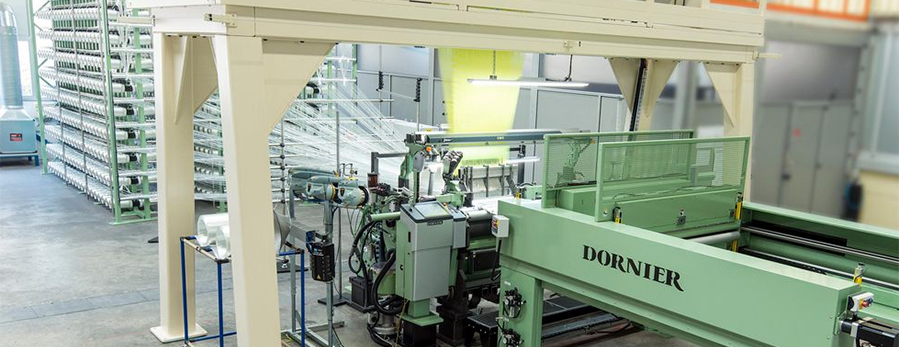
Weaving car and aircraft parts: The DORNIER TRITOS® PP (Preform Production) is able to produce fabrics up to 100 mm thick © 2022 Lindauer DORNIER
A modern composite lightweight design is not based on the material alone. It is rather an optimal synergy of material, process and application. With its PROTOS® and TRITOS® production systems, Lindauer DORNIER is now presenting comprehensive solutions for the economic production of high-quality customized thermoplastic composite structures at the JEC World.

DORNIER presents itself at the JEC world with end-to-end approaches to thermoplastic composites and three-dimensional preforms

PROTOS® Line: With granulate and fiber to the semi-finished thermoplast product

Whether vehicles, airplanes, wind turbines or robots – fiber reinforced materials provide more economic efficiency, sustainability and weight reduction in areas such as e-mobility, energy and mechanical engineering. Semi-finished fibermatrix products based on unidirectional fiber reinforcements (UD tapes) play an important role in this context. The outstanding features are, most of all, short cycle times, good recyclability and easy processing. In order to provide a solution for the low level of availability of suitable UD tapes and prepreg semi-finished products, Lindauer DORNIER has now developed the PROTOS® Line (Polymer and Roving to Sheet). “The integral solution allows tailored manufacturing of high-performance intermediates, products easy to be further processed “, says Dr. Josef Klingele, Head of Composite Systems Product Line. First of all, the Tape Production Line PROTOS® TP produces either dry or fully impregnated tapes and afterwards processes them with the Tape Weaving Machine PROTOS® TW into high-performance semi-finished thermoplastics. DORNIER’s  innovative production system is available for customer trials and sampling in the in-house technology centre.

P2 Mono Rapier Weaving Machine: Machine platform for special products

From roving fabric made of heavy tow to special fabrics made of ceramic fibres: Where many special solutions have been used so far, DORNIER is now launching a highly flexible machine platform with the P2 Mono. The new monorapier weaving machine is available in different versions, enabling customers to produce many special products on one platform. “In combination with the DORNIER Zero Twist Feeder, even two weft colours can be inserted twist-free, at high speed and with a wide variety of patterns”, adds Dr. Josef Klingele.


P2 Roving Rapier Weaving Machine: The new standard

DORNIER has acquired the know-how for customized solutions for the composites industry over the course of more than 50 years in which the company’s roving weaving machines have set the international industry standard for the production of high-performance fabrics made of carbon, glass and aramid fibers. Their successor will now be presented in Paris: the P2 Roving. Thanks to its higher frame stiffness, improved filling insertion performance, the maintenance-free, patented  DORNIER SynchroDrive® drive concept and an optimized positive center transfer, it is already considered as the most flexible rapier weaving machine in the world. According to Product Manager Michael Langer, its improved shed geometries ensure an absolutely symmetrical warp thread path, which means that carbon fabrics for high-end applications can now be produced even better and more reliably. Furthermore, innovative waste saving devices reduce weft waste and allow an efficient production with optimal use of material.

TRITOS® Line: Simple production of complex fiber structures

In high performance applications, 3D fabrics are superior to layered fiber composite structures due to their good   damage tolerance and high dynamic load capacity. “The DORNIER TRITOS® Line (Textile Roving into Three-dimensionally Oriented Structure) combines this material superiority with highly productive, industrial production”, explains Dr. Britta Skoeck-Hartmann, Productmanagement at Composite Systems. With fabric thicknesses of up to 100 mm and the patented DORNIER Weft Saver (DWS), the preform production line TRITOS® PP is ideally suited for the use in areas with high cost pressure.

Visit us in Hall 6 | Booth M72.


More News from Lindauer DORNIER GmbH

#Weaving

Lindauer Dornier announces leadership transition in weaving machine business

After more than ten successful years at Lindauer DORNIER GmbH, Mr Wolfgang Schöffl will leave the family-owned company at the end of the year to enter well-deserved retirement.

#ITMA Asia + CITME Singapore 2025

DORNIER celebrates its anniversary at ITMA Asia + CITME

To mark its 75th anniversary, machine and plant manufacturer Lindauer DORNIER will be presenting the latest developments in its rapier and air-jet weaving machines at ITMA Asia + CITME in Singapore (Hall 2, Stand B401) from 28 to 31 October 2025. The focus will be on energy-efficient weaving technologies, new IoT solutions for networked textile production and systems for the series production of modern fibre composite components.

#Weaving

From the Venus flytrap to foldable aircraft wings: Peter Dornier Foundation Prize 2025 honours bionic research on 3D weaving technology

Long wings with foldable tips have the potential to reduce aircraft fuel consumption and make aviation more sustainable. An interdisciplinary research team has now developed a new solution based on the Venus flytrap: Freely movable wingtips made of fibre composites which are produced using innovative 3D weaving technology. For this pioneering combination of textile technology, aviation and bionics, researchers Patrick Meyer (TU Braunschweig) and Michael Vorhof (TU Dresden) were awarded the Peter Dornier Foundation Prize 2025 in mid-July.

#Weaving

Pattern-controlled “pic-a-pic” setting of rapier release timing on right-hand side

DORNIER PIRO enables the operator to set the timing of the rapier release on the right-hand side of the machine “pic-a-pic” and pattern-controlled. For applications with weft yarns of different fineness or elasticity, the optimum timing can be set for each weft channel. This offers great potential for reducing weft waste on the right-hand side.

More News on JEC WORLD 2022

Latest News

#People

Happy Holidays!

Dear reader, the year 2025 is drawing to a close. We are entering what we hope will be a peaceful holiday season, spending time with our families and taking a moment to pause and reflect. We hope we have been able to support you once again this year with relevant news and articles, and we look forward to surprising you with many innovations in the coming year. Enjoy the festive season, stay healthy, and we wish you a happy and joyful holiday season.

#Heimtextil 2026

Texpertise Focus AI: Messe Frankfurt puts Artificial Intelligence centre stage at its international textile and apparel trade fairs

Under the banner 'Texpertise Focus AI, Messe Frankfurt will place a strong emphasis on Artificial Intelligence (AI) across its international textile and apparel trade fairs from 2026 onwards, setting a future-shaping signal for the industry. The initiative highlights the responsible use of AI along the entire textile value chain, from fibre production to the point of sale. The programme will launch at Heimtextil in Frankfurt in January 2026.

#Technical Textiles

Autoneum and Polestar set new benchmarks for passenger experience and sustainability

As the global market leader in sustainable acoustic and thermal management, Autoneum is a key supplier of interior and exterior components for the highly anticipated Polestar 5 model. The successful collaboration between Autoneum and Polestar marks a significant milestone in sustainable automotive engineering: the electric grand tourer sports car features several innovations in lightweight, fully recyclable polyester-based components that ensure a superior driving experience. Polestar 5 was revealed at the IAA Mobility 2025 in Munich and is available in 24 markets.

#Natural Fibers

Cashmere producers stress the importance of The Good Cashmere Standard®

At the invitation of the Aid by Trade Foundation (AbTF), over 70 experts from the cashmere production and supply chain, as well as other specialists, met at the GCS Unit Meeting in Shanghai, China to discuss the progress and new objectives of The Good Cashmere Standard (GCS). The meeting focused on implementation and verification of the standard, important aspects of animal welfare and the importance of the standard in the global textile market.

TOP