[pageLogInLogOut]
TRÜTZSCHLER SPINNING - THE NEW CARD

#Industry 4.0 / Digitalization

Jeanologia presents expanded EIM platform and COMMON GROUND collection at Kingpins Amsterdam

The company introduces a new generation of environmental impact measurement tools and explores creative applications of laser and ozone technologies in collaboration with Sue Barrett.
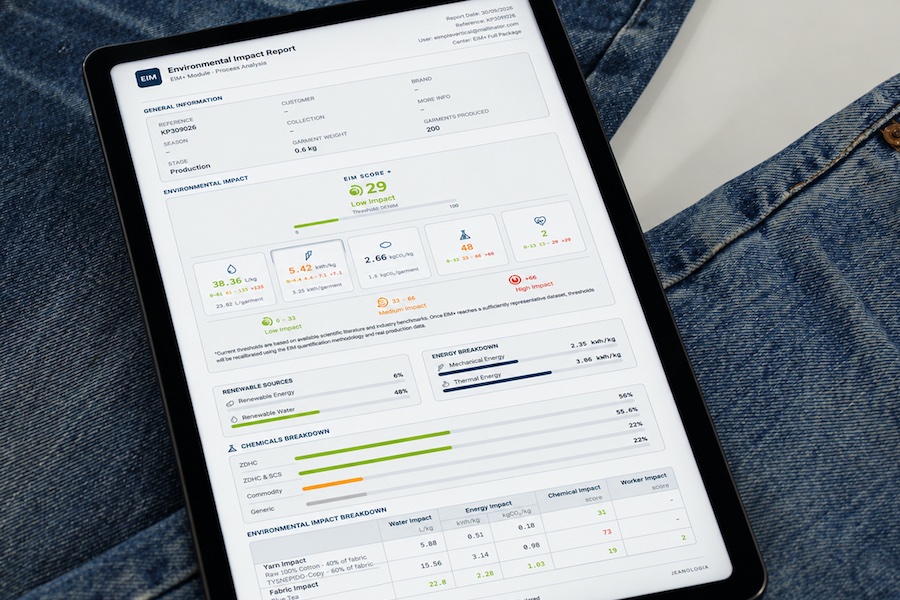
The company presents the new generation of EIM to the international denim community. © 2026 Jeanologia
Jeanologia is presenting two approaches to textile product development at Kingpins Amsterdam on October 14–15: measuring the environmental impact of textile production and exploring new creative possibilities through garment finishing technologies.


The event brings together yarn and fabric manufacturers, garment makers, finishers, brands and designers from the international denim industry. Jeanologia is using the exhibition to introduce the new generation of EIM, which expands environmental measurement across the different stages involved in making a garment, and to present COMMON GROUND, its collaboration with Sue Barrett, where nature and camouflage become the starting point for creative exploration.

From yarn to garment: EIM expands environmental impact measurement

After more than 15 years measuring the environmental impact of garment finishing, EIM is expanding its scope to connect information from yarn, fabric and garment finishing under one common methodology. This evolution addresses one of the textile industry’s key challenges: a garment passes through multiple processes and players before reaching the consumer, and understanding its impact requires reliable, comparable information from each of these stages.

At Kingpins, Jeanologia will demonstrate how this new architecture works through live demonstrations of the different EIM modules and sessions with brands and manufacturers, showing how environmental information can be generated, connected and used throughout the production chain.

The new EIM includes independent Yarn, Fabric and Garment Finishing modules, allowing each stage to be measured separately, while EIM+ brings the results together to provide a complete view of the product. Using primary production data, EIM measures water and energy consumption and chemical use, as well as worker impact at the garment-finishing stage, and classifies environmental performance as low, medium or high impact.

The information remains traceable and is structured for use in tools such as the Digital Product Passport (:) and Life Cycle Assessment (LCA). While EIM has its roots in denim and the measurement of garment-finishing impact, this new generation expands its application to any textile product, from yarn to finished garment.

Begoña García, EIM Director at Jeanologia, explains the objectives behind the expanded platform: “Kingpins gives us the opportunity to introduce the new EIM to a community that brings together many of the players involved in creating a garment. The challenge is no longer to measure processes in isolation, but to connect that information, understand the product as a whole and turn data into a tool to compare, decide and improve.”


COMMON GROUND explores camouflage through laser and ozone technologies

Jeanologia’s second presentation in Amsterdam focuses on creative applications of garment finishing technologies. Developed in collaboration with Sue Barrett, COMMON GROUND is a collection that explores the relationship between nature, pattern, camouflage and transformation.

Inspired by shapes, textures, shadows and patterns found in the natural environment, the collection reinterprets camouflage through craft, creativity and technology. Camouflage becomes the visual thread connecting the pieces and a way to explore ideas of adaptation, identity and belonging.

Jeanologia’s laser and G2 Ozone technologies are part of this creative process. Laser brings pattern, contrast and depth directly onto the garment, while ozone works with colour and ageing to shape the final look. Both technologies are used to translate the creative concept into finished garments and explore different surface effects.
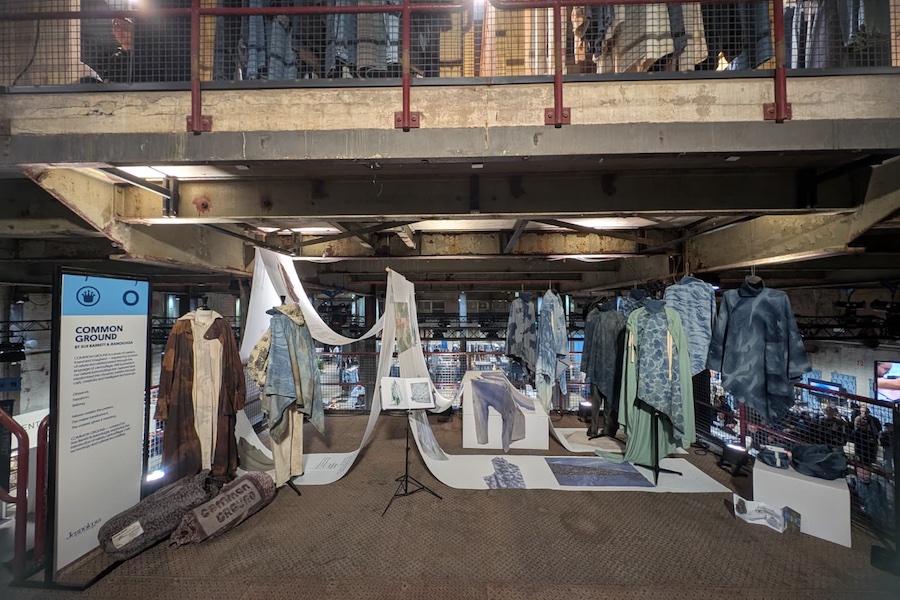
Jeanologia’s presence at Kingpins also includes COMMON GROUND, a collaboration with Sue Barrett exploring the relationship between nature, camouflage, craft and technology. © 2026  Jeanologia
Jeanologia’s presence at Kingpins also includes COMMON GROUND, a collaboration with Sue Barrett exploring the relationship between nature, camouflage, craft and technology. © 2026 Jeanologia


The concept is captured in the COMMON GROUND manifesto:

Observe.

Transform.

Belong.

Nature creates the pattern.

The maker transforms it.

The wearer gives it meaning.


Sue Barrett describes the collaboration and its creative background: “There are a handful of projects we remember as ‘the ones’, built on true collaboration and creativity. COMMON GROUND is one of those. It has been a chance to bring together my passion for camouflage and utility clothing with nature, craft and technology, and reinterpret these references in a new way.”

Carme Santacruz, Creative Director at Jeanologia, highlights the relationship between the creative process and the collection’s underlying concept: “For some of us, the creative process is as meaningful as the final collection. COMMON GROUND made us think about the balance between becoming part of our surroundings while still preserving our own identity, what makes us unique while sharing a common ground.”



More News from JEANOLOGIA S.L.

#Industry 4.0 / Digitalization

Jeanologia and BCome connect factory data with Life Cycle Assessment and Digital Product Passports

A new white paper by EIM by Jeanologia and BCome demonstrates how primary environmental data from denim finishing processes can be integrated into a garment's Life Cycle Assessment (LCA) and prepared for use in a Digital Product Passport (DPP). A comparative case study highlights significant improvements at the production stage while also showing how these translate into the environmental performance of the finished garment.

#Industry 4.0 / Digitalization

EIM evolves into a new Environmental Intelligence to measure the impact of textile production

¿Do we really know the environmental impact behind a garment? Answering this question remains one of the textile industry’s major challenges. Garment production involves multiple stages, from yarn and fabric to final finishing, carried out by different players across the supply chain. Accesing reliable data from each process, connecting it and establishing a common language are essential to understanding a product’s true impact.

#Sustainability

Jeanologia Sustainability Report highlights environmental impact of textile technologies

Jeanologia has published its Sustainability Report 2025, reporting a 13.64% reduction in its own carbon footprint and quantifying the environmental impact associated with the use of its technologies across the global textile industry. According to the company’s calculations, their use avoided the pollution of 21.52 million m³ of water and emissions of approximately 103,530 tonnes of CO₂ compared with conventional textile finishing processes.

#Recycling / Circular Economy

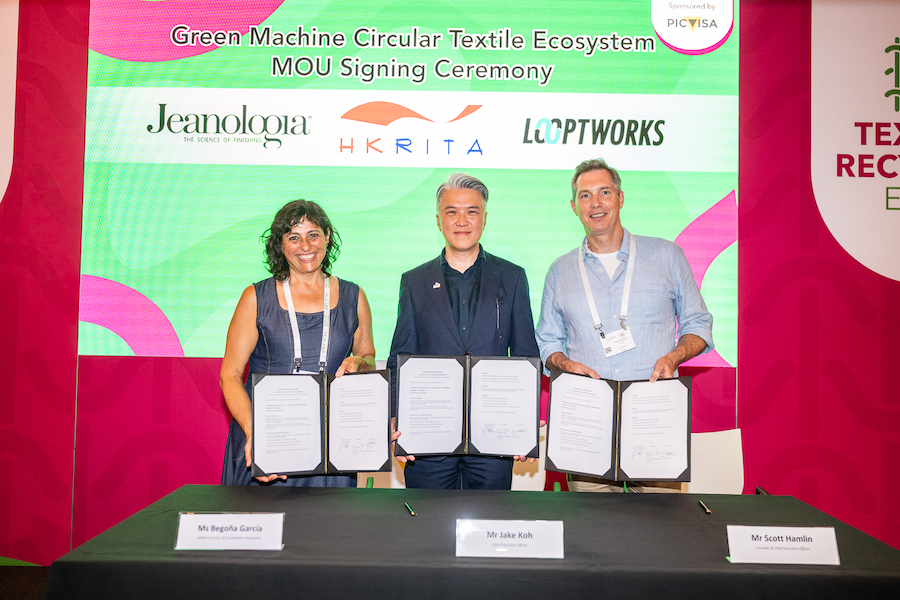
HKRITA signs MoU with Jeanologia and Looptworks to establish the Green Machine Circular Textile Ecosystem

The Hong Kong Research Institute of Textiles and Apparel (HKRITA) yesterday officially signed a landmark Memorandum of Understanding (MoU) with two key global partners, Jeanologia and Looptworks, to establish the Green Machine Circular Textile Ecosystem – a first-of-its-kind collaboration to accelerate the large-scale recycling of blended textiles.

More News on Industry 4.0 / Digitalization

#Industry 4.0 / Digitalization

White House reduces production planning time by up to 80% with Coats Digital’s FastReactPlan

Indian garment manufacturer White House has reduced its production planning cycle by 60–80% following the implementation of Coats Digital’s FastReactPlan software. The integrated planning solution provides greater visibility across production, capacity and material requirements while supporting faster decision-making and improved delivery performance.

#Software

UNIFEQ Europe adopts Coats Digital’s GSDCost and AI-powered GSDQuest to support rapid growth

Coats Digital is pleased to announce that rapidly growing Polish defence and uniform manufacturer UNIFEQ Europe Sp. z o.o. has invested in its award-winning GSDCost solution together with its AI-powered GSDQuest platform to establish a consistent approach to garment costing, improve sewing-floor productivity and accelerate labour costing for tenders and new products.

#Industry 4.0 / Digitalization

Orient Rongheng connects production planning across China and Bangladesh with FastReactPlan

Chinese apparel manufacturer Orient Rongheng is implementing Coats Digital’s FastReactPlan to digitalize production planning across its manufacturing operations in China and Bangladesh. The project aims to connect capacity, materials and order planning across multiple factories while integrating these processes with the company’s existing ERP and Manufacturing Execution System (MES).

#Industry 4.0 / Digitalization

Lectra launches Apogy with agentic AI for fashion product development

Lectra has launched Apogy, a new cloud-based solution for fashion product development that combines product data, collaborative workflows and agentic artificial intelligence. The platform is designed to connect the different stakeholders and processes between initial design and production while using AI agents to automate tasks and support decision-making throughout the development cycle.

Latest News

#India ITME 2026

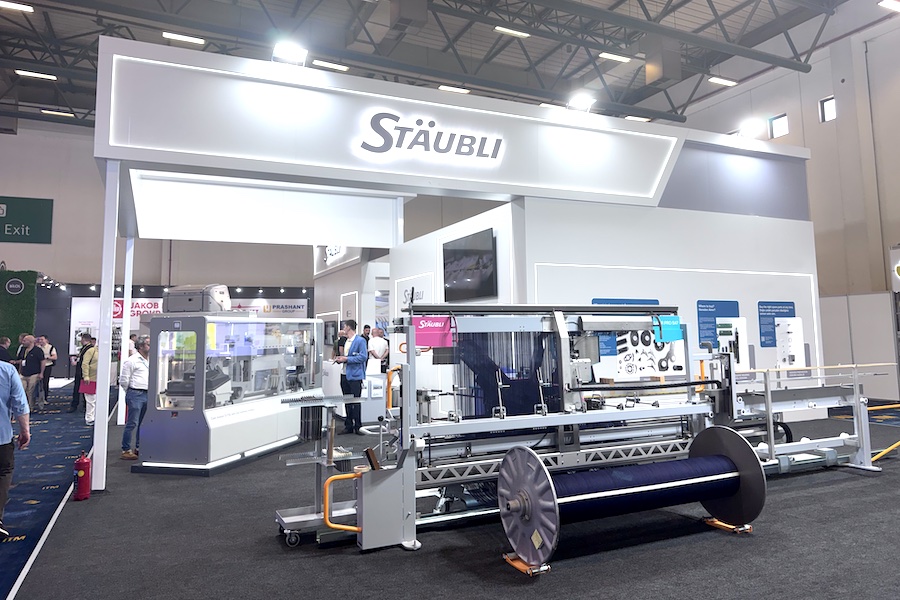
Stäubli to introduce new S3292 dobby for high-speed weaving at ITME India 2026

Stäubli will introduce its new S3292 dobby at ITME India 2026, taking place from December 4 to 9 at the India Expo Centre & Mart in Greater Noida, Uttar Pradesh. Designed for high-speed air-jet weaving, the new machine will be among the highlights of the company's presentation, which also includes warp preparation systems, cam motions, Jacquard technologies and digital services.

#Research & Development

DITF develops bio-based binding fibers for wood-fiber insulation materials

As part of the CelluWoodFlex project, the German Institutes of Textile- and Fiber-Research in Denkendorf (DITF) are developing bio-based cellulose ester fibers as alternative binding fibers for flexible wood fiber insulation materials. In addition to the spinning process and the production of suitable staple fibers, the institute is also investigating how wood and cellulose fibers can be separated and recycled at the end of their useful life.

#Recycled Fibers

Reju expands textile-to-textile recycling network with six international fabric manufacturers

Reju, a textile-to-textile regeneration company, is expanding its industrial network through collaborations with six fabric manufacturers in Europe and the Americas. The initiative aims to accelerate the integration of regenerated polyester into textile manufacturing and support the development of finished fabrics for commercial applications.

#Nonwovens

Magnera highlights HighPleat™ filtration media technology at FiltXPO 2026

At FiltXPO 2026, held on October 28–29 at the Minneapolis Convention Center in Minneapolis, Minnesota, Magnera highlighted advances in air filtration media architecture, with a particular focus on its HighPleat™ platform for MERV 8–10 applications. The technology combines a lofted fiber structure with optimized pore architecture to address the challenge of balancing filtration efficiency, airflow resistance and contaminant-holding capacity.

TOP