[pageLogInLogOut]

#Dyeing, Drying, Finishing

The new and smart way of weft-straightening | PLEVA SL smart

© 2021 Pleva
A high quality fabric is an essential requirement for any finisher who intends to ensure a consistency in quality and resource-efficiency. A particularly important quality criterion in this respect is fabric with straight weft and course. In order to achieve this in an optimum manner, the automatic straightening machine StraightLiner SL smart by PLEVA offers an extremely high level of efficiency which makes it possible to correct distortions over the shortest length of fabric.

Overview of key features

The straightening machine SL smart is designed particularly for knitted and light woven fabrics with a plurality of new design solutions. SL smart is customizable to directly fit the individual customer needs and all at the most efficient cost. According to PLEVAs many years of expertise in the textile industry, the focus of the product is on individual processes and fabrics with their specific needs. To optimally address these needs of the respective applications, several options for customization like fully-integrated accessories for tension-sensitive fabrics, Industry 4.0 applications and more are possible. 
© 2021 Pleva
© 2021 Pleva


The heart of the SL smart system is the well-established advanced traversing camera technology which is unique in weft-straightening. The universal high-resolution camera captures up to 20 measuring points per meter of fabric width. Advanced evaluation algorithms ensure an ultra-precise distortion analysis which enable perfect straightening results in a blink of time.

To get the most out of the ultra-precise distortion detection, PLEVA also offers an innovative solution for the positioning drives. This enables customers to get perfectly straight results out of the fabrics.


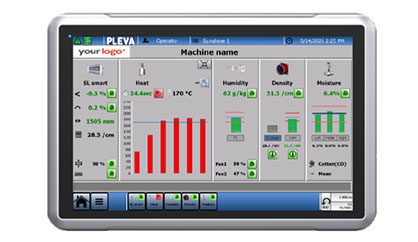
To further enhance the production process, a new customizable user-interface was designed. It displays all important information at one glance, so customers can work more efficiently and stress free.

Meet the highest standards of sustainability and efficiency

Nowadays, products have to meet economical as well as ecological standards. Thus, the new PLEVA weft-straightener SL smart not only helps customers to get the best quality out of their goods, but also improves the sustainability of production.

Due to the first-time-right-principle, the customer only has to go one round through the production line with the fabric and produces directly the aimed result. This saves energy and valuable resources. In addition, due to the higher quality of the goods, there are no more costly readjustments or wasted fabrics and complaints can be reduced drastically. This is not only good for textile producers and customers, but also for the environment.

Finally, a modular control system (PLEVATEC smart) can be directly integrated into the machine. This allows to measure, control, visualize, and protocol the critical parameters of the specific process, for instance:

- Exhaust humidity (FSX)

- Fabric temperature (TDS)

- Pick/course density (CAM)

- Residual moisture (RR)


More News from TEXDATA International

#Techtextil 2026

Performance Apparels: Functional textiles drive innovation at Techtextil 2026

From high-performance fibres and advanced membranes to smart textiles and sustainable material concepts – functional apparel is becoming one of the most dynamic innovation fields in technical textiles. At Techtextil 2026, exhibitors demonstrate how new materials, finishing technologies and digital functions are shaping the next generation of protective, workwear and outdoor systems.

#Texprocess 2026

Texprocess 2026: Automation, digitalisation and AI reshape textile processing

Investment decisions in textile processing have become increasingly complex. Rising energy prices, labour shortages and geopolitical uncertainties are forcing companies to prioritise technologies that deliver measurable improvements in efficiency and process stability. This applies not only to apparel production, but also to the processing of technical textiles and high-performance materials. Modernisation projects are therefore being evaluated more selectively – but the pressure to upgrade production systems continues to grow. Texprocess 2026 reflects this tension between cautious investment behaviour and increasing technological demand.

#Techtextil 2026

Textile Chemicals & Dyes: Innovation in Textile Chemistry moves into focus at Techtextil 2026

From PFAS-free finishes and water-saving dyeing technologies to advanced coatings and recycling-compatible formulations, innovation in textile chemistry is accelerating across the industry. Reflecting this development, Techtextil 2026 introduces Textile Chemicals & Dyes as a dedicated product segment, highlighting the growing role of chemical solutions in shaping the next generation of technical textiles.

#Recycling / Circular Economy

textile.4U publishes special edition “Top 100 Textile Recycling Companies 2025”

With a comprehensive 176-page special edition, textile.4U is dedicating its latest issue entirely to one of the most dynamic and influential topics in today’s textile industry: textile recycling. The new issue, published exclusively in high-quality print, presents the Top 100 textile recycling companies researched and selected by TexData – organizations that already play a key role in the transition to circular textiles or are expected to have a significant impact in the near future.

More News on Dyeing, Drying, Finishing

#Advertorial

New Gravimax MMX-R X-ray sensor platform opens up new application fields

The demands placed on quality control in web-based production processes are increasing: materials are becoming more complex, basis weights are varying more widely, and at the same time, pressure is growing to make processes more efficient and transparent. Precise measurement data across the entire web width has therefore become a key factor in ensuring stable production processes. With its new Gravimax MMX-R sensor platform, Mahlo introduces a radiometric measurement solution designed to set new standards in determining basis weight and material composition. The platform combines advanced X-ray technology with newly developed signal processing, enabling measurement tasks that previously often required multiple sensor technologies.

#Techtextil 2026

BW Converting to present its Baldwin TexCoat® G4 at Techtextil 2026

BW Converting will present its Baldwin TexCoat® G4 precision spray finishing system at Techtextil Frankfurt 2026, taking place April 21-24 at Messe Frankfurt. Visitors to Hall 12, Booth C56B, will have the opportunity to explore how this advanced spray technology helps textile manufacturers improve finishing quality, increase efficiency and reduce resource consumption across a wide range of applications.

#Techtextil 2026

Smart sensors, smart savings - Reducing energy and cost in textile finishing

As energy prices, sustainability requirements and quality expectations continue to rise, manufacturers of technical textiles face increasing pressure to optimize efficiency while ensuring process reliability. At the same time, skilled labor shortages require production systems that are intuitive, automated and easy to manage. PLEVA addresses these challenges with robust, maintenance-friendly sensor technologies combined with intelligent process control.

#Dyeing, Drying, Finishing

Navis TubeTex and Fibroline announce upcoming Innovation Days

Navis TubeTex and Fibroline LLC announced their upcoming Innovation Days, a collaborative 3-day event designed to showcase advancements in product development technologies, and next-generation sustainable manufacturing solutions.

Latest News

#Raw Materials

New study shows low environmental impact by Cotton made in Africa Organic Cotton from Tanzania

Today, the Aid by Trade Foundation (AbTF) is announcing the results of a comprehensive life-cycle analysis (LCA) for cotton produced in Tanzania under the Cotton made in Africa Organic (CmiA Organic) standard. The study emphasises the small ecological footprint of CmiA Organic verified cotton. This can largely be traced back to the absence of synthetic pesticides, artificial fertilisers, and artificial irrigation. Consequently, CmiA Organic cotton can help the textile industry meet regulatory requirements as well as science-based targets. The results also show that the consequences of climate change threaten the livelihoods of these cotton farmers, even though the type of agriculture they practise barely contributes to climate change.

#Raw Materials

Better Cotton Initiative strengthens regenerative focus in standard update

The Better Cotton Initiative (BCI) has strengthened the regenerative focus of its field-level standard with the launch of a new version of its Principles & Criteria (P&C), which marks the next step in the organisation’s journey to becoming a regenerative standards system.

#Man-Made Fibers

Selenis and Kintra Fibers partner to scale 100% bio-based synthetic fiber technology

Selenis, a leading global specialty polyester manufacturer, today announced a strategic manufacturing partnership with materials science company Kintra Fibers to scale Kintra’s patented fiber-grade PBS resin - a 100% bio-based and biodegradable material designed for textile applications.

#Functional Fabrics

PERFORMANCE DAYS proves its relevance as the industry’s key meeting point

Held on March 18–19, 2026, PERFORMANCE DAYS once again confirmed its position as a leading international platform for functional textiles. A total of 3.366 trade visitors and around 560 exhibitors gathered in Munich, with the event already kicking off successfully on DAY 0, which received highly positive feedback for its interactive format. Despite challenging conditions caused by the public transport strike in Munich, the event saw strong attendance and a consistently high level of activity across both exhibition days.

TOP