[pageLogInLogOut]

#Dyeing, Drying, Finishing

RÖKONA trusts in technology made by BRÜCKNER
(c) 2020 Brückner
RÖKONA develops and produces a wide range of demanding textiles for the complete mobility sector as well as for industrial applications, from building protection to medical textiles and cut protection for forest workers.

Shortly after the end of World War II, Gerhard Rösch established in 1949 with only one knitting machine the textile company Gerhard Rösch GmbH in Tübingen in the South of Germany. At that time the company produced mainly sleepwear textiles for ladies and polo shirts as well as men’s shirts. With the foundation of RÖKONA GmbH & Co. KG in 1963, the company established itself also as innovative textile producer beyond the clothing industry and provided very soon well-known automotive manufacturers with technical textile solutions.

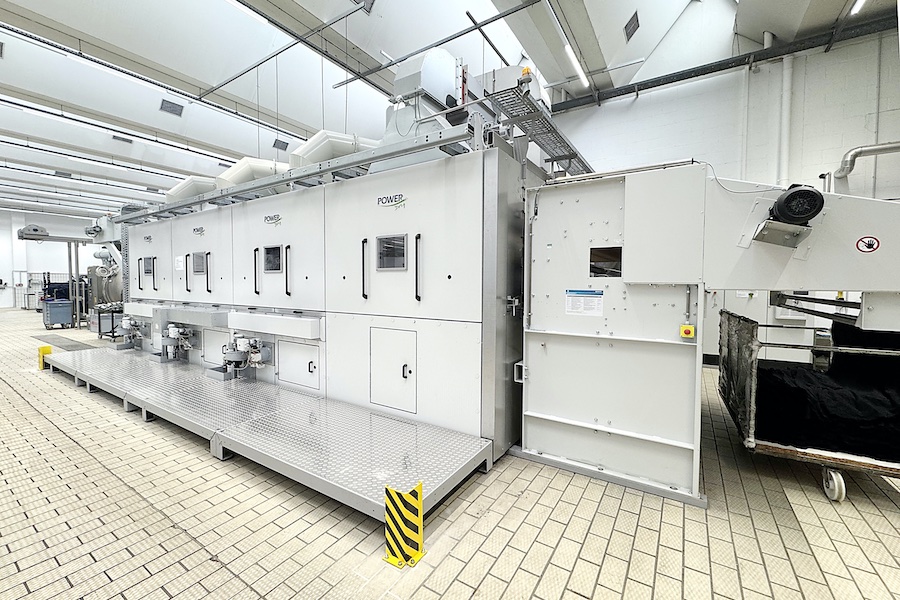
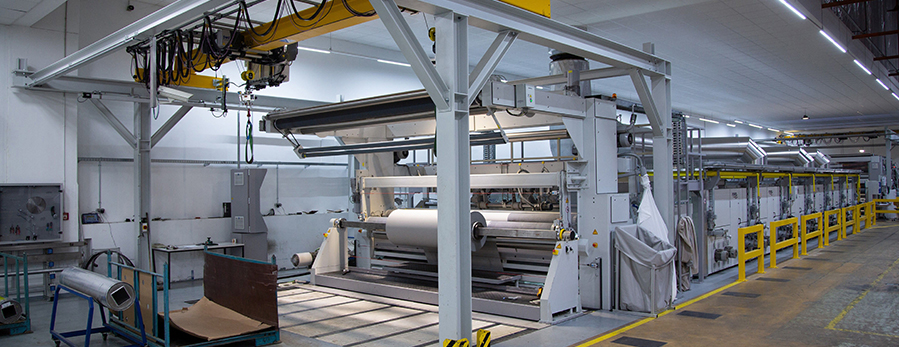
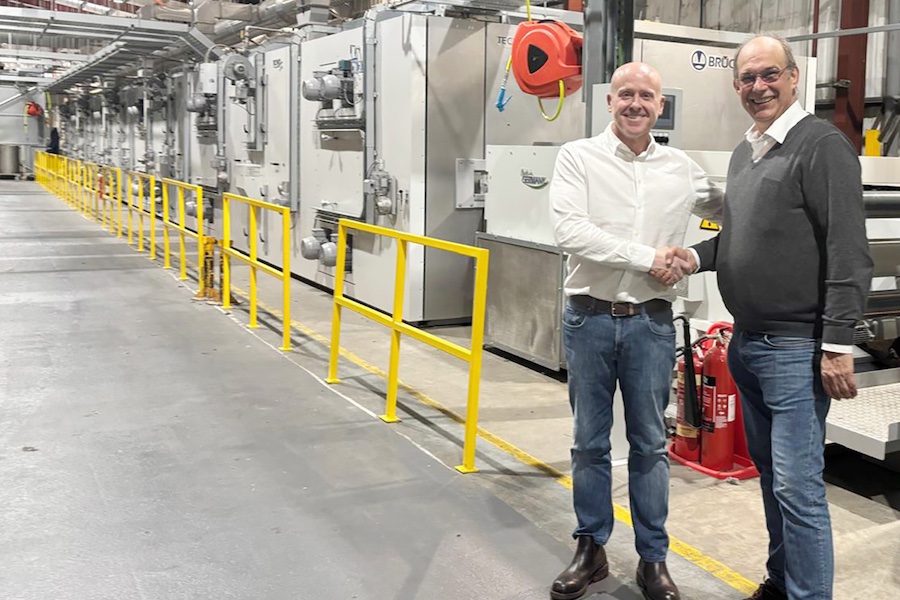
Flexibility and high process safety are basic prerequisites for a successful and customer-oriented production. Equally important is an efficient machine park. For more than 40 years RÖKONA trusts in BRÜCKNER lines for the finishing of their high-quality textiles. The German textile machinery producer supplies not only tailor-made lines for textile finishing but also the necessary technology. In narrow cooperation with the customer BRÜCKNER develops the perfect solution for any application and for any process. The successful partnership of both family-run companies was continued and confirmed just recently with the commissioning of another extremely wide stenter system. In cooperation with the customer’s project team several fabric paths within the line have been planned to allow the finishing with low tension of RÖKONA’s many different fabric types. In front of the stenter is a drum washing machine with a newly developed impregnation padder. This prevents as far as possible excess residual liquor. A straightening unit with intelligent drive system in the entry of the stenter provides for a precise fabric flow without bow and diagonal distortions. The temperature homogeneity in the interior of the stenter is extremely high over the complete dryer length and width. This is due on the one hand to the alternating arrangement of the heating sources every 1.5 m and on the other hand to the sophisticated air circulating system of the BRÜCKNER stenter. The absolutely homogeneous heat-setting ensures the highest possible fabric quality. The newly developped non-lub stenter chain provides for clearly less maintenance and less costs for the customer.


Further cost savings are provided by installed sensors minimizing the energy required by the process and energetically optimized fan motors. For a traceable management and control of the production the line is connected via a data interface to the customer’s ERP system. At the end of the new 6-chamber line the fabric is wound up nearly without tension on a dyebeam thanks to a highly sensitive dancer control. This is extremely important for RÖKONA to achieve an absolutely homogeneous and equal dyeing of the fabric.

RÖKONA is also very active in the field of sustainability and environmental protection. The recently commissioned line is together with all other stenters connected to a regenerative post-combustion system integrated into the district heating system of the municipality of Tübingen. The hot exhaust air of the stenter is first thermally cleaned and is then used for the heating of water which is supplied directly to the public utility network. This saves every year approx. 350.000 l of fuel oil.

Regina Brückner, owner of the textile machinery producer BRÜCKNER located in Leonberg, is particularly happy about this successful project between RÖKONA and the public utility of Tübingen. "It is good to see our customers breaking new ground and continuously optimizing their processes. In order to be successful in today's world and to be able to withstand increasingly tough competition in the future, we urgently need a sustainable business policy.”
More News from BRÜCKNER Textile Technologies GmbH & Co. KG

#Dyeing, Drying, Finishing

Tradition and Innovation – Phoenox Textiles Ltd. relies on state-of-the-art carpet back-coating line from Brückner

For more than 70 years, Phoenox Textiles Ltd. has been synonymous with quality, reliability, and inno-vation in the textile industry. Founded in 1954 in Huddersfield (Yorkshire, UK), a region with a long tradition in textiles, this family-owned business has continued to evolve without losing sight of its roots. Today, in its fourth generation under the leadership of the Mosley family, Phoenox successfully combines decades of experience with a clear, forward-looking corporate strategy.

#ITMA Asia + CITME Singapore 2025

BRÜCKNER will be demonstrating what modern textile finishing looks like today at ITMA ASIA

Brückner Textile Technologies is presenting German engineering expertise and energy-efficient line concepts at this year's ITMA ASIA in Singapore. The family-run company has been a leader in customized technologies and solutions for textile equipment for over 75 years. The focus is on energy efficiency, automation, and maximum productivity.

#Dyeing, Drying, Finishing

Inauguration of the branch office in Coimbatore, India

With the establishment of Brückner Textile India Pvt. Ltd., the Brückner Group, based in Leonberg, Germany, marks another important milestone in its long and successful company history. The new subsidiary in Coimbatore, India, brings Brückner significantly closer to its Indian customers – both geographically and strategically.

#Dyeing, Drying, Finishing

Growing with a vision: BRÜCKNER opens branch office in India

The worldwide leading textile machinery manufacturer BRÜCKNER is opening its own subsidiary in India on June 1st, 2025. With this strategic step, the German family-owned company further strengthens its global presence and expands into the Indian market, which is so important for the textile industry.

More News on Dyeing, Drying, Finishing

Latest News

#Spinning

Ibrahim Fibres and Trützschler: A strong partnership enters its next phase with the TC 30Si

For more than two decades, Ibrahim Fibres and Trützschler have grown side by side, driven by a shared ambition to continuously improve spinning performance, strengthen technology leadership and set new benchmarks in the textile industry. Today, Ibrahim Fibres is a leading yarn and polyester staple fiber manufacturer in Pakistan. The company operates the largest number of Trützschler cards in the country, with more than 200 machines running across its mills in Faisalabad, and plays an important role in one of Asia’s largest textile industries.

#Digital Printing

USColorworks expands digital platform with Kornit Atlas MATRIX and Atlas MAX PLUS solutions

Kornit Digital Ltd. (NASDAQ: KRNT), a global pioneer in sustainable, on-demand digital fashion and textile production, today announced that USColorworks, a North Carolina-based apparel decoration and fulfillment company specializing in custom and on-demand printing for retail and promotional markets, has expanded its Kornit digital production platform with the addition of Atlas MATRIX and Atlas MAX PLUS systems to deliver high-quality, on-demand apparel across cotton, blended fabrics and polyester.

#Functional Fabrics

CovationBio introduces two new bio-based innovations at Functional Fabric Fair New York

Covation Biomaterials LLC (“CovationBio®”) is showcasing its two new bio-based innovations, Xatryx® and Sorona® elasterell-p fiber, at this year’s Functional Fabric Fair in New York City, July 7–9, 2026. Attendees can visit CovationBio at Booth #404 to explore this next generation of bio-based performance materials.

#Research & Development

Geotextiles made from recycled materials: GREEN leads the way into the industry

For the industry, recycled materials are creating new opportunities in geotextile production. In the GREEN project, the Fraunhofer Cluster of Excellence Circular Plastics Economy CCPE demonstrates that recycled polypro-pylene (PP), polyethylene terephthalate (PET), and high-density polyeth-ylene (HDPE) can be processed into nonwovens, fibers, and membranes that meet industrial requirements. This creates opportunities for use in existing production lines and new value chains in the geotextile market.

TOP