[pageLogInLogOut]

#Digital Printing

Industrial printer shipments increased more than 17% year over year in 2021, according to IDC

New data from the International Data Corporation (IDC) Worldwide Quarterly Industrial Printer Tracker shows that industrial printer shipments grew 3.2% in the fourth quarter of 2021 (4Q21) compared to the previous quarter. For the full year 2021, worldwide shipments grew more than 17% year over year.

"Shipments were slower in the second half of the year than the first half in most regions," said Tim Greene, research director, Hardcopy Solutions at IDC. "We're hearing about supply chain and inventory challenges from many of the global suppliers. Despite this, printer shipment numbers for the year were much stronger than 2020. And, with the exception of North America, the global market is still not back to pre-pandemic shipment levels."

Worldwide Industrial Segment Highlights for Q4 2021

• Large format digital printer shipments grew 3.2% worldwide in 4Q21 compared to 3Q21.

• Dedicated direct-to-garment (DTG) printer shipments declined 3.5% sequentially in 4Q21. IDC believes this is partially due to the impact of aqueous direct-to-film printers.

• Direct-to-shape printer shipments grew 10% quarter over quarter in 4Q21.

• Digital label & packaging printer shipments declined 11% sequentially in 4Q21.

• Industrial textile printer shipments grew more than 10% in 4Q21, continuing a strong performance for the full year 2021.

Regional Analysis

• The strongest growth came from the Central Europe, Middle East & Africa (CEMA) region which saw shipments grow more than 26% quarter over quarter in 4Q21.

• Total shipments in the Asia/Pacific region (including China) were essentially flat for 4Q21.

• Japan and North America both declined in 4Q21 when compared to 3Q21.

• Shipments in the Western European market grew nearly 14% quarter over quarter in 4Q21.

• The Europe, Middle East, and Africa (EMEA) region declined 12.5% compared to Q3 2021.


Outlook for 2022

• The year 2021 was considerably better than 2020 as a whole and there are still important segments of the market such as the trade show business that has not fully resumed. IDC expects stronger shipment numbers driven by great demand in those segments in 2022.

• Mix changes drove a separation between shipment trend and revenue trend through the course of the 2021, with more low-end units sold which subtracted revenue from the worldwide industrial printer hardware market. 
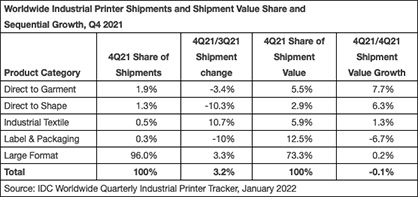

IDC's Worldwide Quarterly Industrial Printer Tracker provides total market size and vendor share for five major market categories: large format, label and packaging, direct to garment, industrial textile, and direct to shape. In addition to units, shipment value, and ASP, the Tracker also provides market results for each product category by ink type, media size, hardware class, or primary application across nine geographic regions and 90 countries.




More News from TEXDATA International

#ITM 2026

ITM 2026: The new geography of textile production

New production hubs are emerging across North Africa and Central Asia, while Türkiye is accelerating its transformation toward higher-value, technology-driven and more sustainable textile manufacturing.

#Research & Development

“Production is a product”

From technical textiles and AI-driven robotics to the limitations of textile circularity: Professor Dr Thomas Gries looks back on more than two decades of development at ITA Aachen. In the interview, he explains why production technology remains a decisive success factor, discusses international collaborations and innovation ecosystems, and shares his views on the transformation of production landscapes and the challenges facing an increasingly regulated industry.

#Knitting & Hosiery

“We need to move away from the price trap and return to a value-driven mindset.”

With its new Textile Innovation Center, KARL MAYER is sending a strong signal for innovation, collaboration, and the future of textile applications. In this interview, Karl Josef Mayer discusses new opportunities in warp knitting, the processing of staple fibres, recycling, the changing role of machinery manufacturers, and why the textile industry must once again focus more strongly on the value of textiles. by Oliver Schmidt

#Associations

“Innovation, resilience and international experience remain the great strengths of the Swiss textile machinery industry”

Geopolitical uncertainty, growing competitive pressure from China, new free trade agreements and the shift towards a circular economy are currently reshaping the global textile industry. In this interview, Cornelia Buchwalder discusses the current mood within the Swiss textile machinery sector, the industry’s distinctive innovative strength, new market opportunities in India and Asia, and the technological trends that could shape the upcoming trade fair cycle leading up to ITMA 2027.

More News on Digital Printing

#Digital Printing

Mimaki advances DTF productivity and stability with new TxF330-800

Mimaki Europe, a leading manufacturer of industrial inkjet printers and cutting plotters, announces the TxF330-800, its new direct-to-film (DTF) printer. Designed to support stable, high-quality garment decoration in demanding print environments, the system combines automated maintenance, expanded white ink capacity and advanced production capabilities to streamline workflow.

#Digital Printing

Where every detail counts: Experiential applications of DTF and UV-DTF printing

Personalisation has moved far beyond the traditional logo on a t-shirt. Today, brands want to create complete experiences, where every detail – from clothing and accessories to décor and packaging – feels distinctive and reflective of their identity.

#Dyeing, Drying, Finishing

EFI Reggiani and Danitech Group announce strategic multi-year agreement for Mezzera textile finishing machinery

Electronics For Imaging, Inc. (EFI), through its subsidiary EFI Reggiani (Reggiani Macchine S.p.A.), together with Danitech Engineering and Solutions Srl (Italy) and Suzhou Danitech Intelligent Technology Co. Ltd (China), announces a multi-year license and manufacturing agreement covering the Mezzera and Jaeggli textile finishing machinery portfolio.

#Digital Printing

USColorworks expands digital platform with Kornit Atlas MATRIX and Atlas MAX PLUS solutions

Kornit Digital Ltd. (NASDAQ: KRNT), a global pioneer in sustainable, on-demand digital fashion and textile production, today announced that USColorworks, a North Carolina-based apparel decoration and fulfillment company specializing in custom and on-demand printing for retail and promotional markets, has expanded its Kornit digital production platform with the addition of Atlas MATRIX and Atlas MAX PLUS systems to deliver high-quality, on-demand apparel across cotton, blended fabrics and polyester.

Latest News

#Industry 4.0 / Digitalization

Coats Digital launches AI-powered GSD RealMotion for motion analysis

Coats Digital has launched GSD RealMotion, an AI-powered solution designed to provide apparel manufacturers with greater visibility into factory-floor operations. By analysing shop-floor video and applying Coats Digital’s GSD methodology, the solution turns video recordings into structured, motion-by-motion method studies.

#Textile chemistry

Archroma and Lameirinho partner in pioneering deployment of InOneGO single-step dyeing

Archroma, a global leader in specialty chemicals, and Lameirinho, a leading home textiles manufacturer based in Portugal, are collaborating to bring InOneGO by Archroma, a new single-step dyeing process, into commercial production. Lameirinho’s first InOneGo bedlinens collection is now available worldwide.

#Knitting & Hosiery

KARL MAYER launches extra-wide HKS 3-M EL for increased productivity

KARL MAYER has launched a new extra-wide version of its HKS 3-M EL tricot machine, designed to increase productivity particularly in the manufacture of textiles for sports, activewear and athleisure applications.

#Research & Development

Reducing development times for technical textiles by accelerated thermo-oxidative aging in a high-pressure autoclave

Synthetic polymers used in technical textiles can be effectively protected against degradation caused by heat, oxygen, and water through the use of stabilizer systems. This enables service lives of several decades, extending to more than 50 years. As the use of durable technical textiles continues to grow, so does the demand for reliable methods to predict their service life within economically feasible testing periods. For the first time the German Institutes of Textile and Fiber Research Denkendorf (DITF) developed methods for robust service life prediction for textiles in an IGF research project.

TOP