#Composites
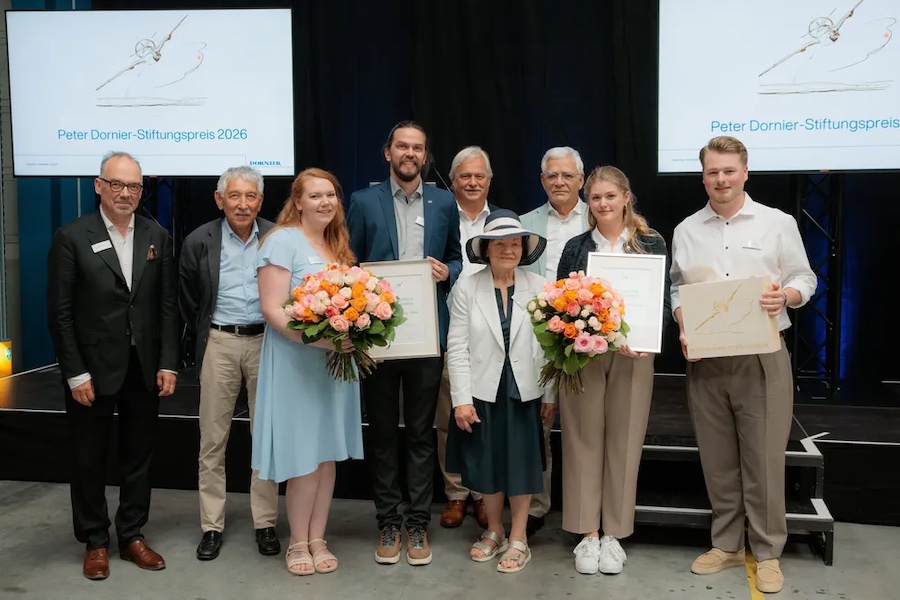
Fewer pores, greater impact tolerance: Peter Dornier Foundation Prize 2026 honours material research on fibre-reinforced composite components for aerospace industry
Reducing costly scrap: 87,5 per cent fewer pores in carbon-fibre-reinforced and glass-fibre-reinforced plastic components
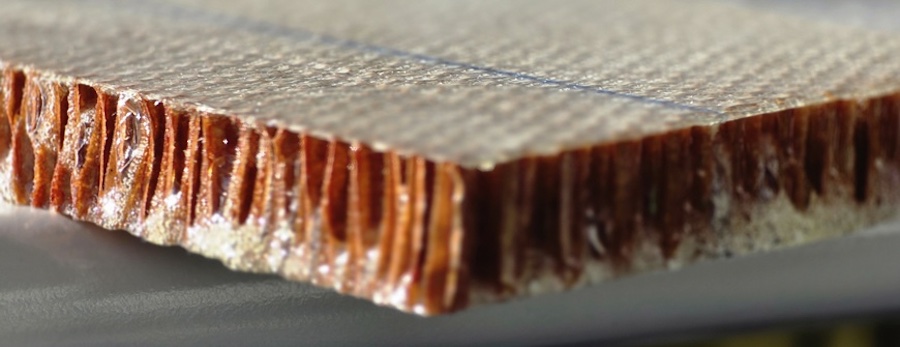
Carbon-fibre-reinforced and glass-fibre-reinforced plastics (CFRP/GFRP) only realise their full potential for lightweight construction and sustainability when the fibres and resin bond together as seamlessly as possible. The problem is that the standard injection moulding process known as ‘resin transfer moulding’ (RTM) often results in microscopically small pores that can weaken the component. “The resin encounters local flow resistance within the fabric and is consequently diverted in an undesirable manner,” explains Dr Benedikt Neitzel, Senior Research Scientist at Ilmenau University of Technology. Until now, such air pockets have been compensated for by generous safety margins. “But that makes the components unnecessarily heavier,” says Neitzel. If the tolerance is exceeded, there is a risk of costly scrap – particularly with carbon fibre.
This is why, in his doctoral thesis (‘Analysis of the permeability of semi-finished textile products to minimise pores in the RTM process’), which was awarded the 2026 Peter Dornier Foundation Prize, Neitzel developed a new calculation method that allows pore formation to be predicted more accurately. He also designed an automated process control system that actively prevents air entrapment. The result: “We were able to reduce the pore content in test specimens by up to 87.5 per cent,” says Neitzel, who is also managing director of the research association “Materials from Sustainable Resources”.
In future, such components with fewer pores can be designed to be significantly thinner and lighter. “The greatest potential for savings in materials and fuel lies where large masses need to be moved – primarily in aircraft construction, but also in machinery and medical technology,” says Neitzel. A major advantage for manufacturers is that his methodology does not require extensive measurement series. “Engineers can read my work today and apply it tomorrow,” says the materials researcher.
Hail and bird strikes: 3D fabrics outperform traditional 2D laminates
Modern aircraft consist largely of fibre-reinforced plastics, usually in the form of layered 2D laminates. 3D fabrics have so far been used less frequently, although they address a key weakness of 2D laminates: their low load-bearing capacity in the thickness direction. As the fibres in 3D composites also run in the third dimension (the z-direction), these materials are significantly less prone to delamination and cracks.
Until now, 3D preforms have mainly been used in applications where maximum damage resistance is required, such as the fan blades of the LEAP engines on the Airbus A320neo family or the Boeing 737 MAX. A recent example from space industry is NASA’s Orion spacecraft, which carried a four-person crew on a flight around the moon in early April during the Artemis II mission. “In Orion, 3D fabrics are used at high-stress connection points, such as between the crew capsule and the service module,” says Johanna Buschmann, M.Sc. “There, they withstand the enormous forces during launch and re-entry and reduce the risk of life-threatening thermal bridges.”
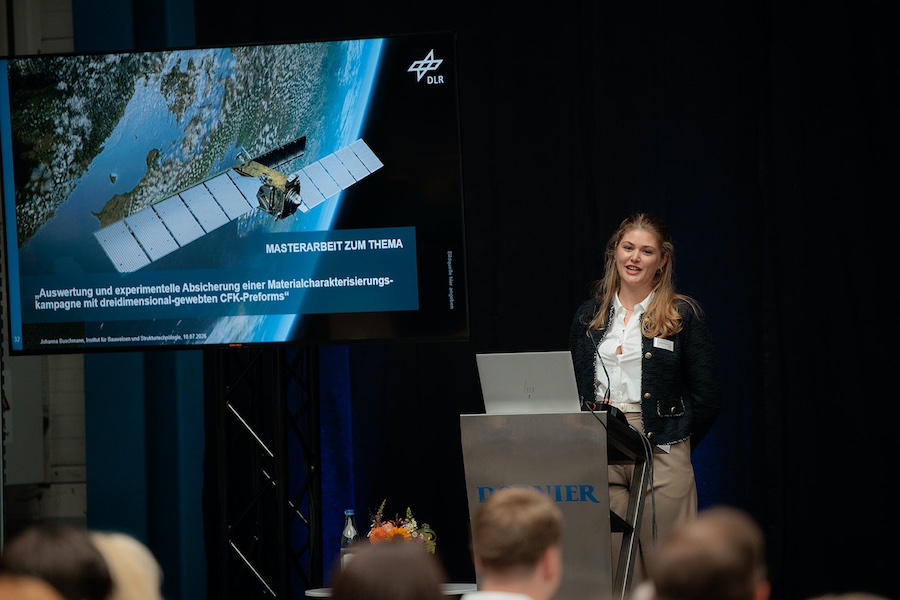
In her master's thesis at the German Aerospace Centre (DLR), for which Buschmann was awarded the 2026 Peter Dornier Foundation Prize, she investigated how well 3D fabrics withstand impacts – such as those caused by bird strikes, hail or dropped tools – compared to 2D laminates. “Such impacts can cause internal damage that is barely visible from the outside but severely compromises the component’s load-bearing capacity,” explains Buschmann. For her work, entitled ‘Evaluation and experimental validation of a material characterisation campaign using three-dimensionally woven CFRP preforms’, she compared 2D fabrics (twill) with 3D CFRP preforms (layer-to-layer and angle-interlock XY). The tests confirm that the 3D CFRP fabrics exhibited significantly higher energy absorption, less delamination and better residual strength upon impact. Whilst the 2D fabric lost around 54 per cent of its compressive strength following a 15-joule impact – comparable to the impact energy of larger hailstones – the losses for the 3D fabrics were only 28 to 40 per cent.
“This shows that the use of 3D preforms can increase the residual strength and impact tolerance of composites,” says Buschmann. This has great potential, particularly for the aerospace industry, as impact damage in that sector often requires costly repairs or component replacements. In the long term, the expected longer service life of 3D-woven components following an impact could also enhance sustainability in aircraft manufacturing.
Coming full circle: from aircraft designer Peter Dornier to 3D fabrics in aviation
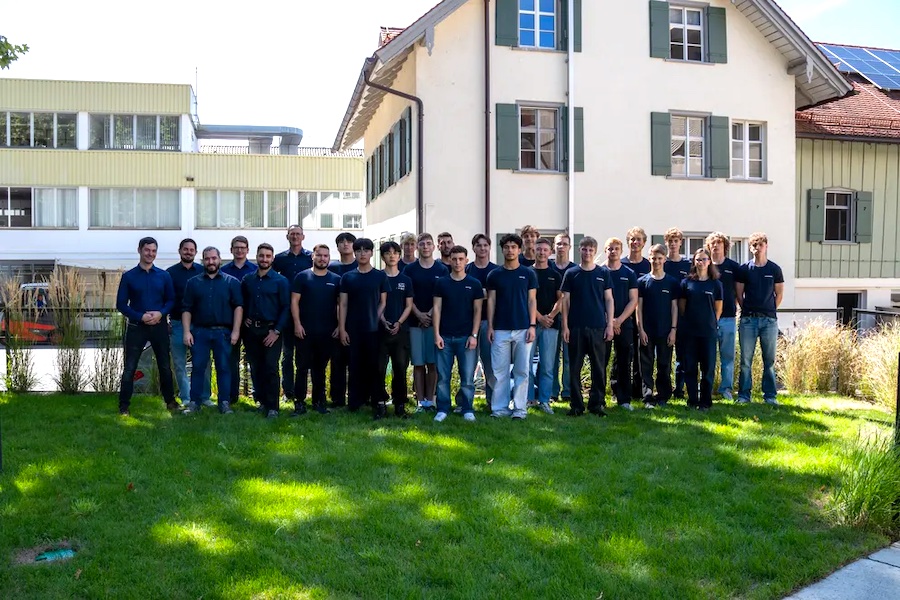
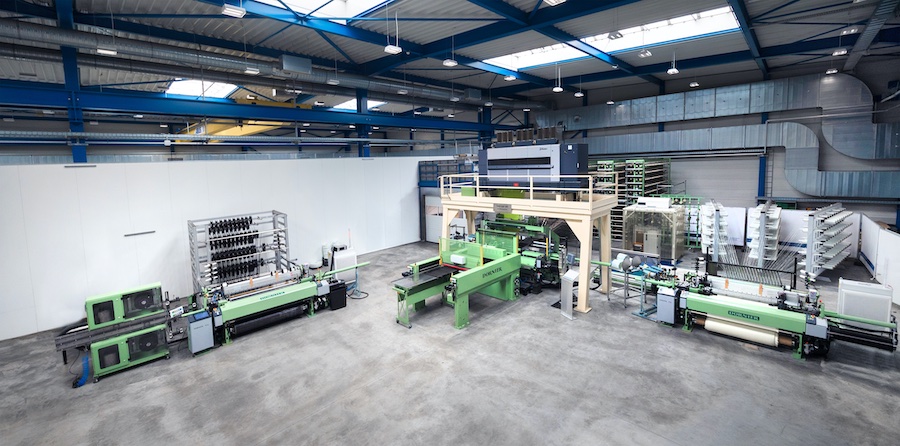
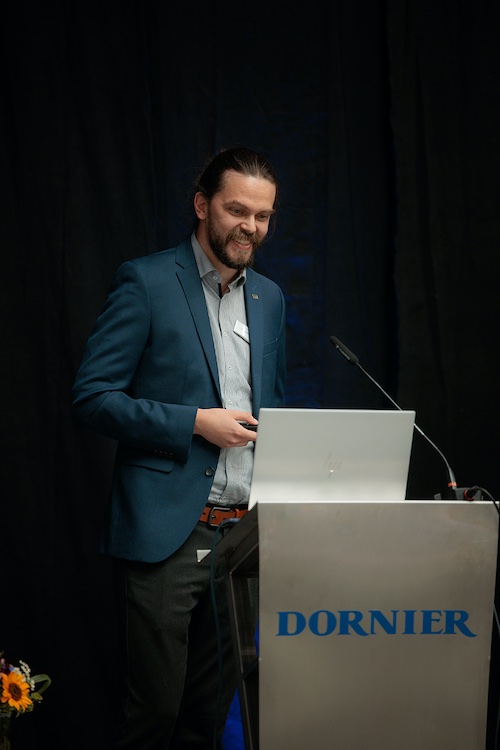
In keeping with the award-winning projects, the awards ceremony took place in mid-July at the technical centre of the Composite Systems division of Lindauer DORNIER. In this division, the manufacturer of weaving machines and film production lines brings together its decades of expertise in processing the two key materials used in fibre composites – fibres and plastics – into systems for scalable composite series production. The Foundation Prize curators, Dr.-Ing. Andreas Rutz and Dr.-Ing. Bernd Sträter, praised the award-winning theses as “highly successful both scientifically and practically” and as “a significant contribution to the further development of fibre composite technology”, as they have, on the one hand, significantly improved calculation and manufacturing processes for fibre-reinforced composite components and, on the other hand, provided reliable material properties for the industrial use of 3D fabrics.
Peter D. Dornier, managing director for many years and now chairman of the supervisory board of the family-run company, as well as responsible for the Peter Dornier Foundation Prize on the foundation's board, drew parallels with the company's history in his laudatory speech: His father, the DORNIER founder and aircraft designer Peter Dornier – son of aviation pioneer Claude Dornier – once said: “Dornier and aeroplanes – they belong together.” The honoured works at the interface between fibre composites and aviation fully embody this spirit and would certainly have met his standards for future-oriented research, said Peter D. Dornier.
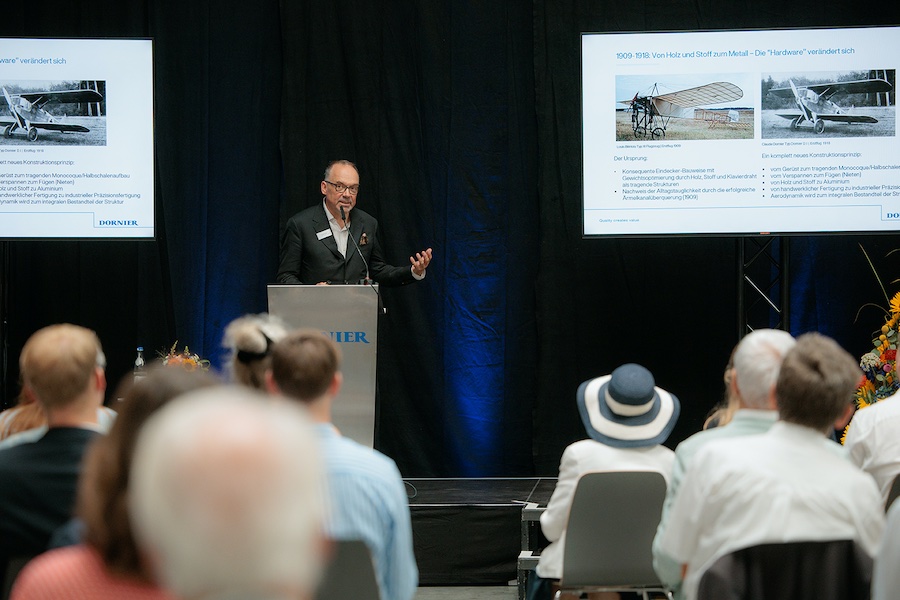
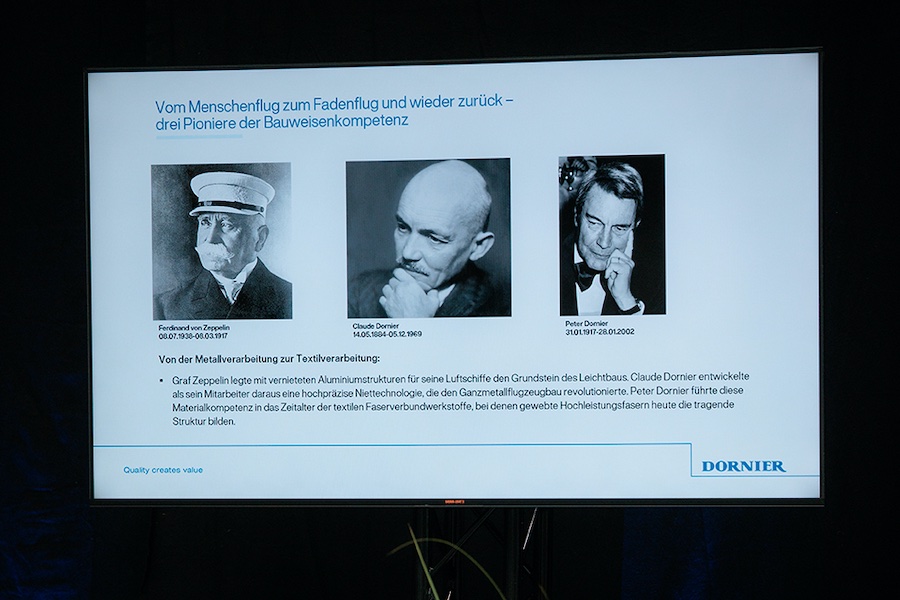
He then took the approximately 120 guests on a journey back to the company’s early days in composites and introduced three “pioneers of structural engineering expertise”: Count Zeppelin, the Count’s employee Claude Dornier, and Peter Dornier, the foundation’s founder. Whilst the first two laid the essential groundwork for the use of aluminium as a light metal in aviation by developing a precise riveting technology, Peter Dornier, in 1967, provided the crucial means of production for processing delicate glass and carbon fibres: the DORNIER rapier weaving machine. As early as in the 1970s, semi-finished textile products were woven on this machine for tail section components of Airbus aircraft, components for the Ariane rocket and the CFRP air brakes for the Alpha Jet – the first CFRP series-production component to be certified in Europe, developed as part of a Franco-German joint project between the aircraft manufacturers Dornier and Dassault-Breguet. According to Dornier, Composite Systems is building on this pioneering work with, for example, 3D weaving machines for aircraft suppliers. He emphasised: “The fact that the fabrics for the award-winning projects were produced on DORNIER customers’ weaving machines brings this story full circle in a very special way.”
“No superlatives, rather practical tools for engineers”
Both prize winners were visibly moved at the award ceremony. “My PhD thesis does not offer superlatives, but rather tools to make life easier for process engineers,” said Neitzel. “I never expected to receive such an award.” Buschmann added: “It is a great honour for me to receive the Peter Dornier Foundation Prize, and it motivates me even more to continue my research in the field of aerospace.” To further develop his calculation methodology and extend it to other fibre structures, Neitzel is already working on a follow-up project funded by the German Research Foundation (DFG). Meanwhile, the DLR, where Buschmann completed her master's thesis, is working on further collaborations to explore the practical application of 3D CFRP preforms in the aerospace sector.
The Peter Dornier Foundation Prize
The idea of the Peter Dornier Foundation Prize goes back to Peter Dornier (1917-2002), the founder of Lindauer DORNIER GmbH. The prize, endowed with 5,000 euros per winner, has been awarded annually since 2021 for outstanding scientific work by young people in the fields of textile, film and fibre composite technology, as well as aviation and aerospace. Funding medical research is just as much a part of the foundation's purpose as supporting hospices for a self-determined and dignified life until the end.