[pageLogInLogOut]

#Composites

DORNIER presents itself with holistic approaches to thermoplastic composites and three-dimensional preforms

Technical center Composite Systems at DORNIER (c) 2020 DORNIER
A modern composite lightweight design is not based on the material alone. It is rather an optimal synergy of material, process and application. With its PROTOS® and TRITOS® production systems, Lindauer DORNIER is now presenting for the first time comprehensive solutions for the economic production of high-quality customized thermoplastic composite structures.

PROTOS Line: With granulate and fiber to the semi-finished thermoplast product

Whether vehicles, airplanes, wind turbines or robots – fiber reinforced materials provide more economic efficiency, sustainability and weight reduction in areas such as e-mobility, energy and mechanical engineering. Semi-finished fiber-matrix products based on unidirectional fiber reinforcements (UD tapes) play an important role in this context. The outstanding features are, most of all, short cycle times, good recyclability and easy processing. In order to provide a solution for the low level of availability of suitable UD tapes and prepreg semi-finished products, Lindauer DORNIER has now developed the PROTOS Line (Polymer and Roving to Sheet). “The integral solution allows tailored manufacturing of high-performance intermediates, products easy to be further processed “, says Dr. Josef Klingele, Head of Composite Systems Product Line. First of all, the Tape Production Line PROTOS TP produces either dry or fully impregnated tapes and afterwards processes them with the Tape Weaving Machine PROTOS TW into high-performance semi-finished thermoplastics. DORNIER’s innovative production system is available for customer trials and sampling in the in-house technology centre.


P2 Mono Rapier Weaving Machine: Machine platform for special products

From fabric made of heavy tow to tape fabric made of thermoplastic tapes: Where many special solutions have been used so far, DORNIER is now launching a highly flexible machine platform with the P2 Mono. The new monorapier weaving machine is available in different versions, enabling customers to produce many special products on one platform. “In combination with the DORNIER Zero Twist Feeder, even two weft colours can be inserted at high speed and with a wide variety of patterns”, adds Dr. Josef Klingele.


P2 Roving Rapier Weaving Machine: The new standard

DORNIER has acquired the know-how for customized solutions for the composites industry over the course of more than 50 years in which the company’s roving weaving machines have set the international industry standard for the production of high-performance fabrics made of carbon, glass and aramid fibers. Their successor will now be presented in Paris: the P2 Roving. Thanks to its higher frame stiffness, improved filling insertion performance, the maintenance-free, patented DORNIER SynchroDrive® drive concept and an optimized positive center transfer, it is already considered as the most flexible rapier weaving machine in the world. According to Product Manager Michael Langer, its improved shed geometries ensure an absolutely symmetrical warp thread path, which means that carbon fabrics for high-end applications can now be produced even better and more reliably. Furthermore, innovative waste saving devices reduce weft waste and allow an efficient production with optimal use of material.

TRITOS Line: Simple production of complex fiber structures


In high performance applications, 3D fabrics are superior to layered fiber composite structures due to their good damage tolerance and high dynamic load capacity. “The DORNIER TRITOS Line (Textile Roving into Three-dimensionally Oriented Structure) combines this material superiority with highly productive, industrial production”, explains Klingele. With fabric thicknesses of up to 100 mm and the patented DORNIER Weft Saver (DWS), the preform production line TRITOS PP is ideally suited for the use in areas with high cost pressure.

More News from Lindauer DORNIER GmbH

#Weaving

Lindauer Dornier announces leadership transition in weaving machine business

After more than ten successful years at Lindauer DORNIER GmbH, Mr Wolfgang Schöffl will leave the family-owned company at the end of the year to enter well-deserved retirement.

#ITMA Asia + CITME Singapore 2025

DORNIER celebrates its anniversary at ITMA Asia + CITME

To mark its 75th anniversary, machine and plant manufacturer Lindauer DORNIER will be presenting the latest developments in its rapier and air-jet weaving machines at ITMA Asia + CITME in Singapore (Hall 2, Stand B401) from 28 to 31 October 2025. The focus will be on energy-efficient weaving technologies, new IoT solutions for networked textile production and systems for the series production of modern fibre composite components.

#Weaving

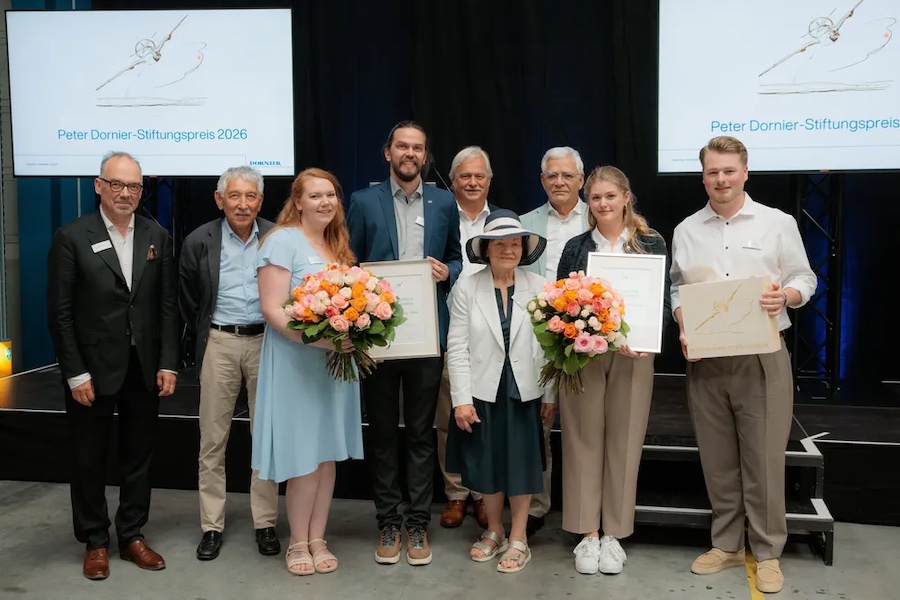
From the Venus flytrap to foldable aircraft wings: Peter Dornier Foundation Prize 2025 honours bionic research on 3D weaving technology

Long wings with foldable tips have the potential to reduce aircraft fuel consumption and make aviation more sustainable. An interdisciplinary research team has now developed a new solution based on the Venus flytrap: Freely movable wingtips made of fibre composites which are produced using innovative 3D weaving technology. For this pioneering combination of textile technology, aviation and bionics, researchers Patrick Meyer (TU Braunschweig) and Michael Vorhof (TU Dresden) were awarded the Peter Dornier Foundation Prize 2025 in mid-July.

#Weaving

Pattern-controlled “pic-a-pic” setting of rapier release timing on right-hand side

DORNIER PIRO enables the operator to set the timing of the rapier release on the right-hand side of the machine “pic-a-pic” and pattern-controlled. For applications with weft yarns of different fineness or elasticity, the optimum timing can be set for each weft channel. This offers great potential for reducing weft waste on the right-hand side.

More News on Composites

#Composites

JEC Composites Startup Booster: 2026 winners announced

The leading global startup competition for composites and advanced materials has crowned its 2026 champions, ahead of a landmark 10th anniversary edition next year. The winners of the JEC Composites Startup Booster 2026 were announced on Wednesday, 11 March, at JEC World, recognizing the most promising emerging companies reshaping the future of composites and advanced materials.

#Yarn & Fiber

Teijin Carbon strengthens high‑end sports offering with advanced prepreg and resin technologies for next‑generation bicycle performance

High‑end bicycle manufacturers are entering a new era in which modern frames and components must be lighter, stiffer, tougher and more sustainable – all while enabling fast, repeatable and cost‑efficient production. To support this shift, Teijin Carbon is expanding its portfolio of advanced prepreg systems developed specifically for premium road, gravel and mountain bike applications.

#Composites

JEC WORLD 2026 opens: Paris becomes the World Capital of composites

JEC World 2026 opens tomorrow, March 10, at Paris Nord Villepinte, bringing together the entire composites ecosystem for three days of exhibitions, conferences, technical sessions, strategic industry gatherings, and business meetings. As the “festival of composites”, JEC World is also a destination for a broad spectrum of other professional visitors, eager to discover how these advanced materials can offer sustainable solutions to their industries.

#Composites

More affordable, environmentally friendly hydrogen pressure tanks at ITA-JEC booth

As a highlight of the JEC, the Institut für Textiltechnik (ITA) of RWTH Aachen University will be presenting hydrogen pressure tanks manufactured using multifilament winding processes at the NRW joint booth in Hall 5, Stand G65.

Latest News

#Techtextil 2026

DIENES at Techtextil 2026: Flexible pilot lines for bio-based fiber development

The growing relevance of bio-based materials in technical textiles is accompanied by increasing demands for reproducibility, high-quality data, and scalable process routes. Especially when working with cellulose and its derivatives, chitosan, lignin-based approaches, or bio-based PAN as a carbon-fiber precursor, R&D teams face variable feedstock quality, tighter process windows, and the need for reliable comparability across trials. This calls for flexible, data-driven experimental setups that can be reconfigured efficiently when recipes, solvents, and raw-material batches change.

#Texprocess 2026

Gunold showcases embroidery product range and services at Texprocess

At Texprocess 2026, GUNOLD will present numerous hands-on examples related to embroidery in Hall 8, Booth E20. The focus is on creative embroidery designs as well as the extensive product range of threads, nonwovens, and accessories for embroidery and embellishment. “Trade visitors can once again look forward to many new and creative embroidery designs. Of course, we will also showcase the matching products required to bring these ideas to life,” announces Marketing Manager Stephan Gunold.

#Nonwovens

EDANA and more than 70 industry organisations call for consistent exemptions in EU packaging regulation

EDANA, together with more than 70 industry associations and organisations, has issued a joint statement commenting on the European Commission’s Delegated Act under Article 29 of the Packaging and Packaging Waste Regulation (PPWR).

#Raw Materials

A Powerful Opening: Global thought leaders launch the International Cotton Conference Bremen

The International Cotton Conference Bremen will open on 25 March 2026 in the Parliament building of the Free Hanseatic City of Bremen with a keynote session of exceptional calibre. Distinguished international experts will set the stage for the conference by offering incisive perspectives on the most pressing challenges and the defining trends shaping the future of the global cotton trade. Their insights will span a broad spectrum — from geopolitically driven disruptions affecting global supply chains to the opportunities emerging from innovation-led agriculture capable of supporting a growing world population. Together, these opening keynotes will frame the dialogue of the conference, highlighting both the complexity of today’s market environment and the pathways toward a resilient and forward-looking cotton sector.

TOP