[pageLogInLogOut]

#Recycling / Circular Economy

Biosorbe buys Renewcell’s facility in Kristinehamn
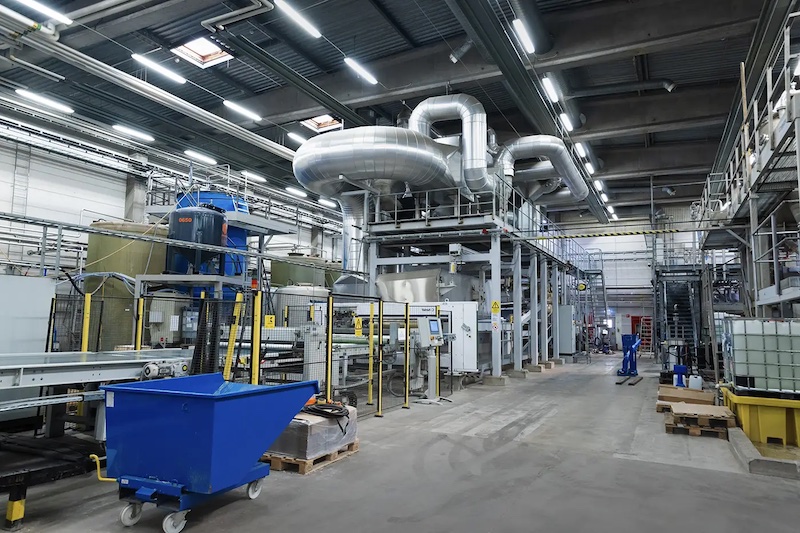
Biosorbe has recently been given the opportunity to purchase new factory premises in Kristinehamn, which was previously owned by Renewcell. Renewcell’s business idea was to recycle textile waste to create new textile fibers. Biosorbe, on the other hand, produces oil-absorption materials. Despite these differences, the factory is still suitable for Biosorbe’s purposes.
© 2024 Biosorbe
© 2024 Biosorbe


Biosorbe has been looking for ways to expand its production, so this acquisition was the first step to achive this goal while at the same time in an eco-friendly way. The advantages of taking over an already existing factory are many – for one thing, you don’t have to take down the factory and sell it part by part, and you don’t have to start a new construction process in order to increase the production capacity. The premises in Kristinehamn are large and offer an approximately 10,000 square meter industrial property as well as a process premises of approximately 2,000 square meters. In addition to this, there are premises for stock management, conference rooms and changing rooms, which will be useful in the future. The production in Kristinehamn is expected to start in May this year.

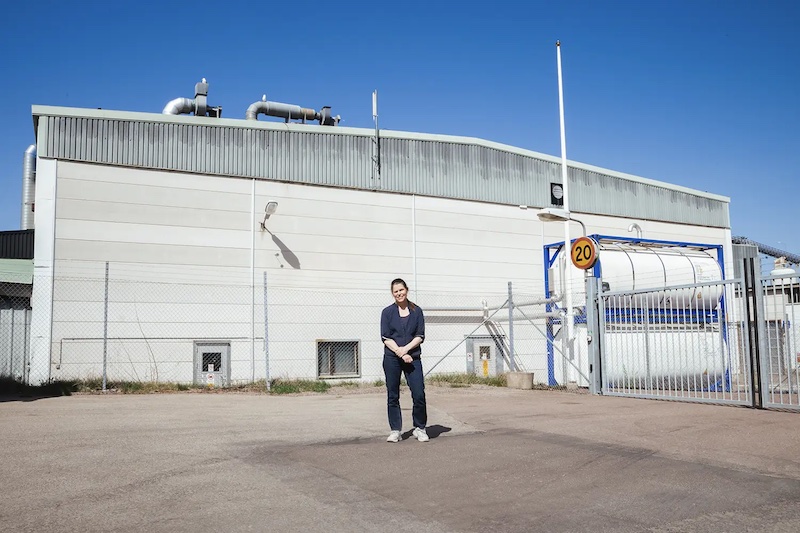
“Right now we are in the process of moving into the premises and preparing for the start of production. The acquisition of the Kristinehamn factory will also mean that Biosorbe’s headquarters will move from Karlstad to Kristinehamn in the near future, as part of the ongoing development. Biosorbe is developing on many levels,” explains Kajsa Fougner, CEO of Biosorbe.

The future of Biosorbe looks bright and exciting. The company is expanding in various directions, collaborating with old and new customers. In addition to Biosorbe’s main product – Biosorbe oil absorbent – there is also development work on new types of products where Biosorbe’s unique material forms a sustainable and bio-based component, for example in the purification of long-lived environmental toxins and in construction materials.

The factory in Kristinehamn also means an opportunity for Biosorbe to package Biosorbe absorbent in a new way, which will make it easier to ship the product abroad.

Biosorbe’s journey began at Kungliga Tekniska Högskolan in Stockholm, in the section for polymer technology. Since then, the company has expanded and is now established in Sunne and Kristinehamn. Kajsa Fougner assumed the role of CEO a month ago. She has a background in the pulp and paper industry, as well as experience as a consultant and project manager. In the past, she has worked with Renewcell and has experience with startup companies.

”We aim to increase production in the coming year, which will enable us to hire more process operators for our facilities. Our hope is to develop the factory to two-shift and later three-shift work. Biosorbe’s main product is absorbent, but we aim to introduce new products and solutions to the market in the near future,” predicts Kajsa Fougner.

© 2024 Biosorbe
© 2024 Biosorbe


More News from TEXDATA International

#Texprocess 2026

Texprocess 2026: Automation, digitalisation and AI redefine textile processing

Making investment decisions in textile processing has become significantly more demanding. Increasing energy costs, a shortage of skilled labour and ongoing geopolitical uncertainties are compelling companies to focus on technologies that deliver clear gains in efficiency and process reliability. This applies equally to apparel manufacturing and to the processing of technical textiles and high-performance materials. As a result, modernisation initiatives are assessed more carefully – even as the need to upgrade production systems continues to intensify.

#Techtextil 2026

Techtextil 2026: Between innovation pressure & market reality

From 21 to 24 April 2026, Techtextil in Frankfurt am Main will once again become the central meeting point for the international technical textiles and nonwovens industry. Running in parallel, Texprocess will focus on the industrial implementation of textile processing technologies as the leading platform in this field. Together, the two trade fairs form a closely integrated presentation and working platform along the entire textile value chain – from material development to finished applications.

#Techtextil 2026

Between geopolitical pressure and industrial resilience

In this interview, Dr. Janpeter Horn (VDMA) discusses the current challenges facing textile machinery manufacturers, shaped by geopolitical tensions, regulatory developments and subdued investment. He also outlines why innovation strength, integrated solutions and strategic positioning remain key to global competitiveness.

#Texprocess 2026

Between investment restraint and modernization pressure

Texprocess 2026 takes place in a complex market environment shaped by uncertainty and innovation pressure. In this interview, Elgar Straub (VDMA) explains why the trade fair is particularly relevant this year and which technologies are driving efficiency and competitiveness.

More News on Recycling / Circular Economy

#Recycling / Circular Economy

Solving the Feedstock Gap: Unlocking Post-consumer Feedstocks for Textile-to-Textile Recycling in Europe

Fashion for Good launches Project FAE (Feedstock Activation Europe) to develop the sorting and pre-processing infrastructure needed to channel non-rewearable post-consumer textiles into textile-to-textile (T2T) recycling at scale. The project is a practical response to one of the most pressing problems in textile circularity: making post-consumer waste a viable, commercially competitive raw material for recyclers.

#Techtextil 2026

BASF at Techtextil 2026: Helping to shape the future of the textile industry with tangible solutions

At the leading international trade fair for technical textiles and nonwovens from April 21 to 24, 2026 at the Messe Frankfurt, BASF will present numerous solutions and new projects in the textile sector to customers and partners at booth B 68 in hall 11.0. The focus is on product innovations and future-oriented technologies.

#Recycled Fibers

RE&UP partners with Madewell and ISKO on textile-to-textile denim capsule

RE&UP Recycling Technologies is accelerating the shift toward a closed-loop textile economy through a collaboration with American denim brand Madewell and global fabric manufacturer ISKO. By transforming approximately 20,000 pairs of post-consumer jeans into recycled feedstock for a textile-to-textile denim capsule, RE&UP demonstrates the commercial viability of circular systems in the denim sector.

#Recycled Fibers

Syre and JEPLAN Announce Strategic Partnership to Accelerate Textile-to-Textile Recycling

JEPLAN, INC. the Japanese pioneer developing and operating chemical recycling technologies for circularity in packaging and textiles, and Syre, the textile impact company on a mission to hyperscale textile-to-textile recycling, announced today a strategic partnership. Together, the companies aim to extensively accelerate the timeline towards commercialization of next generation textile-to-textile polyester recycling technology.

Latest News

#Heimtextil 2027

Heimtextil celebrates Milan Design Week honoring partnerships with Patricia Urquiola and Alcova Milano

Heimtextil is represented at Milan Design Week with its strong design partners Patricia Urquiola and Alcova. At Villa Pestarini, the leading trade fair spotlighted its dynamic collaborations with acclaimed designer Patricia Urquiola and Alcova Milano.

#Texprocess 2026

Kornit Digital expands digital production into footwear and technical textiles with Presto MAX PLUS

Kornit Digital (NASDAQ: KRNT) (“Kornit” or the “Company”), a global pioneer in sustainable, on-demand digital fashion and textile production, today unveiled the Kornit Presto MAX PLUS, a new roll-to-roll system expanding digital manufacturing into footwear, automotive interiors, military camouflage, high-performance sportswear, and high-end furnishings. Debuting at Texprocess 2026 in Frankfurt, Presto MAX PLUS enables entirely new applications for on-demand textile production.

#Textile processing

NATULON® zipper series surpasses 50% of YKK’s global zipper sales

YKK Corporation (Headquarters: Chiyoda-ku, Tokyo; President: Koichi Matsushima; hereafter, YKK) announces that the global sales share of its NATULON® zipper series—zippers that incorporate recycled materials—has exceeded 50%.

#Smart Textiles

Covestro, FILK Freiberg, and OUT e.V. develop flexible, conductive polymer smart textile system

As the smart textiles market continues to grow across healthcare, personal protection, sportswear, and automotive applications, developers are seeking new ways to integrate electronic functionality directly into textiles, without the rigidity and complexity of conventional wiring. To address this challenge, FILK Freiberg Institute, an independent research institution with expertise in polymer coatings for textile applications, collaborated with Optotransmitter-Umweltschutz-Technologie (OUT) e.V. The joint project, funded under the German Industrielle Gemeinschaftsforschung (IGF) program of the Bundesministerium für Wirtschaft und Energie (BMWE), focused on developing flexible, conductive polymer surfaces for next-generation smart textiles.

TOP