[pageLogInLogOut]

#Associations

EURATEX calls for urgent action on industrial competitiveness

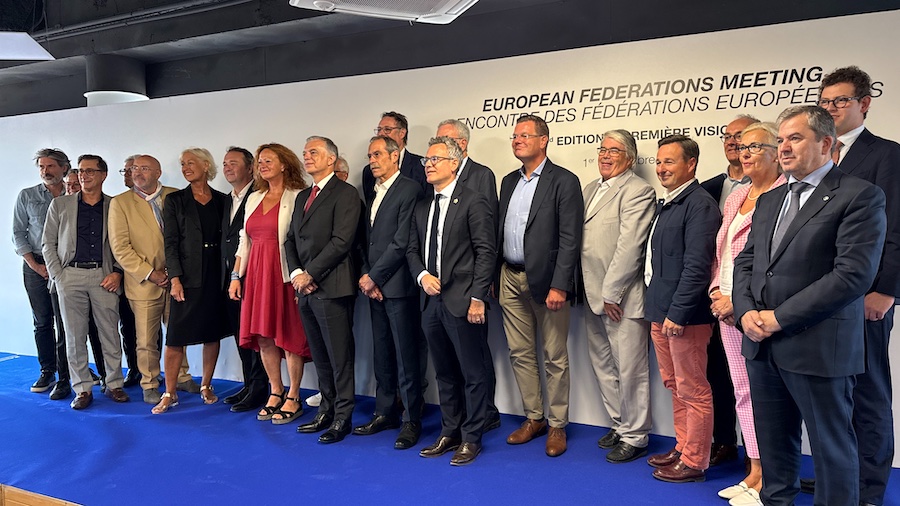
EURATEX, the European Apparel and Textile Confederation, welcomes today’s State of the Union Address by European Commission President, Ursula von der Leyen, and in particular her recognition of Europe’s need to rebalance unfair trade, cut red tape, and strengthen its industrial and strategic autonomy.

EURATEX now calls on the Commission and Member States to translate these commitments into concrete action for the textile and apparel value chain.

At the same time, EURATEX regrets that industrial competitiveness received comparatively limited attention in an otherwise wide-ranging address. The association urges the Commission to match today’s political commitments with an equal sense of urgency on industrial competitiveness, and to place manufacturing sectors, such as textiles, more firmly at the centre of its agenda in the months ahead.

"Europe cannot build a strong defence, lead the green and digital transitions, or protect its social model on a weakening industrial base. Competitiveness is not just one chapter of the European project – it is the foundation all the others are built on; when we get that right, everything else becomes possible,” states Dirk Vantyghem, Director General of EURATEX.

On trade, EURATEX shares the President’s assessment that the EU’s growing trade deficit with China – now standing at €1 billion a day – has reached a tipping point. The textile and apparel sector has been on the front line of this “second China shock” for years, and EURATEX calls on the Commission to move swiftly from dialogue to concrete trade-defence measures, including stronger customs enforcement and import monitoring for textile products.

EURATEX also welcomes the pledge to cut administrative burden and forge a “pact against gold-plating” with Member States. Textile companies, the vast majority of which are SMEs, are disproportionately affected by overlapping and often diverging national implementation of EU rules, and genuine simplification would meaningfully improve their competitiveness.

Looking ahead to the next Multiannual Financial Framework (MFF), EURATEX stresses the need for dedicated support for the textile industry, reflecting its role as a strategic manufacturing sector for Europe’s green, digital, and defence transitions, and ensuring the sector is not left without targeted instruments as EU funding priorities are reshaped.

EURATEX commends the President’s announcement of a new “European Instrument for Strategic Enablers” to strengthen European defence capabilities. Technical and defence-related textiles – from protective equipment and ballistic materials to smart textiles for soldier systems – are an integral part of Europe’s defence industrial base, and EURATEX says it stands ready to help ensure the sector is fully recognised in this effort.

On international partnerships, EURATEX notes with interest the President’s proposal to deepen the EU-Canada relationship through an “Alliance for the Future”. EURATEX has recently signed Memoranda of Understanding with its Canadian counterparts, the Canadian Textiles Industry Association (CTIA) and the Canadian Apparel Federation (CAF), and is well-placed to build on this cooperation as EU-Canada industrial ties are strengthened.

Finally, EURATEX supports the announcement of a new Mediterranean Youth Skills and Jobs initiative. The association is already active in this domain through its role in the Pact for Skills and has ongoing engagement across the Mediterranean region. EURATEX says it is ready to contribute its expertise to help ensure the initiative delivers meaningful opportunities for young people in the textile and apparel value chain.



More News from European Apparel and Textile Confederation (EURATEX)

#Europe

European textile industry calls for €10 handling fee on ultra-fast-fashion imports

The introduction of the €3 customs duty on low-value imports marks an important milestone in Europe’s efforts to address the challenges created by the rapid growth of ultra-fast-fashion imports. Together with the abolition of the €150 customs duty exemption, it demonstrates that policymakers are willing to act when market distortions become impossible to ignore. However, the European textile and clothing industry considers this a first step rather than the final destination.

#Associations

Towards pragmatic and harmonised labelling in the EU

EDANA, alongside 14 European associations, urges the European Commission and Member States to adopt a pragmatic approach for the future harmonised packaging labels, in line with the EU’s agenda for the EU Single Market, simplification and competitiveness. The system should rely on text-free pictograms, available in achromatic or monochromatic versions matching the packaging palette, with the possibility of using digital labelling as a core element. Our associations represent manufacturers of consumer goods across Europe.

#Associations

Textile PRO Forum calls for greater harmonisation of textile EPR systems across Europe

The Textile PRO Forum has published a new analysis highlighting the need for greater harmonisation of textile Extended Producer Responsibility systems across Europe. The document, Toward harmonised Textile EPR Systems in Europe: analysis and recommendations, presents the results of work carried out by Workstream 1 of the Textile PRO Forum, led by Dr. Eng. Viola Corbellini, Strategic Development and Innovation Expert at Erion Textiles, and Eng. Luca Campadello, General Director at Erion Textiles. The workstream focused on reducing administrative burden for textile producers by identifying areas where procedures could be better aligned across countries.

#Associations

Mario Jorge Machado re-elected President of EURATEX

The EURATEX General Assembly has re-elected Mario Jorge Machado as President of EURATEX, renewing its confidence in his leadership at a crucial moment for the European textile and clothing industry. The sector is facing rising costs, global competitive pressure and an increasingly challenging transition towards sustainability and digitalisation.

More News on Associations

#Raw Materials

Cotton Brazil Dialogues 2026 concludes with 50 international participants immersed in Brazilian cotton production

The Cotton Brazil Dialogues concludes its 2026 edition after a series of technical visits to farms, cotton gins and reference centers, as well as workshops focused on Brazilian cotton production. A total of 50 participants from 14 countries took part in the field trips. The initiative is led by the Brazilian Association of Cotton Growers (Abrapa) and the National Association of Cotton Exporters (Anea), with support from the Brazilian Trade and Investment Promotion Agency (ApexBrasil).

#Associations

Business situation weakens slightly, but the industry stays cautiously optimistic

The International Textile Manufacturers Federation (ITMF) has published the results of its 39th Global Textile Industry Survey (GTIS), conducted from 14 to 22 July 2026 among companies along the entire global textile value chain. Worldwide, 10% of participants rated their business situation as good, 53% as satisfactory and 37% as bad — a balance of -26pp, down from -17pp in May but still well above the 2023 lows. All regions are now in negative territory, from South Asia at -3pp to North & Central America at -58pp.

#Associations

IVGT membership: expertise that pays off

For energy-intensive textile companies, government compensation mechanisms are an important economic factor. The IVGT successfully supports its member companies in applying for state aid and thereby regularly contributes to significant financial relief.

#Associations

Italian textile machinery orders show quarterly recovery in Q2 2026

In the period between April and June 2026, order intake for Italian textile machinery manufacturers showed mixed but encouraging signals for the second half of the year. The order index at constant prices stood at 46.6 points (taking 2021=100 as the base year), showing a slight decrease of 3% compared to the same quarter of 2025. This trend was largely due to the contraction recorded in the domestic market, which fell by 25% compared to the corresponding period of the previous year.

Latest News

TOP



