[pageLogInLogOut]

#Associations

In March 2025 global textile industry struggled but kept resilient optimism

The International Textile Manufacturers Federation (ITMF), has released the results of its Global Textile Industry Survey (GTIS) for March 2025. This survey, conducted regularly across all key regions and segments of the textile value chain, revealed a complex picture of a deteriorated business situation, cautious optimism, regional divergence, and ongoing structural challenges.


Results of the 31st ITMF Global Textile Industry Survey

After a slow but steady recovery since November 2023, the global business situation in the textile industry has slightly deteriorated in March 2025. While East Asia and North & Central America reported modest improvements, they remain at rather low levels. Garment producers continued to show the most stable performance across the value chain. Despite the current challenges, expectations for the 4th quarter of 2025 remained positive. Optimism was highest in Africa and the Americas, while East Asia stood out with a more pessimistic outlook. Producers of garments, fibers, and finished fabrics were the most hopeful, in contrast to technical and home textiles, where expectations remained subdued.
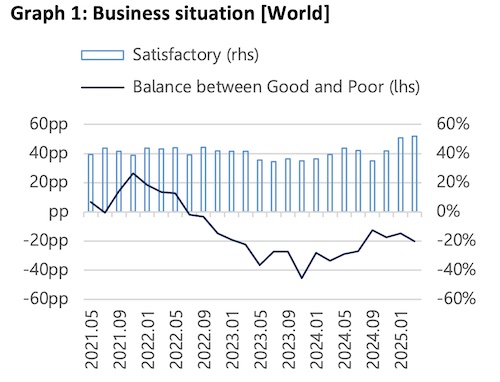
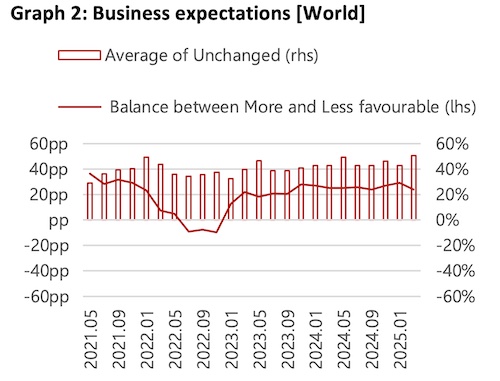
Source: 8th-31st ITMF Global Textile Industry Survey (31st: 17-26.03.2025) – last data point = March 2025 © 2025 ITMF


The prior recovery in order intake had also lost momentum, with declines in East Asia and Europe, while South-East Asia remained relatively stable. Garment producers continued to outperform other segments in maintaining order levels. Order backlogs slightly declined to a global average of 2.2 months, with Europe leading due to the strong presence of textile manufacturers. Capacity utilization held firm at 73%, driven by relatively higher rates in Asia. Meanwhile, textile inventories were showing signs of increases, led by yarn producers, while garment makers continued to keep stock levels low amid ongoing market caution.

The survey also revealed that concerns around demand and geopolitics were still growing. Weak demand remained the most pressing issue, cited by 62% of respondents, followed by geopolitical tensions (41%). Although worries over energy and raw material costs had slightly eased, concerns around interest rates and new sustainability regulations were on the rise.

For more information, please see www.itmf.org


More News from International Textile Manufacturers Federation (ITMF)

#Associations

Results of the 38th ITMF Global Textile Industry Survey

The global textile industry appears to be turning a corner, but this is more likely a fragile and possibly temporary improvement than the start of a durable recovery. According to the 38th ITMF Global Textile Industry Survey, conducted worldwide during the second half of May 2026, business sentiment, order intake, order backlogs and capacity utilization all improved versus March — yet every indicator remains weak by historical standards, and rising costs cast doubt on how long the upturn can last.

#Associations

Results of the 37th ITMF Global Textile Industry Survey

The International Textile Manufacturers Federation (ITMF) released findings from its 37th Global Textile Industry Survey (GTIS), conducted in March sharing how regions and segments are impacted by the latest geopolitical disruptions.

#Associations

Azerbaijan Textile Association (ATA) becomes member of ITMF

The Azerbaijan Textile Association (ATA) has officially become a Member Association of the International Textile Manufacturers Federation (ITMF), further strengthening Azerbaijan’s integration into the global textile value chain.

#Associations

SIMTA joins ITMF as Corporate Member

In the past two decades SIMTA has established itself as producer of specialized machinery for the textile industry. In short period of time, SIMTA became an important supplier of precise rollers for top OEMs. Afterwards SIMTA started manufacturing overhead cleaners, bobbin transport systems, and other textile ancillaries. In the meantime, SIMTA is a leader in this space in collaboration with the German automation technology partner Jacobi.

More News on Associations

#Associations

Sustainability: European industry calls on EU to keep Single-Use Plastics Directive unchanged

A broad coalition of European industry associations, including EDANA, Euratex and Plastics Europe, has urged EU institutions to maintain the current legal framework of the Single-Use Plastics Directive (SUPD). In a joint statement, the organisations argue that reopening the Directive at this stage would create legal uncertainty, increase regulatory complexity and undermine investment, while its implementation across the European Union is still incomplete.

#Associations

Textile machinery: Italian technology charts the course for revival

Operating in a scenario characterized by geopolitical instability, slowing industrial investments, and new protectionist pressures. This is the main challenge for the Italian textile machinery industry that emerged during the General Assembly of ACIMIT (Association of Italian Textile Machinery Manufacturers), held today in Milan at the Shareholders’ Hall of Palazzo Edison.

#Recycling / Circular Economy

New skills for a circular textile economy

Based on the results of a comprehensive analysis, the Erasmus+ project Skills4Circularity is developing three practical training modules covering recycling technologies, eco-design for the circular economy and sustainable manufacturing. The content of the first module, Recycling Technologies, has now been developed and validated together with industry representatives. The module provides participants with knowledge of regulatory requirements, material sorting and the preparation of textile waste for recycling.

#Associations

Bangladesh: Italian textile machinery mission stops in Dhaka and Chittagong

Technological upgrading and the transition toward higher value-added production are driving the new Italian industrial mission to Bangladesh. This year, the mission will split between the country’s two main manufacturing hubs, where Italian manufacturers will meet the leaders of the local textile supply chain in two strategic stages: July 7th in Dhaka and July 9th in Chittagong.

Latest News

#Dyeing, Drying, Finishing

Ferraro S.p.A. acquires the “Finishing” business unit of Cibitex S.r.l.

Ferraro S.p.A. and Cibitex S.r.l. are pleased to announce the completion of the agreement pursuant to which Ferraro S.p.A. has acquired the “Finishing” business unit of Cibitex S.r.l., specialized in the development and manufacturing of technological solutions for textile finishing.

#Recycling / Circular Economy

Reju opens its first R&D Center in the U.S. in Conshohocken, Pennsylvania

Reju, the company specializing in textile regeneration, today announced the opening of a Research and Development (R&D) Center in Conshohocken, Pennsylvania, the company's first proprietary research center in North America. Located within Technip Energies' existing Advanced Materials and Catalysts research center, the lab will allow Reju to accelerate the rollout of its recycling technologies and develop its next-generation circular solutions.

#Weaving

Itema reaffirms its commitment to the Syrian textile industry at NasTex 2026

From July 18th to 21st, Itema will exhibit at NasTex at the Damascus Fairground (Hall 11 – Stand C02), marking its return to one of the Middle East’s historically significant textile markets. Itema will showcase advanced weaving technology designed to support the competitiveness and technological evolution of Syrian manufacturers and announces a new partnership with Growfast Agency as the sole agent of Itema in Syria.

#Knitting & Hosiery

KARL MAYER's HKS 2-SE Expands Possibilities for Premium Stretch WARP KNITS

Warp knitted fabrics with a woven look are more in demand than ever in the fashion and apparel industries. Stretch WARP KNITS, in particular, impress with their freedom of movement, breathability, and virtually wrinkle-free wear – thereby opening up new style worlds such as smart casual or business casual. When it comes to the highly efficient production of premium-quality stretch WARP KNITS, the HKS 2-SE has long been the machine of choice. KARL MAYER’s best-selling tricot machine produces standard elastic fabrics characterized by high gauges, smooth, delicate surfaces, and a soft hand feel.

TOP