[pageLogInLogOut]

#Associations

The EU Textiles industry is highly concerned about the potential loss of competitiveness, caused by the EU’s inaction of the energy crisis, and Chinese and US subsidies to domestic industry
© 2022 EURATEX
Following yesterday’s European Council summit and its conclusions on the measures to tackle the energy crisis, the European textiles industry is extremely concerned about the fast loss of competitiveness of Europe and demands urgent action to save the industry.

The chain of factors determining this sharp decline in our competitiveness is twofold. First, the energy cost in Europe is more than 6 times higher than in the US, China, and neighbouring countries. This factor alone has almost erased the business case for producing in the EU. At present, many textiles and clothing companies are producing at net loss or have shut down production. The industrial conditions have worsened in such a way that there is no business case to invest in Europe or buy products produced or processed in the EU. It is only the sense of responsibility of our entrepreneurs towards the European society that is keeping the plants and production running.

Secondly, while the EU is passive and extremely slow in articulating a credible and effective response to the energy crisis, our main international competitors and trade partners (China, India and the US respectively) have developed comprehensive state-aid frameworks for their domestic industry despite not being affected by this crisis at all. The latest example is the 369-billion-dollar scheme of the Inflation Reduction Act rolled out by the Biden administration.


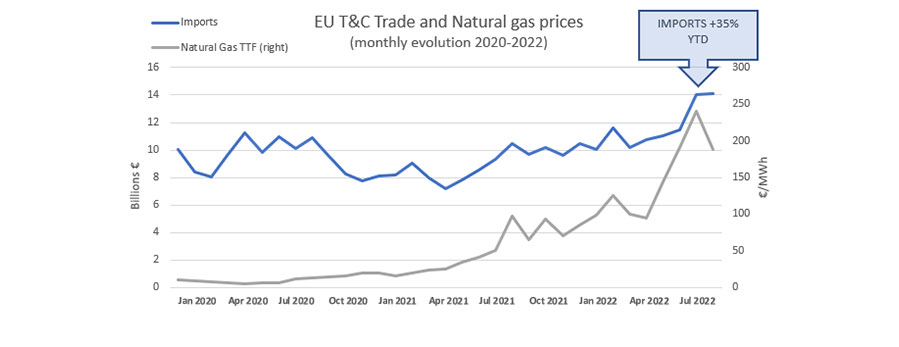
Recent trade data[1] already indicate a loss of global competitiveness: imports to the EU have grown tremendously in 2022 (+35% year-to-date). It is also evident that the surge in imports goes in parallel with the surge of natural gas price. It is expected that energy prices will remain high and volatile, opening the door for imports to gain substantial market shares in the EU.



More News from European Apparel and Textile Confederation (EURATEX)

#Associations

Europe is losing its textile industry

EURATEX has released its latest Economic Update on the performance of the European textile and apparel industry in 2025. For the third consecutive year, the sector recorded negative results across all key indicators — production, turnover and employment — confirming a continued erosion of competitiveness across Europe.

#Associations

European Business Coalition welcomes provisional application of EU–Mercosur Agreement and calls for Swift and full implementation

With the European Commission’s decision to provisionally apply the EU–Mercosur Interim Trade Agreement, a process spanning more than 25 years now moves decisively into its implementation phase.

#Europe

Antwerp Declaration community urges EU leaders to deliver emergency measures as Europe’s competitiveness crisis deepens

EURATEX, representing the European textile and fashion industry, joins the Antwerp Declaration Community’s call on EU Heads of State and Government to adopt emergency measures that restore industrial competitiveness and deliver tangible results for Europe’s manufacturing base in 2026.

#Europe

FITA, ABIT and EURATEX underline strategic importance of Mercosur – EU Partnership Agreement for the textile and apparel industry

The Argentine Textile Industry Federation (FITA), the Brazilian Textile and Apparel Industry Association (ABIT), and the European Apparel and Textile Confederation (EURATEX) continue to monitor the process of internalizing the Mercosur-European Union Partnership Agreement. This agreement is essential for the competitiveness of our industries, on both sides of the Atlantic.

More News on Associations

#Associations

BTMA backs global growth while investing in future UK leaders

As one of a number of new initiatives launched this year, the British Textile Machinery Association (BTMA) is launching the UK-India Textile Machinery Coalition. The UK-India Free Trade Agreement, signed in July 2025, has implications that extend across sourcing, competitiveness and long-term trade dynamics, believes BTMA CEO Jason Kent.

#Raw Materials

China projected to increase cotton production, yields, and imports in 2026/27

World cotton production in the 2026/27 season is projected at 25.9 million tonnes, exceeding global consumption of 25.2 million tonnes, according to the May 2026 issue of Cotton This Month. That means both production and consumption are expected to remain close to current season levels, while global cotton trade is projected to decline by 2.7% to approximately 9.6-9.7 million tonnes.

#Techtextil 2026

VDMA members at Techtextil: Smart technologies for technical textiles

At Techtextil 2026 in Frankfurt, the members of VDMA Textile Machinery underline their key role as global technology leaders for technical textiles and textile processing. With a strong presence of more than 50 members they will highlight how engineering excellence, innovation strength and sustainability expertise from Germany and Europe are shaping the future of the textile industry. Seven companies will be present at the VDMA group stand in the centre of hall 12.0.

#Techtextil 2026

Between geopolitical pressure and industrial resilience

In this interview, Dr. Janpeter Horn (VDMA) discusses the current challenges facing textile machinery manufacturers, shaped by geopolitical tensions, regulatory developments and subdued investment. He also outlines why innovation strength, integrated solutions and strategic positioning remain key to global competitiveness.

Latest News

#Raw Materials

ICAC launches Carbon Credits Initiative to deliver new income streams to cotton farmers

The International Cotton Advisory Committee (ICAC) has announced a new initiative designed to unlock additional income streams for cotton farmers through participation in carbon credit markets, linking sustainable production practices directly to financial returns.

#Sustainability

Number of GOTS-certified facilities grow 15% globally as demand for credible sustainability standards continues to strengthen

Global Organic Textile Standard (GOTS) certification continued to grow in 2025, with nearly 18,000 certified facilities worldwide, despite ongoing geopolitical uncertainty and rapidly evolving regulatory requirements across global textile supply chains.

#Raw Materials

ECCO introduces first shoe featuring innovative protein-based fibre

ECCO, in partnership with Spinnova, announces the launch of the limited edition ECCO BIOM® 720, a first-of-its-kind shoe utilising an often overlooked leather by-product, transformed into a protein-based fibre. The fibres are produced using patented technology that advances material innovation while reducing waste and supporting full resource use across the leather and textile industry.

#Man-Made Fibers

The LYCRA Company strengthens sustainability leadership, appoints Alistair Williamson as VP of Product Sustainability

The LYCRA Company has appointed longtime executive Alistair Williamson as vice president of product sustainability, reaffirming its commitment to developing sustainable solutions for apparel and personal care products. In this role, he will guide the company’s next chapter of sustainability strategy and oversee all initiatives aimed at reducing environmental impact across products, operations, and innovation platforms.

TOP