[pageLogInLogOut]

#Associations

Results of the 15th ITMF Corona-Survey
© 2022 ITMF
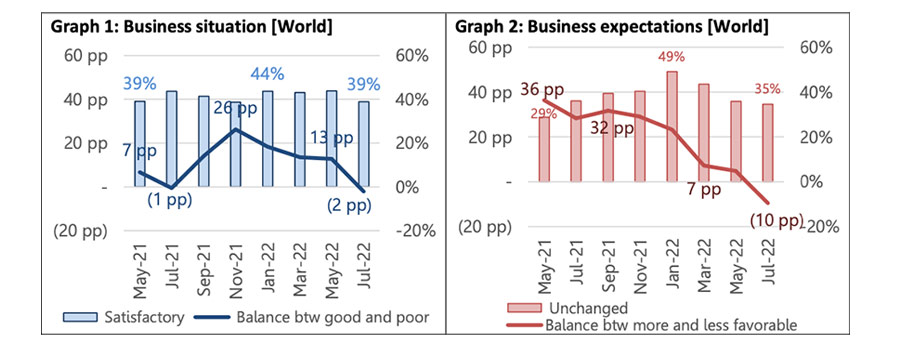
The 15th ITMF Corona-Survey shows that the business situation plunged into negative territory in July 2022. The business situation is worse in Asia than in the rest of the world. Textile machinery is the only segment still in positive territory. Business expectations have also turned negative for the first time since the start of survey in May 2021. South-East Asia and South America are relatively more optimistic, downstream segments as well.

Business situation and expectation have turned negative.

Order intake is weakening globally but is still in positive territory. Here too, expectations have turned negative in all textile segments except for textile machinery producers. A difficult period is to be expected ahead. Order intake is deteriorating in all Asian regions and stable in North America, South America, and Africa.

Order backlog has been slightly decreasing in the past few months, from a maximum of 3.1 months in March 2022 to 2.9 months in July. It is expected to continue falling until March 2023. Capacity utilization rate has been stagnating since the beginning of 2022, on average. This indicator is rising in Africa and North and Central America. South Asia reports a strong decrease in capacity utilization, so do fibre and home textile producers as well as spinners.


While high prices for raw materials, energy, and logistics are still regarded as major supply side concerns, they have somewhat eased compared to May 2022. The prospects of weakening demand caused by surging inflation are worrisome.

For more information, please see http://www.itmf.org or contact secretariat@itmf.org.


More News from International Textile Manufacturers Federation (ITMF)

#Associations

Data and skills, not algorithms, hold back AI adoption in textiles, finds ITMF and ITA white paper

The International Textile Manufacturers Federation (ITMF) and the Institut für Textiltechnik of RWTH Aachen University (ITA) have published a new white paper entitled AI in the Textile Value Chain: A Strategic Guide to Artificial Intelligence for the Global Textile Industry. The study concludes that the main barriers to artificial intelligence adoption in the textile and apparel industry are not technological limitations, but poor data integration, skills shortages and gaps in governance. According to the authors, further progress will depend on coordinated efforts to develop capabilities across the industry.

#Associations

ITMF survey shows slight improvement in global textile industry despite continued pressure

The 40th ITMF Global Textile Industry Survey (GTIS), conducted from 21 to 29 September 2026, shows a slight improvement in the global business situation, to -23pp, well above the November 2023 low of -46pp. Conditions nevertheless remain weak, in what has become a new normal of high uncertainty. Only South Asia (+13pp) and Africa (+9pp) are positive, while Europe (-36pp), South America (-44pp) and North & Central America (-56pp) report the weakest conditions.

#Associations

ITMF names three winners of the Sustainability & Innovation Award 2026

Three projects from the UK, Korea and China have been selected as winners of the ITMF Sustainability & Innovation Award 2026. The projects address textile-to-textile recycling, chemical recycling for automotive textiles and a regenerative approach combining silk production with ecological restoration.

#Associations

ITMF names five winners of the Start-up Award 2026

Five start-ups from Switzerland, Brazil, the United States and China have been selected as winners of the ITMF Start-up Award 2026. Their concepts range from new polymer chemistry and natural-fiber biocomposites to zero-waste design, 3D weaving and enzymatic PET recycling.

More News on Associations

#Associations

China and India: Different market dynamics create opportunities for Swiss textile machinery

Ahead of ITMA Asia + CITME in Shanghai and India ITME in Greater Noida, Swiss Textile Machinery highlights the contrasting industrial structures, investment priorities and technological requirements of two of the world's most important textile manufacturing markets.

#Associations

European and Canadian textile associations call for stronger transatlantic cooperation

Ahead of the EU–Canada Summit in Montréal on 29–30 October 2026, EURATEX, the Canadian Textile Industry Association (CTIA) and the Canadian Apparel Federation (CAF) have issued a joint statement calling for closer industrial cooperation, improved implementation of the CETA trade agreement and stronger partnerships in innovation, sustainability and advanced textile technologies.

#Associations

Italian textile machinery orders rise 7% in Q3 2026 as export demand strengthens

Order intake for Italian textile machinery manufacturers increased by 7% in the third quarter of 2026 compared with the same period of 2025. Growth was driven by international markets, where orders rose by 8%, while domestic demand remained weak, declining by 4%.

#Associations

EU and Mercosur textile industries launch new Textile and Apparel Dialogue

EURATEX, ABIT and FITA have launched the EU–Mercosur Textile and Apparel Dialogue (TAD), a new industry platform aimed at strengthening cooperation between the European and Mercosur textile and apparel sectors.

Latest News

#Spinning

Georg Stausberg, a veteran of the textile machinery industry, takes over as Rieter Group CEO

Georg Stausberg, one of the most experienced executives in the international textile machinery industry, has been appointed Chief Executive Officer of the Rieter Group with immediate effect from 4 November 2026. With more than three decades of industry experience and a long-standing leadership career at Barmag, Stausberg brings extensive technological expertise, international market knowledge and an established network across the global textile industry to his new position.

#Industry 4.0 / Digitalization

Jeanologia and BCome connect factory data with Life Cycle Assessment and Digital Product Passports

A new white paper by EIM by Jeanologia and BCome demonstrates how primary environmental data from denim finishing processes can be integrated into a garment's Life Cycle Assessment (LCA) and prepared for use in a Digital Product Passport (DPP). A comparative case study highlights significant improvements at the production stage while also showing how these translate into the environmental performance of the finished garment.

#Denim

Inside the Making connects denim and sportswear supply chains at Ecomondo 2026

Six European companies are joining forces at Ecomondo 2026 in Rimini to demonstrate how different stages of denim and sportswear production are interconnected. The new initiative, Inside the Making, highlights the importance of cooperation across the textile supply chain in addressing sustainability challenges, from reducing resource consumption to improving transparency and the reliability of environmental claims.

#Nonwovens

EDANA welcomes definitive EU anti-dumping measures on Chinese PET spunbond

EDANA, the international association serving the nonwovens and related industries, has welcomed the European Commission's decision to impose definitive anti-dumping duties on imports of PET spunbond originating in China. The association considers the measures an important step towards restoring fair competition and safeguarding European industrial capacity.

TOP