[pageLogInLogOut]

#Associations

Italian textile machinery: Sharp rebound in orders intake for second quarter 2021
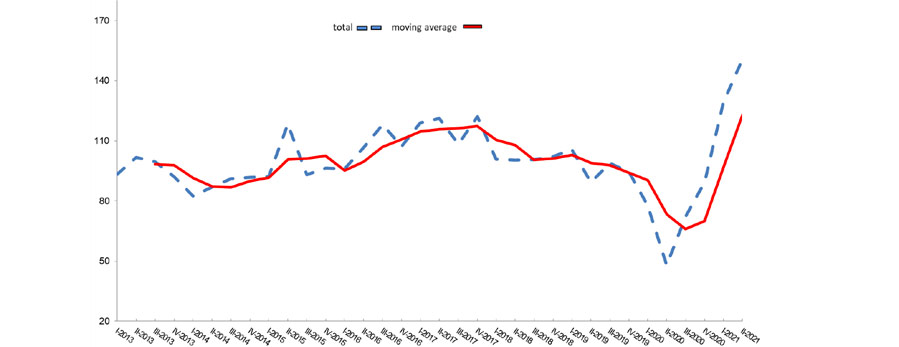
Italian textile machinery - The index of orders intake at constant value (Bases 2015=100) © 2021 ACIMIT
The index of orders intake for Italian textile machinery, as processed by ACIMIT, the Association of Italian textile machinery manufacturers, for the period ranging from April-June 2021, was up 214% compared to the same 2020 period. The value of the index was attested at 150.7 points (basis: 2015 = 100), a result that was no doubt influenced by the comparison with a quarter, from April-June 2020, in which orders were obviously at a minimum, due to the Covid-19 pandemic.

An analysis of the index of orders intake for the first six months of 2021 confirms a clearly positive business dynamic for Italian manufacturers. An overall growth rate of 122% compared to the first half of 2020 regarded both the domestic and export markets.

Alessandro Zucchi, president di ACIMIT, comments: "The data are certainly positive, bearing witness to a renewed climate of confidence.” On the domestic market, in addition to a physiological rebound following the collapse in 2020, the boost generated by 4.0 incentives is being felt. "The push towards digitalization in the business sector,” adds Zucchi, “is being perceived as creating a competitive edge for the entire textile industry, especially here in Italy.”

In spite of these encouraging signals, a sense of uncertainty persists nonetheless on the actual solidity of this recovery. “There is no lack of obstacles facing our machinery producers during this phase,” states ACIMIT’s president.

“The sharp rise in the price of raw materials does not seem to be stopping, to which we can add the limited availability of components, making it difficult for our manufacturers to fulfil the many orders they’ve received. Finally, the limitations imposed on the business travels of our staff persist, above all qualified assembly technicians.”

These are all issues that affect the sector's order forecasts for the third quarter of 2021. To this end, ACIMIT’s survey have revealed a substantial stability compared to the previous three months for domestic orders (as expressed by 59% of companies), and a prevailing caution also abroad, where forecasts of stable or decreasing orders make up 74% of the answers given by Italian companies in the sector.


More News from Associazione Costruttori Italiani di Macchinario per l Industria Tessile (ACIMIT)

#Associations

Mongolia: Workshop on Italian textile technologies kicks off in Ulaanbaatar

The workshop dedicated to Italian textile technologies will kick off in Ulaanbaatar from 21 to 23 June 2026. Focused on the most advanced innovative solutions for the textile industry, the initiative will bring together 13 Italian textile machinery manufacturers, confirming the growing interest in strengthening industrial cooperation between the two countries and highlighting Mongolia’s strategic importance for Italian textile machinery producers.

#Associations

Turkmenistan: Italian textile machinery focuses on high technology and specialization

The Italian textile machinery industry flies to Ashgabat to participate with a large “Made in Italy” delegation at TURKMEN TEXTILE EXPO 2026, the major international showcase taking place from June 4 to 6, 2026. The Italian presence, coordinated by the Italian Trade Agency (ICE) and ACIMIT (the Association of Italian Textile Machinery Manufacturers), aims to consolidate Italy’s primary technological role in a highly strategic market with interesting prospects.

#Associations

Egypt: Workshop on Italian textile technologies concludes

The workshop dedicated to Italian technologies for the textile industry, held in Cairo on May 5–6, 2026 and focusing on the most advanced innovative solutions for the sector, has come to a close.

#Associations

Italian textile machinery sector faces weak start to 2026 despite domestic growth

In the first quarter of 2026, order intake for Italian textile machinery manufacturers recorded a decrease of 5% compared to the same period in 2025, reflecting a still challenging start to the year. The decline affected foreign markets (-7%), while the domestic market showed growth (+21%).

More News on Associations

#Associations

Towards pragmatic and harmonised labelling in the EU

EDANA, alongside 14 European associations, urges the European Commission and Member States to adopt a pragmatic approach for the future harmonised packaging labels, in line with the EU’s agenda for the EU Single Market, simplification and competitiveness. The system should rely on text-free pictograms, available in achromatic or monochromatic versions matching the packaging palette, with the possibility of using digital labelling as a core element. Our associations represent manufacturers of consumer goods across Europe.

#Associations

Textile PRO Forum calls for greater harmonisation of textile EPR systems across Europe

The Textile PRO Forum has published a new analysis highlighting the need for greater harmonisation of textile Extended Producer Responsibility systems across Europe. The document, Toward harmonised Textile EPR Systems in Europe: analysis and recommendations, presents the results of work carried out by Workstream 1 of the Textile PRO Forum, led by Dr. Eng. Viola Corbellini, Strategic Development and Innovation Expert at Erion Textiles, and Eng. Luca Campadello, General Director at Erion Textiles. The workstream focused on reducing administrative burden for textile producers by identifying areas where procedures could be better aligned across countries.

#Associations

Mario Jorge Machado re-elected President of EURATEX

The EURATEX General Assembly has re-elected Mario Jorge Machado as President of EURATEX, renewing its confidence in his leadership at a crucial moment for the European textile and clothing industry. The sector is facing rising costs, global competitive pressure and an increasingly challenging transition towards sustainability and digitalisation.

#Associations

Keeping products moving with Swedish automation at FILTECH 2026

At FILTECH 2026, taking place in Cologne from June 30th to July 2nd, members of TMAS – the Swedish textile machinery association – will highlight how the country’s engineering expertise is enabling filtration manufacturers to increase productivity, improve traceability and reduce dependence on labour-intensive manual processes.

Latest News

#Natural Fibers

Bremen Cotton Exchange: Fritz A. Grobien re-elected as President

The members of the Bremen Cotton Exchange have re-elected Fritz A. Grobien as President during the association’s 152nd General Assembly on June 18, 2026. The election confirms the organization’s commitment to maintaining its role as a leading international platform for the cotton and fiber industry amid a period of geopolitical and economic uncertainty.

#Natural Fibers

Organic cotton at the crossroads: Ideology, evidence, and the road ahead

Organic cotton occupies one of the most contentious spaces in global agriculture. While praised by brands and consumers for its environmental ideals, it also faces persistent questions about yield stability, certification integrity, and scalability. The current edition of The ICAC Recorder cuts through the ideology to deliver a rigorous, evidence-based assessment of both sides of the debate.

#Spinning

New spinning package with two-step filtration for recycled yarns and more

At the ITM in Istanbul, BB Engineering unveiled its new, patented ValuePack spinning package for the first time, which features a two-stage filtration system. This is particularly beneficial for re-cycling processes. Until now, spinning packs have used either metal powder (“sand”) or filter candles as filter media. Both options are suitable for differ-ent applications, and each has its own specific advantages and dis-advantages.

#ITMA 2027

ITMA 2027 gains strong momentum

In line with the theme "Co-creating the future of textiles", ITMA continues to strengthen its support for start-ups, recognising their role in driving innovation and shaping the future of textile and garment manufacturing. Through the Start-Up Valley, emerging companies gain access to a global marketplace where they can connect with industry leaders, potential partners, investors and customers.

TOP