[pageLogInLogOut]

#Associations

COVID-19 outbreak may cause a 50% drop in sales and production for the European textile and clothing sector
(c) 2020 Euratex
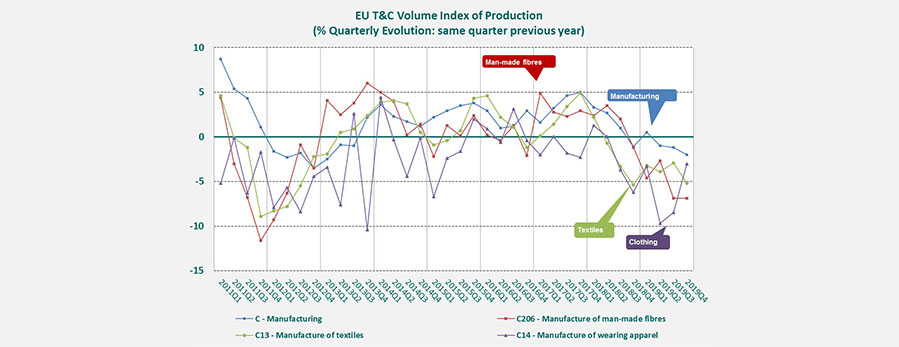
Recent Eurostat data show that the European textile and clothing manufacturing went through a difficult year in 2019, despite good retail sales and export performances. This trend will worsen in 2020 due to the coronavirus outbreak. An ongoing EURATEX poll with its members shows that 80% of companies are already laying off workers; more than half of them expect a drop in sales and production by over 50%, creating serious financial constraints.

Data for 2019 show an economic slowdown in Europe, with manufacturing remaining under pressure from Brexit and trade frictions. Figures for the textile and clothing (T&C) industry are in line with that general situation: employment declined with over 2%, , and the EU27 turnover evolution turned negative for the first time since 2012-2013 with a -2% setback for textiles, and a -1.3% for clothing, compared to 2018.

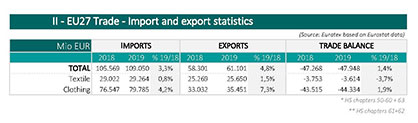
However, some positive signs are still coming from the retail sales and trade. The growth rate in the retail sales of textiles, clothing, footwear and leather goods in specialised stores remained positive in 2019 (+0.9%).. In addition, EU27 trade is now exceeding €170 bn, a +4% increase compared to the previous year. Exports grew at a higher pace than imports.

The outlook for 2020 is expected to worsen due to the coronavirus’ outbreak, as in March 2020 industry confidence fell dramatically. EURATEX is conducting a survey among European companies: preliminary results indicate that more than half of the companies expect a drop in sales and production by more than 50%. Moreover, almost 9 out of 10 companies face serious constraints on their financial situation and 80% of companies is temporarily laying off workers. 1 out of 4 is considering closing down the company.

(c) 2020 Euratex
(c) 2020 Euratex


EURATEX, as representative of the textile and clothing sector, is concerned about the crisis and the pressure on the functioning of the internal market. Border controls within the EU have increased sharply, leading to delays in supplies but also cancelling of orders, thus aggravating the economic impact. Many companies in the T&C sector work under strong global pressure, with limited absorption capacity for such a crisis, and this survey shows that measures need to be taken immediately. EURATEX already asked the European Commission to foresee fiscal and financial relieve, ensure a coherent approach across EU Member States and avoid limitations to the free movement of goods and of the workforce.

Director General Dirk Vantyghem commented: “The EU and its Member States must do all it takes to save our industry. At the same time, this crisis is an opportunity to develop a new blueprint for our sector; the Commission’s new EU Industrial Strategy can offer a basis for rethinking our business model.”

(c) 2020 Euratex
(c) 2020 Euratex


More News from European Apparel and Textile Confederation (EURATEX)

#Associations

Europe is losing its textile industry

EURATEX has released its latest Economic Update on the performance of the European textile and apparel industry in 2025. For the third consecutive year, the sector recorded negative results across all key indicators — production, turnover and employment — confirming a continued erosion of competitiveness across Europe.

#Associations

European Business Coalition welcomes provisional application of EU–Mercosur Agreement and calls for Swift and full implementation

With the European Commission’s decision to provisionally apply the EU–Mercosur Interim Trade Agreement, a process spanning more than 25 years now moves decisively into its implementation phase.

#Europe

Antwerp Declaration community urges EU leaders to deliver emergency measures as Europe’s competitiveness crisis deepens

EURATEX, representing the European textile and fashion industry, joins the Antwerp Declaration Community’s call on EU Heads of State and Government to adopt emergency measures that restore industrial competitiveness and deliver tangible results for Europe’s manufacturing base in 2026.

#Europe

FITA, ABIT and EURATEX underline strategic importance of Mercosur – EU Partnership Agreement for the textile and apparel industry

The Argentine Textile Industry Federation (FITA), the Brazilian Textile and Apparel Industry Association (ABIT), and the European Apparel and Textile Confederation (EURATEX) continue to monitor the process of internalizing the Mercosur-European Union Partnership Agreement. This agreement is essential for the competitiveness of our industries, on both sides of the Atlantic.

More News on Associations

#Associations

BTMA backs global growth while investing in future UK leaders

As one of a number of new initiatives launched this year, the British Textile Machinery Association (BTMA) is launching the UK-India Textile Machinery Coalition. The UK-India Free Trade Agreement, signed in July 2025, has implications that extend across sourcing, competitiveness and long-term trade dynamics, believes BTMA CEO Jason Kent.

#Raw Materials

China projected to increase cotton production, yields, and imports in 2026/27

World cotton production in the 2026/27 season is projected at 25.9 million tonnes, exceeding global consumption of 25.2 million tonnes, according to the May 2026 issue of Cotton This Month. That means both production and consumption are expected to remain close to current season levels, while global cotton trade is projected to decline by 2.7% to approximately 9.6-9.7 million tonnes.

#Techtextil 2026

VDMA members at Techtextil: Smart technologies for technical textiles

At Techtextil 2026 in Frankfurt, the members of VDMA Textile Machinery underline their key role as global technology leaders for technical textiles and textile processing. With a strong presence of more than 50 members they will highlight how engineering excellence, innovation strength and sustainability expertise from Germany and Europe are shaping the future of the textile industry. Seven companies will be present at the VDMA group stand in the centre of hall 12.0.

#Techtextil 2026

Between geopolitical pressure and industrial resilience

In this interview, Dr. Janpeter Horn (VDMA) discusses the current challenges facing textile machinery manufacturers, shaped by geopolitical tensions, regulatory developments and subdued investment. He also outlines why innovation strength, integrated solutions and strategic positioning remain key to global competitiveness.

Latest News

#Digital Printing

Kornit Digital launches Konnections 365

Kornit Digital (NASDAQ: KRNT) (“Kornit” or the “Company”), a global pioneer in sustainable, on-demand digital fashion and textile production today announced the launch of Konnections 365 - a year-round movement designed for the people moving the apparel, print, and retail industries forward. The strategy is built on the overwhelming success of Konnections 2026 held in Hollywood, Florida, featuring more than 500 customers, partners, and collaborators who together are driving the future of apparel and textiles.

#Techtextil 2026

Techtextil 2026: KARL MAYER impresses as an innovative sector partner

KARL MAYER looks back with satisfaction on its participation in Techtextil 2026. From April 21 to 24, the international industry leader used the trade show in Frankfurt to meet with numerous key customers at its booth and, at the same time, establish many new contacts. Most visitors came from Germany, followed by major markets such as Poland, the United Kingdom, Turkey, France, and Portugal.

#Raw Materials

ICAC launches Carbon Credits Initiative to deliver new income streams to cotton farmers

The International Cotton Advisory Committee (ICAC) has announced a new initiative designed to unlock additional income streams for cotton farmers through participation in carbon credit markets, linking sustainable production practices directly to financial returns.

#Sustainability

Number of GOTS-certified facilities grow 15% globally as demand for credible sustainability standards continues to strengthen

Global Organic Textile Standard (GOTS) certification continued to grow in 2025, with nearly 18,000 certified facilities worldwide, despite ongoing geopolitical uncertainty and rapidly evolving regulatory requirements across global textile supply chains.

TOP