[pageLogInLogOut]

#Yarn & Fiber

Five wool trends for 2023

What’s on the wool horizon for 2023? Wool’s natural versatility means there is always something new on the market, while sheep have stepped up in perhaps surprising ways to meet our collective need for more sustainable, earth-friendly practices.

From farm to fashion, take a peek at five wool/sheep trends for the new year.
© IWTO
© IWTO


Five Wool Trends for 2023

1. Regenerative Farming

Case studies confirm: improving the natural capital of farms through holistic management pays off.

This article in Suston magazine shares recent case studies from Australia, Uruguay and South Africa showing how the wool industry’s emissions reductions, regenerative practices and community-building are helping to build a more resilient world.

Through regenerative land management practices, wool farms are sequestering carbon and improving biodiversity. Equally, community wool farming projects are empowering subsistence farmers to create new livelihoods along with healthier ecosystems.

Photo: Landbou Weekblad


2. Hand Knitting

During lockdown, many young people turned to knitting as an outlet for creativity.

This trend shows no sign up letting up!

“Custom-made and sustainable, this past-time is indicative of two larger trends of Generation Z,” says a recent Vogue magazine article. “What’s more, upcycling and self-made clothing folds into the sense of environmental awareness and social consciousness that also dictates the generation’s buying decisions.”

© IWTO
© IWTO


3. The Power of Grazing

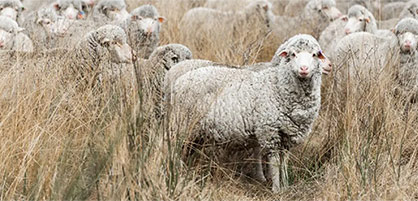
From wind and solar farms to the ruins of Pompeii, sheep are the latest trend in landscaping.

In the case of Pompeii, Gabriel Zuchtriegel, the park’s director, told The New York Times that he came up with the idea of bringing in the sheep after seeing them maintain the land on top of dikes in the North Sea.

The Pompeii sheep chomp down invasive vegetation, destructive roots and wild terrains that could lead to the city’s reburial under landslides.

© IWTO
© IWTO


4. The Knitted Suit

The next stage in suit evolution is a fully knitted Merino wool-blend suit.

The Woolmark Company worked closely with fashion giant BOSS and STOLL (a leader in flat-knitting machine technology), using yarns from Südwolle Group, to develop this game-changing innovation.

The suit was knitted in Germany before being made in Italy. BOSS launched the suit in their global flagship stores late in 2022 and quickly sold out.

© BOSS
© BOSS


5. The Difference Wool Makes

People are discovering what synthetic fibres are made from, and the difference they can make when they choose wool.

In September 2022, AWI’s marketing arm The Woolmark Company launched a powerful marketing campaign highlighting to consumers that synthetic fibres are made from oil, whereas wool is a 100% natural, renewable and biodegradable fibre.

The global campaign features a series of powerful images showing people struggling to escape from an oil-filled swimming pool, symbolizing the fact that every 25 minutes, an Olympic pool’s worth of crude oil is used to produce more synthetic clothing (amounting to almost 350 million barrels a year).


© The Woolmark Company


More News from TEXDATA International

#ITM 2026

ITM 2026: The new geography of textile production

New production hubs are emerging across North Africa and Central Asia, while Türkiye is accelerating its transformation toward higher-value, technology-driven and more sustainable textile manufacturing.

#Research & Development

“Production is a product”

From technical textiles and AI-driven robotics to the limitations of textile circularity: Professor Dr Thomas Gries looks back on more than two decades of development at ITA Aachen. In the interview, he explains why production technology remains a decisive success factor, discusses international collaborations and innovation ecosystems, and shares his views on the transformation of production landscapes and the challenges facing an increasingly regulated industry.

#Knitting & Hosiery

“We need to move away from the price trap and return to a value-driven mindset.”

With its new Textile Innovation Center, KARL MAYER is sending a strong signal for innovation, collaboration, and the future of textile applications. In this interview, Karl Josef Mayer discusses new opportunities in warp knitting, the processing of staple fibres, recycling, the changing role of machinery manufacturers, and why the textile industry must once again focus more strongly on the value of textiles. by Oliver Schmidt

#Associations

“Innovation, resilience and international experience remain the great strengths of the Swiss textile machinery industry”

Geopolitical uncertainty, growing competitive pressure from China, new free trade agreements and the shift towards a circular economy are currently reshaping the global textile industry. In this interview, Cornelia Buchwalder discusses the current mood within the Swiss textile machinery sector, the industry’s distinctive innovative strength, new market opportunities in India and Asia, and the technological trends that could shape the upcoming trade fair cycle leading up to ITMA 2027.

More News on Yarn & Fiber

#Recycling / Circular Economy

The textile industry in transition

Recycling, traceability, eco-design and digitalisation are among the key future challenges facing the European textile industry. The Erasmus+ project Skills4Circularity, involving 21 partners from twelve countries, is investigating the skills required to address these challenges. As the German industry partner, the Industry Association for Finishing – Yarns – Fabrics – Technical Textiles (IVGT) is bringing the industry’s perspective to the project.

#Research & Development

GenuTrace client advisory: Is your cotton supply chain UFLPA ready?

U.S. Customs and Border Protection has released updated operational guidance (CBP Publication No. 5560-0526) expanding its forced labor enforcement framework. The guidance supersedes the original 2022 UFLPA Operational Guidance and now covers all forced labor enforcement authorities — UFLPA, CAATSA, and WROs/Findings — in a single unified document. For cotton importers, the enforcement posture has not softened. It has become more structured, more documented, and more demanding. Learn more about UFLPA.

#Spinning

"We will become a recycling powerhouse"

The textile industry is now in its fourth consecutive year of crisis, while automation, artificial intelligence and recycling are reshaping the rules of the game. In this interview, Rieter CEO Thomas Oetterli discusses the first signs of a market recovery, reflects on his first three years at the helm of the company, explains the integration of Barmag, outlines Rieter’s vision of the fully automated spinning mill and highlights the strategic importance of recycling. In doing so, he explains why the new Rieter Group aims to play a leading role in transforming the textile value chain into a circular economy.

#Man-Made Fibers

ROICA™ launches new global brand identity and digital experience

ROICA™, the premium stretch fiber developed by Asahi Kasei, today announced the launch of its new global brand identity, including a new key visual and a fully redesigned website. This milestone initiative marks the beginning of a new phase in ROICA™’s evolution as a global brand.

Latest News

#Spinning

New spinning package with two-step filtration for recycled yarns and more

At the ITM in Istanbul, BB Engineering unveiled its new, patented ValuePack spinning package for the first time, which features a two-stage filtration system. This is particularly beneficial for re-cycling processes. Until now, spinning packs have used either metal powder (“sand”) or filter candles as filter media. Both options are suitable for differ-ent applications, and each has its own specific advantages and dis-advantages.

#ITMA 2027

ITMA 2027 gains strong momentum

In line with the theme "Co-creating the future of textiles", ITMA continues to strengthen its support for start-ups, recognising their role in driving innovation and shaping the future of textile and garment manufacturing. Through the Start-Up Valley, emerging companies gain access to a global marketplace where they can connect with industry leaders, potential partners, investors and customers.

#ITM 2026

Positive market signals for KARL MAYER at ITM 2026

KARL MAYER is pleased with its participation as an exhibitor at ITM 2026. Faced with the challenges of rising domestic costs and fierce competition from low-priced Asian markets, the industry leader had traveled to Istanbul with mixed feelings – yet still draws a really positive conclusion.

#Associations

Mongolia: Workshop on Italian textile technologies kicks off in Ulaanbaatar

The workshop dedicated to Italian textile technologies will kick off in Ulaanbaatar from 21 to 23 June 2026. Focused on the most advanced innovative solutions for the textile industry, the initiative will bring together 13 Italian textile machinery manufacturers, confirming the growing interest in strengthening industrial cooperation between the two countries and highlighting Mongolia’s strategic importance for Italian textile machinery producers.

TOP