[pageLogInLogOut]
CONNECTED BY NARROW FABRICS.

#Weaving

Data-based success for fabric manufacturers

© 2022 Uster
Producing quality fabrics is much easier with automated inspection. Uster EVS Fabriq Vision gathers quality data and presents it in an album, which is used to certify the quality of each fabric roll, with total traceability. It combines quality assurance and process optimization – automatically – in a solution which is already popular in technical textiles.

Automated fabric inspection delivers quality and optimization along the process chain

In a survey, customers reported that data from the Uster fabric inspection system was useful in quality assessment of the final product, as well as reports for customers. Traceability data was viewed as a particularly strong point for customers serving the automotive industry. Suppliers to this sector, and to other sensitive applications, value Uster EVS Fabriq Vision as a solution which meets the high standards of traceability, they need throughout the production chain.

Smooth and fast

Fabric producers need to guarantee reliable quality, which demands a consistently high rate of defect detection. Uster EVS Fabriq Vision ensures this is by using automated control during intermediate and final inspection, removing the need for manual inspection.

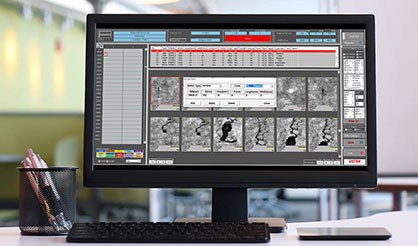
Multiple spectroscopes inspect the material. Unique image processing algorithms identify all defects automatically, recording them in a dataset for each produced roll – which is also used for traceability. A defect map is automatically generated, to help operators understand the allocation of defects in the fabric roll. This information is also available at an offline PC in the Fabriq Album software, which is a valuable tool for optimizing data for final cutting or further processing steps.

Effective – and people-friendly

A good investment shows up in spreadsheets for performance and sales – but it’s also confirmed by feedback from shopfloor personnel, as with Uster EVS Fabriq Vision.

Staff working daily with this fabric inspection system soon recognize that it’s a game-changer, because the inspection routine is increasingly automated. It works smoothly and quickly, in real time, checking every roll and locating every defect, at line running speeds.

Fabriq Album has even more people-friendly tools to make life easier for users. With manual classification, defects can be given customer-specific codes to identify each defect clearly. Unwanted images, or defects which can be ignored, can be removed automatically from the dataset, but are then retained in a hidden layer, for completeness of the dataset.


The future starts

The Fabriq Album software ensures optimum inspection efficiency and throughput. Machine learning capabilities and the implementation of AI-assisted defect classification extend the use of quality data generated by Fabriq Vision. Uster Fabric Inspection solutions bring the added benefit of helping customers to prepare for a digital future.
© 2022 Uster
© 2022 Uster


Uster’s use of Artificial Intelligence for automated fabric inspection was the subject of Michelle Salg’s talk at Techtextil Frankfurt. The Uster Product Manager for Fabric Inspection spoke in the Digitalization and Artificial Intelligence session, on June 22. Anyone who missed it can see all the details from her white paper available at uster.com/adc.

Data-based delivers

Leaders in fabric manufacturing – including knitters – can use Fabriq Vision to help make their own customers more successful. The key is the Fabriq Album. The whole finishing process contains different steps, sometimes executed by various companies. The dataset in Fabriq Album, generated by automated fabric inspection, is effectively a quality status report of process inputs, allowing manufacturers to manage all process steps for optimal output. Therefore, Fabriq Album empowers quality control and optimized end-products along the production chain.

The quality report, automatically created by Fabriq Album, can be provided to customers as an add-on, to give full transparency for every meter of the fabric. In technical textiles, and everywhere fabric inspection is needed – or should be – Uster Fabriq Vision can tap the potential to deliver major benefits for business.


More News from Uster Technologies AG

#Spinning

Measure and control the fiber – optimize yarn quality

Producing consistent yarn quality is an everyday challenge – and a very difficult one. Detailed knowledge and understanding of the fiber raw material is absolutely critical to achieving the best possible quality in the yarn. To help spinners, Uster experts have put together guidelines for avoiding yarn irregularity claims, in a special edition of the Uster News Bulletin.

#ITMA Asia + CITME Singapore 2025

Uster presents novelties at ITMA Asia + CITME 2025

There’s news from Uster Technologies to be announced for the industry’s upcoming event in Singapore. The Uster 360Q universe is growing with new products, solutions and services. Innovation developments can also be recorded in the fields of man-made fiber testing and fabric inspection. Uster innovations address the industry’s trending topics as mill management and process control, optimization of delivered fabric quality and yield.

#Spinning

Uster Technologies marks 150 years of empowering quality excellence

Uster Technologies marks 150 years of excellence – a milestone that reflects continuous adaptation to customer needs and industry change. Over the decades, Uster has evolved from manufacturing quality testing instruments into a trusted partner shaping the future of textile production.

#Recycling / Circular Economy

Challenges of making yarn from recycled fibers

What does it take to spin quality yarn from recycled fibers? Uster Technologies brought textile industry leaders together to discuss the role of technology, data and automation – as well as the current challenges in using recycled raw material. Experts from Rieter, Säntis Textiles, Otto Yarns, and TVU commented on the current situation and looked into the future of spinning in a panel discussion organized at Uster headquarters.

More News on Weaving

#Techtextil 2026

Groz-Beckert showcases cross-segment innovations for technical textiles in Frankfurt

From April 21 to 24, 2026, Groz-Beckert will present its latest innovations and solutions across the product areas of knitting, weaving, nonwovens and sewing at Techtextil 2026 in Frankfurt (Hall 12, Booth B90).

#Techtextil 2026

Crealet to showcase electronic warp feeding solutions at techtextil 2026

Crealet AG will present its latest developments in electronic warp yarn feeding at Techtextil 2026 in Frankfurt. The company will exhibit at the Swiss Pavilion (Hall 12.0, Booth B01), organised by Swiss Textile Machinery.

#Techtextil 2026

From preparation to 3D weaving: Stäubli’s solutions at Techtextil 2026

Stäubli, a global leader in high performance weaving technologies, is pleased to announce its participation at Techtextil 2026 in Frankfurt, Germany, the leading international trade fair for technical textiles and nonwovens. As technical textiles continue their rapid expansion across demanding markets such as defense, mobility, aerospace, construction, energy… Stäubli will showcase innovative solutions designed to empower mills to produce the next generation of advanced fabrics. Stäubli will exhibit its trend-setting technologies at the Swiss Pavilion Booth B01.6 in Hall 12.0.

#Weaving

Itema America acquires Palmetto Loom Reed, strengthening local manufacturing and service in the U.S.

Itema America, the U.S. subsidiary of Italy-based Itema Group, has acquired – through an Assets Purchase Agreement – Palmetto Loom Reed, a Greenville, South Carolina-based manufacturer of weaving reeds and one of the last remaining domestic producers of these precision components in the United States.

Latest News

#Techtextil 2026

Modernizing Needling – DiloGroup at Techtextil & INDEX 2026

With the theme “Modernizing Needling”, the DiloGroup presents a comprehensively enhanced portfolio for needling technology. The objective is to further increase the performance and application range of needlefelt production lines in terms of productivity, flexibility, and the development of new products, thereby meeting the growing demands of modern technical textiles.

#Advertorial

New Gravimax MMX-R X-ray sensor platform opens up new application fields

The demands placed on quality control in web-based production processes are increasing: materials are becoming more complex, basis weights are varying more widely, and at the same time, pressure is growing to make processes more efficient and transparent. Precise measurement data across the entire web width has therefore become a key factor in ensuring stable production processes. With its new Gravimax MMX-R sensor platform, Mahlo introduces a radiometric measurement solution designed to set new standards in determining basis weight and material composition. The platform combines advanced X-ray technology with newly developed signal processing, enabling measurement tasks that previously often required multiple sensor technologies.

#Recycling / Circular Economy

Carbios confirms Longlaville plant in France following financing progress

Carbios has reaffirmed its plans to build its Longlaville plant in France within a project financing framework, targeting the start of production in the first half of 2028. The company also reports a solid cash position of around €60 million at the end of 2025 and has appointed Benoît Grenot as Deputy Chief Executive Officer to support the execution of its strategic projects.

#Composites

KARL MAYER strengthens partnerships in the composites industry at JEC World 2026

KARL MAYER further strengthened its role as a reliable and competent partner to the composites industry at JEC World 2026. The global market leader in textile machinery manufacturing used the trade show to meet key customers, establish numerous new contacts, and engage in in-depth technical discussions.

TOP