#Textiles & Apparel / Garment
US apparel market: Rising prices, tariff uncertainty and resilient consumer spending
Trade policy and inflation remain key uncertainties
The recent US elections resulted in significant changes in the composition of both chambers of Congress. However, the president retains veto authority, potentially limiting the scope for legislative changes. The implications of the new political landscape for trade and economic policy therefore remain uncertain.
For apparel sourcing, tariffs continue to be a central concern. According to Cotton Incorporated’s November 2026 report, current tariffs on apparel imports from most trading partners are 10 or 12.5 percentage points above the most-favored-nation (MFN) rates that applied before 2025. Exceptions include certain countries covered by free trade agreements, such as those in Central America.
The increases were justified by findings from a Section 301 investigation into forced labor. A second investigation, launched in March 2026, focuses on excess production capacity. Its findings have not yet been released, leaving open the possibility of further tariff measures.
Inflation also remains above the Federal Reserve’s target. The US Consumer Price Index (CPI) rose by 3.7% year-over-year in September, while the core Personal Consumption Expenditures (PCE) price index, which excludes food and energy, increased by 3.1%.
Both readings remain above the Federal Reserve’s 2.0% inflation target. Following a quarter-percentage-point interest rate increase in September, the first in more than three years, the Fed left rates unchanged at its late October meeting. Its next policy meeting is scheduled for early December.
Employment improves, but purchasing power remains under pressure
The US economy is estimated to have added 165,000 jobs in October. Previous employment figures were also revised upward, with August gaining 53,000 jobs to reach 133,000 and September increasing by 31,000 to 61,000.
These revisions suggest that hiring may have reached its lowest point in late 2025 and has gradually recovered during 2026. The 12-month average for job creation now stands at 74,000, compared with just 10,000 in December 2025.
The unemployment rate remained exceptionally low at 4.1% in October, slightly below September’s 4.2%. Excluding the pandemic, unemployment has remained below 5.0% since September 2016, an unusually long period by historical standards.
However, wage growth continues to slow. Average hourly earnings increased by 3.1% year-over-year in October, compared with a post-pandemic peak of 5.9% in March 2022.
With inflation accelerating in 2026, consumer prices have been rising faster than wages since April. This development is reducing purchasing power, although it has not yet translated into weaker overall consumer spending. Instead, households have been saving less to maintain consumption.
Clothing expenditure continues to outperform overall consumption
Consumer confidence remains weak despite recent improvements. The University of Michigan’s Index of Consumer Sentiment rose from 48.0 in October to a preliminary reading of 51.0 in November. Nevertheless, readings around 50 remain among the lowest recorded since the index was introduced in 1952.
The Conference Board’s Consumer Confidence Index increased by 7.5 points to 91.7 in October, returning to the range of 90 to 100 that has generally prevailed since early 2025.
Inflation-adjusted overall consumer spending was virtually unchanged in August, increasing by just 0.02% month-over-month. Compared with the previous year, however, spending was 2.5% higher.
The apparel sector performed considerably better on an annual basis. Inflation-adjusted spending on garments increased by 0.1% month-over-month in August and was 4.8% higher than a year earlier.
This growth rate remains more than twice the multi-decade average of approximately 2.0%, indicating that demand for clothing has so far remained resilient despite rising prices and pressure on household purchasing power.
Apparel prices rise while import costs remain stable
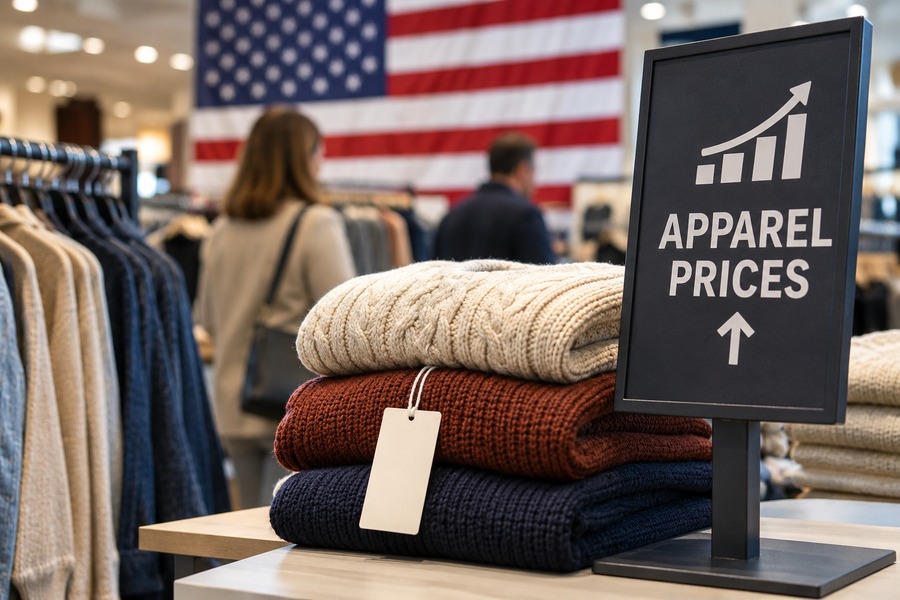
Retail clothing prices have continued to increase. Following several strong monthly gains between February and May 2026, apparel price inflation briefly stabilized before further increases of 0.1% in July and 0.2% in August.
On a year-over-year basis, average retail apparel prices were 3.4% higher.
At the import level, however, the average cost of cotton-dominant apparel remained relatively stable. In September, the seasonally adjusted average cost per square meter equivalent (SME) was unchanged at USD 3.74, broadly in line with levels observed since 2023.
Importantly, these figures do not include the additional tariffs imposed on apparel imports.
The contrast between relatively stable import costs and rising retail prices highlights the importance of tariff policy and other cost factors in shaping the US apparel market. At the same time, the continued strength of clothing expenditure suggests that consumer demand has remained an important stabilizing factor despite the uncertain economic environment.
Source: Cotton Incorporated, Executive Cotton Update, November 11, 2026.