[pageLogInLogOut]

#Textiles & Apparel / Garment

SAITEX releases 2024 impact report, showing decarbonization at scale and industry-leading circularity
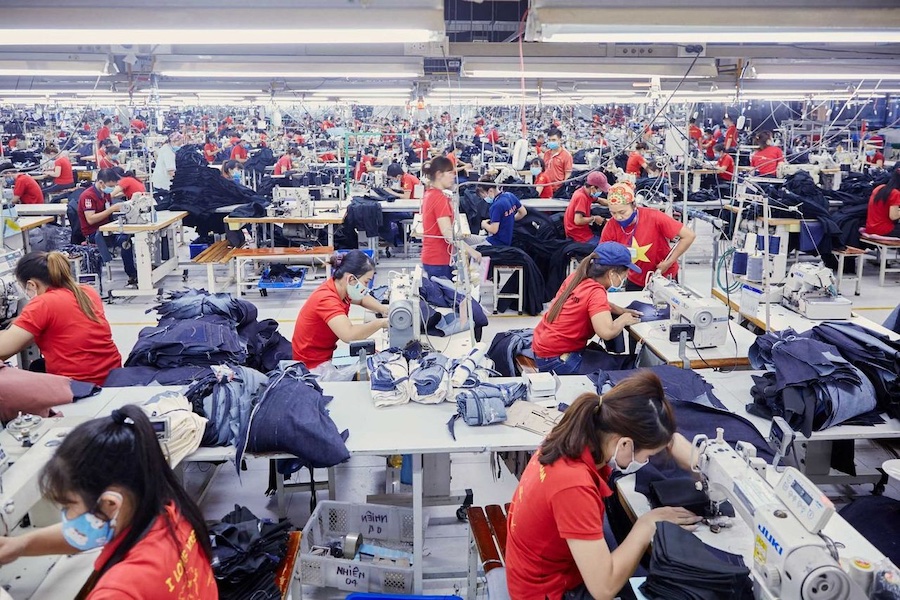
SAITEX, a global pioneer in sustainable apparel and denim manufacturing, has released its 2024 Impact Report, highlighting measurable progress toward net-zero operations, renewable energy expansion, and community-driven innovation across its vertically integrated platforms.
Sewing at SAITEX factory in Vietnam © 2025 SAITEX


The Vietnam and U.S. based apparel manufacturer reports double-digit production growth while reducing emissions per garment by 18% and scaling renewable energy, water recycling, circularity and social stewardship programs.

Even though production grew by 25% in their apparel manufacturing division and grew by 124% at their denim mill, the company cut carbon emissions by 18% and 16% respectively. They also advanced existing closed-loop water systems and expanded social and circularity programs, demonstrating what clean fashion manufacturing can look like in the 21st century.

“Our mission has never been about incremental change, but about systemic transformation,” said Sanjeev Bahl, Founder and CEO of SAITEX. “Our 2024 results exhibit that scale and sustainability are not in conflict. We’ve demonstrated growth can align with measurable reductions in carbon, water, and waste. As a vertically integrated ecosystem, we’re committed to sharing both our successes and shortcomings transparently.

Since its inception in 2001, SAITEX, regarded as the ‘cleanest denim factory in the world’, has been grounded in purpose and driven by a mission to improve social and environmental practices in the apparel manufacturing space. Over the years, the organization has organically evolved from an apparel manufacturer into an ecosystem which currently includes: Saitex Apparel Manufacturing in Vietnam (2006) & USA (2021), Saitex Fabric Mill with its own spinning in Vietnam (2022), STELAPOP upcycling (2019), REKUT (2019), and Atelier & Repairs (2021). All of these entities share the same vision and work jointly to redefine the way we make and [re]use denim.

Key 2024 Impact Report Highlights

(SAITEX reports with full transparency on areas requiring continued focus)
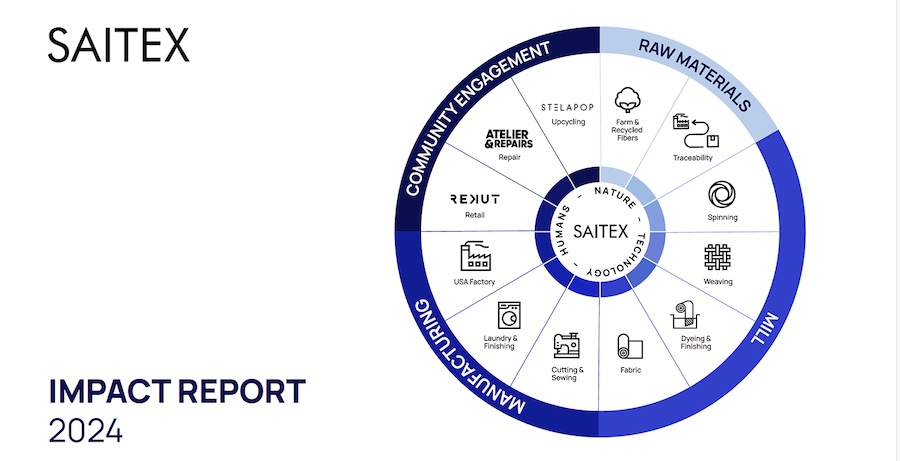
© 2025 SAITEX
© 2025 SAITEX


Apparel Manufacturing (Vietnam)

Production & Energy: Production output increased 25% Year over Year, with electricity use per garment went down by 6,8% while emissions per garment decreased by 18% (5,56 ? 4,56 kg CO?e per garment).

Carbon Offsetting: In 2024, 8647 trees were planted through a partnership with Gaia Nature Conservation program, contributing to a cumulative target of 139 783 trees by 2027. Combined with solar expansion, this supported a 35% CO? offset in 2024. Furthermore the Gaia partnership also advances biodiversity, soil health, and community livelihoods.

Steam & Gas: Steam per garment down by 26,8%; gas use up by 16% due to 3D fashion and coating processes demand. Mitigation planned via switch from MPG to solar powered operations as rollout expands.

Water & Wastewater: Water use per garment up by 7,3% and wastewater discharge up by 21,4%, linked to scheduled RO filter replacement (June 2025). Laundry remains closed-loop since 2016, recycling 98% of water.

Waste & Circularity: Waste increased by 1,1% due to new chemistry testing. Fixes include repurposing 40% of sludge into bricks/blocks and scaling STELAPOP’s NFC-powered upcycling program.

Denim Mill (Vietnam)

Production & Energy: Production output increased by 124%, with electricity use per meter down by 16% and emissions per meter down by 18% (4,04 ? 3,31 kg CO?e per meter).

Energy Mix: Achieved 70% renewable energy (34% onsite solar, rest coming from industrial park).

Water: The Mill is preparing to install a closed-loop wastewater system by Nov 2025, aiming for minimal freshwater input.

Waste: Waste dropped by 8%, with 92% of being recycled.

Certification: Mill became a bluesign® System Partner (Nov 2024) where 18% of fabrics are bluesign® certified fabrics allowing for seamless integration into already certified bluesign® apparel manufacturing. Thanks to this, brands have an opportunity to produce fully certified bluesign® garments.

Human & Community Impact (Across all operations)

Community Outreach: Programs expanded by 60%, reaching 13 245 people through Every Drop Counts (launched 2019), 4Ps (2005), Clean Water Project (2024), and other education initiatives.

Workforce Inclusion: REKUT program continues to integrate disabled workers into core production lines.

Community Impact: Introduced Gaia x Saitex employee initiative called Transforming Used Items to Trees Gaia Project.

Traceability & Data

LCAs: Ongoing Life Cycle Assessments since 2019. In 2024, mill LCAs migrated to Made2Flow for more granular data assessments. Garment LCAs will be consolidated in Q1 2025 put under the same umbrella due to contractual agreements.

Digital Product Passports: Rolled out for brand partners in 2023, providing higher transparency and compliance readiness.

Areas for Improvement & Next Steps:

Gas Usage (increased 16%): Driven by higher energy needs of 3D processes; addressed through process optimization, electrification and designer education. Planned to switch from LPG powered operation to solar powered with future solar expansion.

Water & Wastewater (increased by 7,29% / increased by 21,4%): Temporary increases tied to reverse osmosis filter maintenance; updated system fix scheduled for June 2025.

Waste (increased by 1,1%): Increase linked to expanded chemistry testing; mitigation includes reuse initiatives and scaling up STELAPOP.

Labor Practices: Internal audit flagged 27 cases of undeclared Sunday work. Fixes implemented and improved by digital overtime tracking, worker retraining, quarterly compliance audits, and updated bonus systems. All workers have been fully compensated.

Forward-Looking Goals

Apparel Manufacturing (Vietnam): 100% renewable energy by 2027; with progress towards 35% on-site solar by end of 2026.

Denim Mill (Vietnam): Closed-loop wastewater with minimal fresh water input by end of 2025; aiming for net-zero operations by 2030.

System-wide: Expansion of circular STELAPOP materials, using NFC-powered trims, and carbon-positive ambitions.
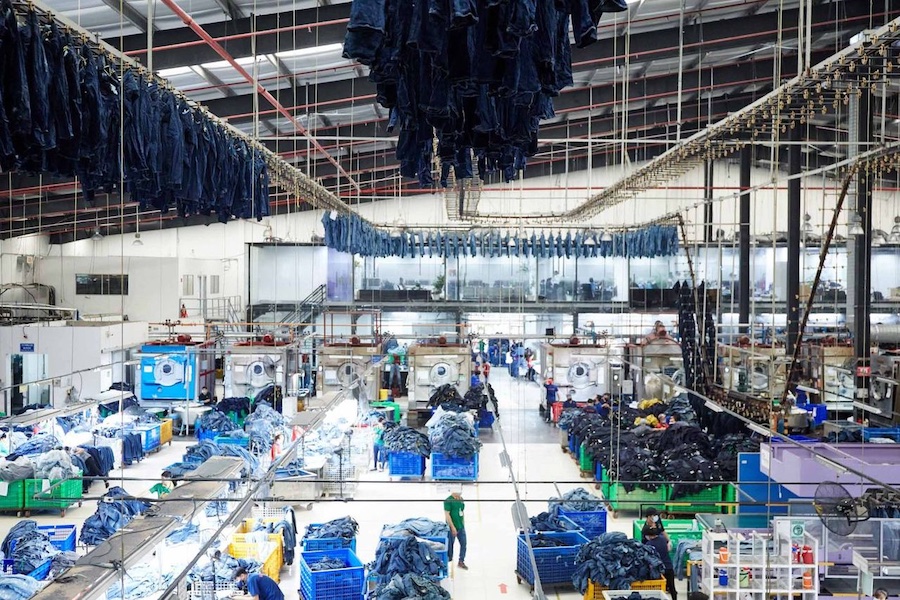


More News from SAITEX

More News on Textiles & Apparel / Garment

#Sustainability

GOTS version 8.0 released: advanced supply chain accountability, from fibre to finished product

Global Standard is pleased to announce the release of GOTS Version 8.0, the latest update to the world's leading processing standard for organic textiles. The updated Standard strengthens requirements for air emissions and waste management, as well as criteria for product safety. It introduces new provisions on circularity, microfibre management and updates in residue testing. Version 8.0 also elevates due diligence obligations and formalises governance requirements, including ESG disclosure, anti-corruption policies and conflict-of-interest safeguards, to support credible, responsible business conduct.

#Textiles & Apparel / Garment

Connecting the ASEAN textile sector: sustainability, trends, and technology take centre stage at this week’s VIATT 2026

Opening this week Thursday, the Vietnam International Trade Fair for Apparel, Textiles, and Textile Technologies (VIATT) is set to welcome visitors from ASEAN’s dynamic textile market and beyond. From 26 to 28 February, VIATT 2026 – the fair’s third editions – will reinforce its strategic proposition with an integrated showcase of the three core sectors of the entire textile value chain. Beyond new sourcing opportunities in Apparel Fabrics & Fashion, Home & Contract Textiles, and Technical Textiles & Technologies, the fair will present an expanded fringe programme.

#Textiles & Apparel / Garment

Global Standard strengthens presence in Southeast Asia at VIATT 2026

Global Standard will participate in the Vietnam International Trade Fair for Apparel, Textiles and Textile Technologies (VIATT) 2026, organized by Messe Frankfurt, the first textile trade show in the APAC region this year. Global Standard will host a booth and Felica Shi will lead a seminar on Global Organic Textile Standard (GOTS). The trade fair will take place from February 26 to 28, 2026, in Ho Chi Minh City, Vietnam.

#Textiles & Apparel / Garment

VIATT 2026 to debut German Pavilion, strengthening European participation alongside key Asian textile hubs

Vietnam’s textile and garment sector continues to be a major contributor to the country’s economic growth, with export revenues expected to reach USD 46 billion in 2025, a 5.6% increase from 2024 . From 26 – 28 February, the Vietnam International Trade Fair for Apparel, Textiles and Textile Technologies (VIATT) is set to contribute to economic growth opportunities by accelerating digital transformation and green transition across the entire textile value chain. The upcoming edition will respond to the rising demand for advanced technologies and sustainable materials with the introduction of the German Pavilion, alongside strong exhibitor participation from key Asian sectors, as well as several high-profile fringe events.

Latest News

#Techtextil 2026

Knowledge that drives progress: Techtextil and Texprocess forums strengthen the global textile industry with a future-oriented programme

From AI-supported production optimisation and digital manufacturing solutions to circular technologies and bio-based high-performance materials: the Techtextil and Texprocess forums provide answers to the key challenges of the global textile industry with a curated content programme. As hubs for innovation and knowledge, they enhance competitiveness and offer orientation in changing markets. From 21 to 24 April 2026, Frankfurt is once again the global meeting point for thought leaders from industry, research and business.

#Techtextil 2026

Enhanced protection without added weight: Innovative technology for flame-retardant textiles doubles reaction time and ensures high wearing comfort

Flame-retardant textiles have long faced the same dilemma: the higher the level of protection, the greater the compromise in comfort, weight and breathability. This is especially important for workwear and protective clothing worn for long hours, where comfort is crucial to wearer acceptance and satisfaction. At Techtextil 2026 in Frankfurt, Swiss company Textilcolor AG will unveil pyroshell™, an innovative flame-retardant technology designed to tackle this challenge. Protection is provided by a graphite-based functional layer integrated into the textile structure, which doubles the reaction time before burns occur while significantly enhancing comfort. The material does not release any toxic fumes and offers textile manufacturers entirely new opportunities to design and produce protective and functional garments. It is also durable enough to withstand up to 50 industrial washes.

#Composites

JEC WORLD 2026 opens: Paris becomes the World Capital of composites

JEC World 2026 opens tomorrow, March 10, at Paris Nord Villepinte, bringing together the entire composites ecosystem for three days of exhibitions, conferences, technical sessions, strategic industry gatherings, and business meetings. As the “festival of composites”, JEC World is also a destination for a broad spectrum of other professional visitors, eager to discover how these advanced materials can offer sustainable solutions to their industries.

#Spinning

Barmag presents the next generation of POY production – energy-efficient and partial-automated

With POY 2.0, Barmag is introducing a completely redesigned spinning concept that takes the production of partially oriented yarn (POY) to a new level in terms of technology and economy. The solution, which was presented to a selected audience of experts for the first time at ITMA Asia + CITME 2025, was met with great enthusiasm: several yarn producers worldwide immediately expressed their interest in a pilot plant.

TOP