[pageLogInLogOut]

#Textiles & Apparel / Garment

ATP promotes Portuguese Textile Industry at Expo 2025 Osaka with “TEXTILE LIVE” Installation

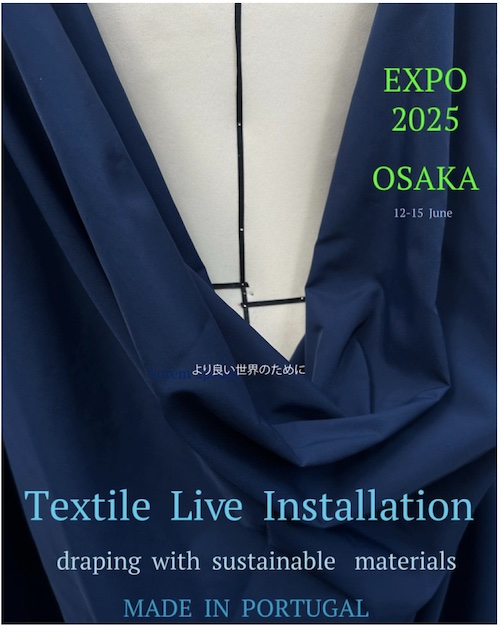
The Portuguese Textile and Apparel Association (ATP) is promoting the national textile-industry at Expo 2025 Osaka with the installation TEXTILE LIVE – Draping withSustainable Materials, made in Portugal, featured in the Portugal Pavilion under thetheme Ocean, The Blue Dialogue.This international initiative celebrates innovation, environmental responsibil-ity, andthe heritage of the Portuguese textile and clothing industry, highlighting materials andprocesses developed in Portugal that respect ecosystems and place sustainability at the-heart of creative practice.

From 12 to 15 June, the thousands of visitors of the Portuguese Pavilion everyday, namely the Multiuse Room (with doors opening directly onto the Expo grounds), will be able to watch and witness an unprecedented live work action by 15 young Japanese designers and one Portuguese designer, on textile materials made in Portugal based on the pillars of sustainability and environmental responsibility.

In collaboration with three Japanese fashion schools - Osaka Institute of Fashion, Marronnier College of Fashion Design and Kobe Bunka Fashion College - art, tradition and innovation, in the form of draping work on busts also made from sustainable materials, will show the world the creative potential of the most eco-friendly materials.

This live draping performance will take place twice a day, one in the morning and another in the afternoon. In addition, visitors will also be able to see a photo exhibition in which Portuguese textiles materials are “interpreted” through the beauty and talent of top Portuguese models from past generations. The experience is further enriched by a miniature doll’s installation, the Marias Paperdolls by Cláudia Oliveira and an informative video that explains the sustainable processes behind the materials on display.

Altogether, these elements offer more than enough reason for high anticipation around the event, which aims to reaffirm the active role that Portugal’s textile and clothing industry is playing in positioning itself at the forefront of the Circular Economy.
© 2025 ATP
© 2025 ATP


Curated by Paulo Gomes, the installation highlights textile solutions made in Portugal with:

+ Natural wool and linen, responsibly sourced and rooted in traditional craftsmanship.

+ Bio-based artificial fibers, derived from food industry by-products.

+ Recycled synthetic fibers, including polyester from PET bottle waste.

+ Seaweed-based finishes, which reduce water consumption and create unique effects.

+ Natural and eco-friendly dyes, with environmentally conscious processes.

The result is a living dialogue between tradition and innovation, Portugal and Japan — where textiles become a medium of artistic expression and a symbol of an industry intransformation.

ATP extends its gratitude to all those who made this installation possible — especially the Portuguese companies Albano Morgado, Burel Factory, Lemar, Positive Materials e Trimalhas; the curator Paulo Gomes; the designer Renato Luiz; and the 15 Japanese fashion students from the Osaka Institute of Fashion, Marronnier College of Fashion Design, and Kobe Bunka Fashion College and AICEP.

They further acknowledge the valuable contributions of Cláudia Oliveira (Marias Paperdolls); the volunteer interpreters Kazuha Toriyama and Ayu Adachi; photographer Sorin Opait; models Elsa Correia, Isabel Sousa, Milene Veiga, and Telma Santos; Rui Guimarães (graphic materials); Liliana Alves (video production); and the team from Saiunion Co., Ltd (mannequins), as well as the support of our sponsors, Aquitex and Mind.pt.

With this action, ATP reinforces the positioning of the Portuguese Textile and Apparel Industry as a global benchmark in sustainable innovation, presenting itself to the world through art, design, and the matter that defines us: textiles made in Portugal – FOR A BETTER WOLRD.



More News from Associação Têxtil e Vestuário de Portugal (ATP)

More News on Textiles & Apparel / Garment

#Textiles & Apparel / Garment

VIATT 2026 to debut German Pavilion, strengthening European participation alongside key Asian textile hubs

Vietnam’s textile and garment sector continues to be a major contributor to the country’s economic growth, with export revenues expected to reach USD 46 billion in 2025, a 5.6% increase from 2024 . From 26 – 28 February, the Vietnam International Trade Fair for Apparel, Textiles and Textile Technologies (VIATT) is set to contribute to economic growth opportunities by accelerating digital transformation and green transition across the entire textile value chain. The upcoming edition will respond to the rising demand for advanced technologies and sustainable materials with the introduction of the German Pavilion, alongside strong exhibitor participation from key Asian sectors, as well as several high-profile fringe events.

#Sustainability

Ying McGuire becomes new CEO of Cascale

Cascale today announced the appointment of Ying McGuire as Chief Executive Officer, effective June 1, 2026.

#Europe

Antwerp Declaration community urges EU leaders to deliver emergency measures as Europe’s competitiveness crisis deepens

EURATEX, representing the European textile and fashion industry, joins the Antwerp Declaration Community’s call on EU Heads of State and Government to adopt emergency measures that restore industrial competitiveness and deliver tangible results for Europe’s manufacturing base in 2026.

#Textiles & Apparel / Garment

Pets in fashion: functional and sustainable textiles find new market at Intertextile Apparel

China’s pet economy is booming, especially amongst younger generations, and pet apparel – from designer outfits to functional garments – was a RMB 3.5 billion (over USD 500 million) market in 2024, growing more than 20% annually¹. To help exhibitors harness this trend, Intertextile Shanghai Apparel Fabrics – Spring Edition 2026 will launch the Pet Boutique, presenting a range of innovative, sustainable materials that prioritise both functionality and comfort for pets.

Latest News

#Recycling / Circular Economy

Circulose restarts commercial-scale production at Ortviken plant in Sundsvall

Circulose today announced the restart of its commercial-scale production plant at Ortviken in Sundsvall, Sweden, marking a significant step in scaling next-generation materials for the global fashion industry. The company plans to resume production of CIRCULOSE®, a recycled pulp made entirely from discarded cotton textiles, in the fourth quarter of 2026.

#Technical Textiles

Sustainable, lightweight, and sound absorbing: Polyester-based front trunk solution for BEVs

As car manufacturers look to further reduce their carbon footprint, Autoneum has developed an innovative front trunk solution for battery electric vehicles (BEVs), made entirely from polyester-based textile. The Ultra-Silent Frunk offers significant weight reduction, improved acoustic and thermal insulation, and uses up to 70 percent recycled material, supporting sustainable and efficient vehicle design. Autoneum, global technology leader in acoustic and thermal management for vehicles, has already received orders for the new frunk from three major OEMs in Asia and Europe to be built in three BEV models. Series production for two BEVs has been underway in China and Germany since last year.

#Raw Materials

Modern testing methods for raw cotton

The 38th International Cotton Conference Bremen will take place from 25 to 27 March 2026 at the Bremen Parliament. This conference has traditionally stood for in-depth expertise and international exchange. The program will focus on technical innovations, market trends, and regulatory frameworks across the entire value chain – from agriculture to the circular economy. With high-profile speakers, the conference is regarded as the key meeting point for the global cotton industry. Today’s focus: Cotton quality and testing methods.

#Spinning

Rieter responds to higher raw material prices

Global political and economic developments have been leading to rising raw material and energy costs for some time. The textile machinery industry is also affected by this trend. Rieter machines and components consist to a large extent of steel, copper, aluminum and electronics. These materials in particular have seen higher demand and higher prices in recent months.

TOP