#Textiles & Apparel / Garment
Fashion industry experts reveal post-pandemic moves
Expand product categories and enhance online sales
In the webinar titled “The Perfect Storm: Future-Proofing Your Fashion Business”, Michael Ho, Marketing & Brand Partnerships Manager at ZALORA, described 2020 as a year of expansion. Thanks to more brands setting up shopfronts on ZALORA, the product categories carried by the platform expanded from fashion to luxury, beauty and lifestyle. Mr Ho explained that with consumers unable to travel during the pandemic, sales at many of the physical stores of global brands have plummeted. This prompted the brands to look for new sales channels, with ZALORA becoming an attractive choice. For ZALORA, this development not only enabled it to cover the losses in fashion sales, it also boosted consumers’ average order frequency from three times a year to 3.3 times a year. According to the company’s Q4 2020 figures, sales on ZALORA’s Hong Kong platform grew 60%, with further growth expected in 2021.
Last year, CASETiFY, a brand known for its smartphone cases and tech accessories, opened five physical shops in Hong Kong despite the adverse economic conditions and achieved remarkable sales. “When there is a need in the market, we address it,” said Harvey Mok, Senior Vice President of Business Development at CASETiFY, adding that the brand released a UV sanitiser for smartphones and reusable cotton face masks in 2020 to address customers’ safety concerns.
The company also observed that although Hong Kong’s consumers were shopping online, they still missed travelling and visiting physical stores. Accordingly, CASETiFY offered experiential purchases at its shops, decorating each one differently to provide a unique consumer experience. Customers can try out different smartphone cases and buy in-store or online. Mr Mok believed this “try offline, buy online” model will continue after the pandemic and that the two sales models can complement each other. “Many people in Hong Kong are hesitant about spending HK$400 on a smartphone case. But once they try our case in a store, they will be convinced of its value over a HK$40 case.” This, he said, will directly increase their desire to buy.
Innovative clothing materials give sustainability boost
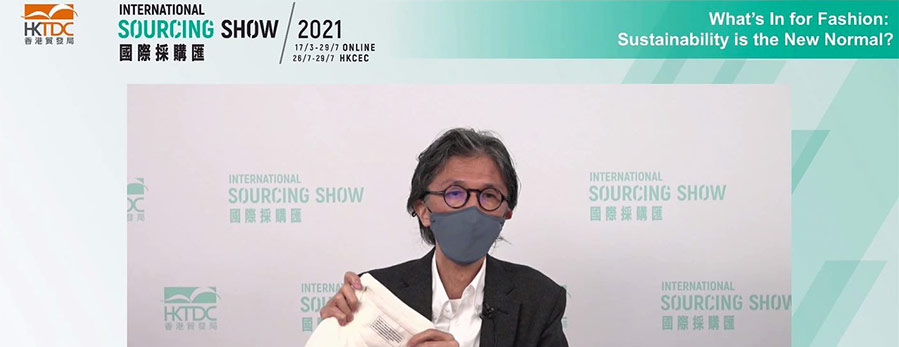
Speaking during the webinar “What’s In for Fashion: Sustainability is the New Normal?”, Edwin Keh, CEO of the Hong Kong Research Institute of Textiles and Apparel (HKRITA), noted that the pandemic has changed the sentiment of many industry practitioners and consumers. They have gone from focusing purely on aesthetics to emphasising comfort and safety, and have also become more discerning about the materials used and the manufacturing process employed. In the face of the pandemic and the world’s mounting environmental problems, consumers are participating more in creating solutions, which is helpful to companies conducting research and development (R&D) on different materials.
Mr Keh brought along some of the materials developed by HKRITA to illustrate how materials R&D can address the needs of both the market and society. He showed one material that can absorb carbon dioxide from the ambient environment, and another made from post-consumer waste that feels like cotton to the touch. When asked if only large companies can afford the resources to innovate, he said that organisations of all sizes can all play a role in tackling the challenge of sustainability. “A lot of innovations are coming from small start-ups that have great ideas. There is nothing wrong with being small, but one must make sure that the innovation can be adapted to the marketplace,” Mr Keh said.
Global fashion retailer H&M is striving to lead the fashion industry into a circular economy. Malin Lundahl, Sustainability Manager of H&M Greater China, said that with the continued growth of the global population, H&M must become 100% circular if it is to sustain its success. Presently, most clothes end up in the landfill. H&M wants to change this by turning products that have reached the end of their lives into resources for something new. The company encourages customers to bring used clothes to their stores, and H&M will take care of collection and recycling.
For example, 20% of the jeans the brand produces are made from recycled cotton. This saves 1,000 litres of water for each pair of jeans during production, reducing the impact on the environment. The products are also fitted with green hang tags that show the materials used in the products. Ms Lundahl explained that the company’s goal is to engage customers and invite them to contribute to sustainability as they shop. H&M has also developed a material called Desserto, which is made from cactus and can be used as a vegan alternative to leather. “Our goal is to use only recycled or sustainably sourced materials by 2030, and we passed the halfway point in 2019 when we reached 57%,” she said.
2022 trends: minimalistic and soothing
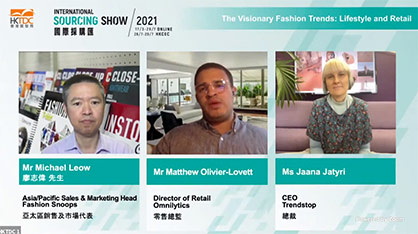
Many people experienced separation and loss in 2020, which will have a direct impact on future trends. Speaking at the webinar “The Visionary Fashion Trends: Lifestyle and Retail”, Michael Leow, Asia/Pacific Sales & Marketing Head at trend forecaster Fashion Snoops, said the four key trends they identified for Spring/Summer 2022 are all related to the restoration of humanity and morality.
The first theme is “Essential”. As countries went into lockdown, people went through separation and craved intimacy, meaningful relationships and protection. Consumers are now shifting towards a simplicity of choice and a quest towards “less but better”. The second theme is “Nourish”. In addition to health, consumers cherish the well-being of their mind and soul. Consequently, there needs to be more human-centred designs with soothing colours that calm the senses without being too sweet. The third theme is “Liberate”, reflecting people’s desire to be free of pandemic-induced restrictions. Accordingly, brands should provide tools that proactively empower customers to contribute to social and creative issues. This leads to the last theme of “Rebirth”. With people becoming increasingly concerned for the environment, brands will need to demonstrate their commitment towards issues such as sustainability and fair trade.
Trendstop, a trend and consumer taste forecasting agency, predicted that 50% of fashion businesses and jobs may be gone in the next five years. Jaana Jatyri, Trendstop’s CEO, remarked that after the pandemic, “having a great brand does not guarantee success. The product must be perfect and match the tastes of consumers.” Ms Jatyri cited the example of a famous brand that released a clothing item with a star pattern. The quality was good, but the product did not sell. A simple search on Trendstop’s online platform showed that the last time a star pattern trended was five years ago, which explained why the product did not become popular.
She suggested that fashion suppliers use trend data to understand the colours, prints and graphics, materials, shapes and detailing that are coming into fashion. “This way, everyone can produce only items that consumers will want to buy and not waste time, money or resources on creating products that are not going to sell. This is also better for the planet and can avoid unwanted products ending up in the landfill or having to be burned.”
The International Sourcing Show?ONLINE hosted a total of 17 webinars with more than 60 industry luminaries invited to share their insights and ideas. All the webinars are available for replaying now at the fair website: https://isshow-online.hktdc.com/en/intelligence-hub.