[pageLogInLogOut]

#Textile chemistry

Covestro and Lanxess cooperate to produce more sustainable raw materials with reduced CO2 footprint
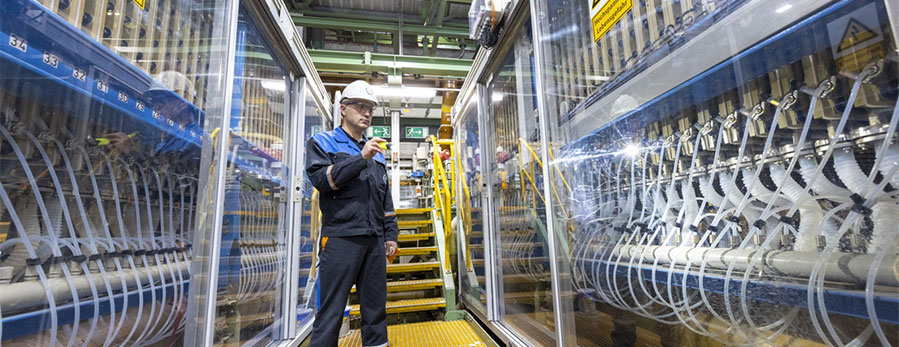
View of Covestro's chlorine electrolysis plant in Leverkusen. With immediate effect, the company is manufacturing around one-third of the product volume supplied to LANXESS using energy from hydropower based on guarantees of origin. © Covestro
Chemical companies Covestro and LANXESS are cooperating in the energy-intensive production of basic chemicals at their Lower Rhine sites in Germany and make them more climate friendly. LANXESS procures chlorine, caustic soda and hydrogen from the ISCC PLUS-certified sites of Covestro in Leverkusen and Krefeld-Uerdingen. With immediate effect, Covestro is manufacturing around one-third of the volume of products it supplies to LANXESS using energy from hydropower based on guarantees of origin.
  • Companies agree production of key basic chemicals
  • Covestro uses electricity with certificates of origin from hydropower for electrolysis in North Rhine-Westphalia
  • Cooperation reduces CO? emissions by up to 120,000 tons per year


Chemical companies Covestro and LANXESS are cooperating in the energy-intensive production of basic chemicals at their Lower Rhine sites in Germany and make them more climate friendly. LANXESS procures chlorine, caustic soda and hydrogen from the ISCC PLUS-certified sites of Covestro in Leverkusen and Krefeld-Uerdingen. With immediate effect, Covestro is manufacturing around one-third of the volume of products it supplies to LANXESS using energy from hydropower based on guarantees of origin.

"Covestro is pursuing the goal of completely converting its production to electricity from renewable sources on its path to operational climate neutrality in 2035," says Dr. Klaus Schäfer, Chief Technology Officer of Covestro. "A particular focus is on the energy-intensive production of basic raw materials. In cooperation with LANXESS, we use energy in our electrolysis plants in North Rhine-Westphalia on a pro-rata basis, which enables us to reduce our reported emissions by up to 120,000 metric tons of CO2 per year."

"The joint project with Covestro is an important building block in making our entire value chain climate-neutral. By sourcing raw materials for these products with a significantly reduced carbon footprint, we will be able to reduce our reported indirect emissions by up to 120,000 metric tons of CO2 equivalents per year," says Dr. Hubert Fink, member of the LANXESS Board of Management. With its Net Zero Value Chain Initiative, the specialty chemicals group plans to eliminate Scope 3 emissions within its upstream and downstream supply chain by 2050. This includes indirect emissions, particularly from purchased raw materials, but also in logistics or disposal. For Scope 1 and 2 emissions, the company aims to be climate neutral as early as 2040. "With this program, we are taking the next step towards a climate-neutral product portfolio and also supporting our customers, who are increasingly looking for sustainable solutions," says Fink.

Chlorine, caustic soda and hydrogen are basic building blocks for many products in the chemical industry. However, their production is very energy-intensive. LANXESS uses the raw materials supplied by Covestro, for example, for products that are then used in the food and agricultural industries. Covestro produces the three basic raw materials at its North Rhine-Westphalian sites in Leverkusen, Krefeld-Uerdingen and Dormagen. Both the former have already been certified to the internationally recognized ISCC PLUS standard for the production of the strategic raw material chlorine, while this is also planned for Dormagen in the near future. The correct allocation of the electricity to the products is ensured via this certification and the use of the renewable energy is proven by the invalidation of certificates of origin at the Federal Environment Agency.


Covestro is also actively involved in various projects to build a hydrogen economy that uses mainly or exclusively green hydrogen as an energy carrier. Among other things, the company is supporting, in cooperation with Hydrogenious LOHC Technologies, to build the world's largest plant for storing renewable hydrogen in liquid organic carriers in Dormagen, Germany. 
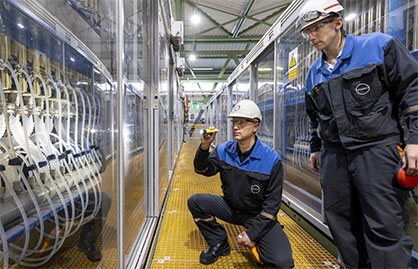
Teamwork during production monitoring in the electrolysis hall. © Covestro


With regard to its energy supply, Covestro focuses on power purchase agreements (PPAs) for renewable energy or high-level certificates. Only recently, the company signed PPAs with Chinese supplier CGN New Energy on wind and solar power that will cover around 30 percent of the electricity needs of its important production site in Shanghai. Under another, utility Ørsted will supply offshore wind energy starting in 2025, which is expected to meet 10 percent of the electricity needs of Covestro's sites in Germany. ENGIE, Belgium's largest renewable energy producer, will provide onshore wind energy to meet 45 percent of the electricity demand of Covestro's Antwerp production site in Belgium.


More News from Covestro AG

#Technical Textiles

Covestro showcases monomaterial concept in autonomous SUE People Mover

UE | STUDIOS has unveiled the fully autonomous electric minibus “Self-driving Urban E-Shuttle” (SUE), placing strong emphasis on sustainable material design. Developed within a project funded by the Federal Ministry for Economic Affairs and Energy (BMWE) and the European Union, the vehicle will begin public road testing this year. At the core of the concept is the consistent use of recyclable monomaterials to improve circularity at end of life.

#Textile chemistry

Covestro and Heraeus Precious Metals collaborate to enable safer, more sustainable antimicrobial textile coatings

Laboratory tests reveal that AGXX antimicrobial surface technology from Heraeus Precious Metals is fully compatible with Impranil® PU dispersions which are part of the waterborne INSQIN® textile coating technology from Covestro, paving the way for more sustainable antimicrobial textile coatings. This discovery comes at a key moment for the textile coatings industry. As the sharing economy continues to grow, more people are coming into regular contact with high-use surfaces, creating ideal conditions for bacteria, viruses, and other microorganisms to thrive.

#Textile chemistry

Covestro celebrates decade of innovation and sustainable growth

Covestro celebrates its 10-year anniversary today. Since its carve-out from Bayer in 2015, the company has developed into a global leader in high-performance polymer materials and a pioneer in circular economy solutions. With a strong focus on innovation and sustainability, Covestro’s materials are now embedded in countless applications worldwide – from mobility and construction to electronics, healthcare, and consumer goods.

#Textile chemistry

Covestro extends contract with CTO Dr. Thorsten Dreier ahead of schedule until 2031

Dr. Thorsten Dreier will remain Chief Technology Officer of Covestro for a further five years. The Supervisory Board has extended his contract, which runs until June 2026, ahead of schedule from July 1, 2026 to June 30, 2031.

More News on Textile chemistry

#Textile chemistry

A flagship for chemical production: BASF inaugurates world-scale Verbund site in China

BASF today (March 26, 2026) celebrated the official inauguration of its newly built, world-scale Verbund site in Zhanjiang, Guangdong Province in southern China. Covering an area of around four square kilometers, it is more than a major BASF project in the chemical growth market of China. “Zhanjiang shows what the future of chemistry looks like: efficient, digital and sustainable by design. The site showcases a smart integrated Verbund structure on an industrial scale,” said Dr. Markus Kamieth, CEO of BASF, at the ceremony attended by representatives from government, customers, business partners and employees.

#Research & Development

Hof University develops sustainable textile coating for the fashion of tomorrow from mushrooms

Clothing is often treated as disposable: T-shirts for events, general merchandise, or short-term campaigns frequently end up in the trash after only a few uses. This is particularly problematic given that their production still largely relies on fossil-based materials. This is precisely where a new research project at Hof University of Applied Sciences comes in.

#Textile chemistry

DyStar Group announces Board transition to drive innovation

DyStar, a leading specialty chemical company with a heritage of more than a century in product development and innovation, announced today the appointment of Ruan Cunfan to its Board of Directors, effective 20 February 2026.

#Textile chemistry

Jeanologia urges industry to accelerate PP Spray phase-out following ZDHC Watchlist update

Potassium permanganate has officially entered the Chemical Watchlist of the ZDHC Foundation, signaling increased scrutiny and potential phase-out of one of the most hazardous chemicals still used in denim finishing. The inclusion confirms an industry shift that Jeanologia anticipated more than a decade ago.

Latest News

#Techtextil 2026

Groz-Beckert showcases cross-segment innovations for technical textiles in Frankfurt

From April 21 to 24, 2026, Groz-Beckert will present its latest innovations and solutions across the product areas of knitting, weaving, nonwovens and sewing at Techtextil 2026 in Frankfurt (Hall 12, Booth B90).

#Techtextil 2026

LineONE – Smart performance, smart investment at Techtextil 2026

At Techtextil 2026 in Frankfurt (April 21–24, Hall 12, Booth C79), AUTEFA Solutions will present its LineONE concepts for cost-efficient nonwoven production. As a full-line supplier for nonwoven production lines, AUTEFA Solutions covers the entire process chain – from fibre opening through to web bonding. With its LineONE line concepts, the company combines proven technologies into well-balanced, cost-efficient turnkey solutions. These concepts are designed for capacity expansions, modernisation projects and new production lines, offering robust design and high flexibility for applications such as filtration, geotextiles and automotive.

#Europe

EU and Australia strengthen relations with Security and Defence Partnership and Trade Agreement

The EU and Australia have today announced the adoption of a groundbreaking Security and Defence Partnership. They have also concluded negotiations for an ambitious and balanced free trade agreement (FTA) and agreed to launch formal negotiations for the association of Australia to Horizon Europe, the world's largest funding programme for research and innovation. With these steps, the EU and Australia are delivering mutually beneficial outcomes and further reinforcing their already close relations in a time of geopolitical uncertainty.

#Technical Textiles

DuPont introduces Tyvek® APX™ 400 protective coverall, setting a new benchmark for extreme breathability

DuPont (NYSE:DD) announced the launch of the Tyvek® APX™ 400 protective coverall, the first in a new generation of extremely breathable disposable chemical protection garments. Manufactured using DuPont™ Tyvek® APX™ groundbreaking fabric, the new garment combines 360° protection and durability with extreme breathability, taking worker comfort and safety to a whole new level.

TOP