[pageLogInLogOut]

#Textile chemistry

Solvay announces jury for its €300k Science Prize

The next edition of the Science for the Future Solvay Prize, to occur in 2022, will mark the 100-year anniversary of the first Solvay Conference for Chemistry

The next edition of the Science for the Future Solvay Prize, to occur in 2022, will mark the 100-year anniversary of the first Solvay Conference for Chemistry

The prize winner will be selected by an independent jury of renowned scientists, which include two Nobel Prize laureates: 

• Sven Lidin, president of the Solvay Prize jury, professor of inorganic chemistry at Lund University;

• Steven Chu, recipient of the Nobel Prize in Physics in 1997, former U.S. secretary of energy and professor at Stanford University;

• Ben Feringa, recipient of the Nobel Prize for Chemistry in 2016, professor at the University of Groningen, former recipient of the 2015 Solvay Prize 

• Susumu Kitagawa, winner of the 2017 Solvay Prize, professor at Kyoto University;

• Geraldine Lee Richmond, presidential chair in science and professor of chemistry at the University of Oregon, nominated for U.S. under secretary of energy for science;

• Dame Carol Vivien Robinson, Professor of Chemistry and first director of the Kavli Institute for Nanoscience Discovery at Oxford University.


https://www.solvay.com/en/innovation/encourage-science/chemistry-future-solvay-prize

© 2021 Solvay
© 2021 Solvay


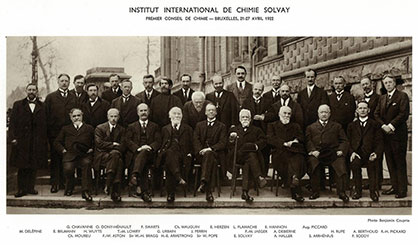
In 1922, the company’s founder, Ernest Solvay held the first scientific conference focused on chemistry, gathering many scientists who would later become Nobel Prize laureates, to discuss new theories in micro-physics in chemistry. The prize, which will be awarded in 2022, marks the 100-year anniversary of Ernest Solvay’s first chemistry conference. 

“Solvay has a long history of promoting fundamental science, and the Solvay Prize continues this legacy,” said Patrick Maestro, member of the Académie des Technologies in France and scientific director of Solvay. “Science based innovation drives Solvay’s strategy today, and is one of Solvay’s key differentiators among its competitors."


About the Science for the Future Solvay Prize 

Created in 2013, the Solvay Prize perpetuates Ernest Solvay’s lifelong passion and support for scientific research. It rewards a single recipient for fundamental contributions to chemistry with potential industrial impact. 

The broad field of the prize covers chemistry in all its aspects, such as synthesis, materials science, soft matter, biophysics or biochemistry, chemical engineering, environmental sciences, or certain aspects of molecular biology. 

Nominations are made by members of the scientific committee for chemistry and the advisory committee (past and present) of the International Solvay Institutes for Physics and Chemistry, participants to the Solvay Conferences on Chemistry, members of prestigious international scientific organizations and renowned chemists.

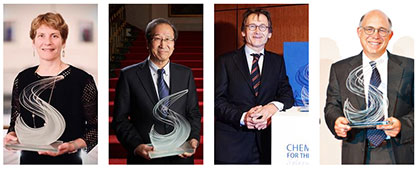
Past winners include (pictured from left to right):
© 2021 Solvay
© 2021 Solvay


• Professor Carolyn Bertozzi (USA) for her invention of bioorthogonal chemical reactions that can be performed in living cells and organisms, with potential significant breakthroughs in the treatment of numerous diseases, including cancer (2020);

• Professor Susumu Kitagawa (Japan), for his work in developing metal organic frameworks, a new class of materials with a range of potential future applications, including the capturing of polluting gases (2017);

• Professor Ben Feringa (Netherlands), for his groundbreaking research on molecular motors, a research field that paves the way to new therapeutic and technological applications with nanorobots (2015);

• Professor Peter G. Schultz (USA), for his work at the interface of chemistry and life sciences, with important implications for regenerative medicine, and the treatment of infectious disease, autoimmune disease and cancer (2013).




More News from TEXDATA International

#Techtextil 2026

Performance Apparels: Functional textiles drive innovation at Techtextil 2026

From high-performance fibres and advanced membranes to smart textiles and sustainable material concepts – functional apparel is becoming one of the most dynamic innovation fields in technical textiles. At Techtextil 2026, exhibitors demonstrate how new materials, finishing technologies and digital functions are shaping the next generation of protective, workwear and outdoor systems.

#Texprocess 2026

Texprocess 2026: Automation, digitalisation and AI reshape textile processing

Investment decisions in textile processing have become increasingly complex. Rising energy prices, labour shortages and geopolitical uncertainties are forcing companies to prioritise technologies that deliver measurable improvements in efficiency and process stability. This applies not only to apparel production, but also to the processing of technical textiles and high-performance materials. Modernisation projects are therefore being evaluated more selectively – but the pressure to upgrade production systems continues to grow. Texprocess 2026 reflects this tension between cautious investment behaviour and increasing technological demand.

#Techtextil 2026

Textile Chemicals & Dyes: Innovation in Textile Chemistry moves into focus at Techtextil 2026

From PFAS-free finishes and water-saving dyeing technologies to advanced coatings and recycling-compatible formulations, innovation in textile chemistry is accelerating across the industry. Reflecting this development, Techtextil 2026 introduces Textile Chemicals & Dyes as a dedicated product segment, highlighting the growing role of chemical solutions in shaping the next generation of technical textiles.

#Recycling / Circular Economy

textile.4U publishes special edition “Top 100 Textile Recycling Companies 2025”

With a comprehensive 176-page special edition, textile.4U is dedicating its latest issue entirely to one of the most dynamic and influential topics in today’s textile industry: textile recycling. The new issue, published exclusively in high-quality print, presents the Top 100 textile recycling companies researched and selected by TexData – organizations that already play a key role in the transition to circular textiles or are expected to have a significant impact in the near future.

More News on Textile chemistry

#Textile chemistry

A flagship for chemical production: BASF inaugurates world-scale Verbund site in China

BASF today (March 26, 2026) celebrated the official inauguration of its newly built, world-scale Verbund site in Zhanjiang, Guangdong Province in southern China. Covering an area of around four square kilometers, it is more than a major BASF project in the chemical growth market of China. “Zhanjiang shows what the future of chemistry looks like: efficient, digital and sustainable by design. The site showcases a smart integrated Verbund structure on an industrial scale,” said Dr. Markus Kamieth, CEO of BASF, at the ceremony attended by representatives from government, customers, business partners and employees.

#Research & Development

Hof University develops sustainable textile coating for the fashion of tomorrow from mushrooms

Clothing is often treated as disposable: T-shirts for events, general merchandise, or short-term campaigns frequently end up in the trash after only a few uses. This is particularly problematic given that their production still largely relies on fossil-based materials. This is precisely where a new research project at Hof University of Applied Sciences comes in.

#Textile chemistry

DyStar Group announces Board transition to drive innovation

DyStar, a leading specialty chemical company with a heritage of more than a century in product development and innovation, announced today the appointment of Ruan Cunfan to its Board of Directors, effective 20 February 2026.

#Textile chemistry

Jeanologia urges industry to accelerate PP Spray phase-out following ZDHC Watchlist update

Potassium permanganate has officially entered the Chemical Watchlist of the ZDHC Foundation, signaling increased scrutiny and potential phase-out of one of the most hazardous chemicals still used in denim finishing. The inclusion confirms an industry shift that Jeanologia anticipated more than a decade ago.

Latest News

#Composites

KARL MAYER strengthens partnerships in the composites industry at JEC World 2026

KARL MAYER further strengthened its role as a reliable and competent partner to the composites industry at JEC World 2026. The global market leader in textile machinery manufacturing used the trade show to meet key customers, establish numerous new contacts, and engage in in-depth technical discussions.

#Recycling / Circular Economy

ABB and Syre partner to explore technologies for industrial-scale textile recycling

ABB has signed a Memorandum of Understanding (MoU) with Swedish textile impact company Syre to jointly explore technologies to support the development of Syre’s first textile-to-textile recycling plant in Vietnam. The agreement establishes a framework for collaboration to investigate how ABB’s automation, electrification and digital technologies could contribute to safe, efficient and scalable operations. It will also explore how these capabilities could further optimize process and quality control performance as Syre advances its ambition to produce circular polyester at industrial scale.

#Techtextil 2026

From Nature Performance to Circular Economy: Techtextil 2026 focuses on the future market for technical textiles

Alternative materials and recycling technologies are one of the most important future segments and drivers of innovation in technical textiles. Sustainability goals and regulatory requirements increase their relevance, while advances in performance and economic viability enhance their market competitiveness. Taking place from 21 to 24 April 2026, Techtextil reflects this key industry trend with a growing number of specialised exhibitors. With the new “Nature Performance” label, the leading global trade fair bundles relevant market offerings and facilitates access to new solutions – from natural fibres and yarns to bio-based materials and circular approaches.

#Research & Development

Textile cascade filter for removing microplastics from wastewater

Microplastics are now found almost everywhere, even in remote regions of Antarctica. They enter the human body through the food chain. Studies indicate that microplastics may have negative effects on the human health.

TOP