[pageLogInLogOut]

#Textile chemistry

BIONIC-FINISH®ECO

In recent years, many scientists have shifted from favoring a “primordial soup” in pools of water to hydrothermal vents deep in the ocean as the original source of life on Earth. Regardless what the real beginning really was, water was certainly involved in the process some 3,5bln years ago. And since then, Mother Nature designed many ways to benefit of water and to be sheltered from it. Many engineering challenges humans face can be solved by turning to those 3,5bln years of experience and by using natural design as springboard. That’s biologically inspired engineering or, in short, bionics.

Fluorine-Free, Water Repellent Finishes for Ultimate Performance 

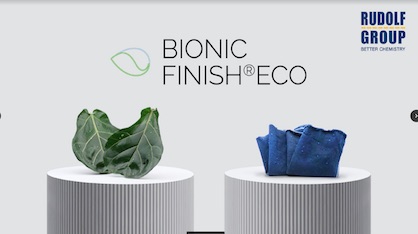
BIONIC-FINISH®ECO of RUDOLF GROUP is Mother Nature’s work reproduced on textiles and apparel to protect us from water. To perform.

Back in 2003, RUDOLF GROUP borrowed from Mother Nature the idea of dendrimers (from dendron, Greek word for ‘tree’), molecules made of multi-functional branches that interact among themselves, co-crystallize, and self-organize into highly ordered, multi- component systems. These hyper-branched polymers attach to the textile and embed fluorine-free, durable water-repellent performance.

In 2021 BIONIC-FINISH®ECO comes as a reviewed and extended family of unique non- halogenated, APEO-free, fluorine-free formulations suited for different materials and designed for different applications and needs. Still very much based on patented dendrimer technology, the new and strengthened BIONIC-FINISH®ECO’s product portfolio:

  • Provides non-fluorinated and highly durable water repellent textile finishes for high-performance, professional applications (e.g. when brushing resistance is required);
  • Delivers highly efficient and durable performance with low application amounts thus not affecting fabric feel and appearance (e.g. when remarkable softness is important);
  • Fulfills a range of challenging technical requirements (e.g. minimal impact on flame retardant properties of technical fibers);
  • Is suitable for both sportswear and outdoor applications, as well as for casual apparel and fashion clothing;
  • Is bluesign® approved, ZDHC chemical gateway certified and compliant with most RSLs;


BIONIC-FINISH®ECO new portfolio includes universal and versatile solutions targeting the most standard requirements, as well as customized solutions that meet more demanding and specific expectations such as improved resistance to dry-cleaning. 

“None of us can entirely predict where our voyage will lead” says Dr. Gunther Duschek, RUDOLF GROUP Managing Director. “However, BIONIC-FINISH®ECO of RUDOLF GROUP will always be the fluorine-free, durable water repellent for ultimate performance. As it is today”.


(c) 2021 RUDOLF GROUP


More News from TEXDATA International

#ITM 2026

ITM 2026: The new geography of textile production

New production hubs are emerging across North Africa and Central Asia, while Türkiye is accelerating its transformation toward higher-value, technology-driven and more sustainable textile manufacturing.

#Research & Development

“Production is a product”

From technical textiles and AI-driven robotics to the limitations of textile circularity: Professor Dr Thomas Gries looks back on more than two decades of development at ITA Aachen. In the interview, he explains why production technology remains a decisive success factor, discusses international collaborations and innovation ecosystems, and shares his views on the transformation of production landscapes and the challenges facing an increasingly regulated industry.

#Knitting & Hosiery

“We need to move away from the price trap and return to a value-driven mindset.”

With its new Textile Innovation Center, KARL MAYER is sending a strong signal for innovation, collaboration, and the future of textile applications. In this interview, Karl Josef Mayer discusses new opportunities in warp knitting, the processing of staple fibres, recycling, the changing role of machinery manufacturers, and why the textile industry must once again focus more strongly on the value of textiles. by Oliver Schmidt

#Associations

“Innovation, resilience and international experience remain the great strengths of the Swiss textile machinery industry”

Geopolitical uncertainty, growing competitive pressure from China, new free trade agreements and the shift towards a circular economy are currently reshaping the global textile industry. In this interview, Cornelia Buchwalder discusses the current mood within the Swiss textile machinery sector, the industry’s distinctive innovative strength, new market opportunities in India and Asia, and the technological trends that could shape the upcoming trade fair cycle leading up to ITMA 2027.

More News on Textile chemistry

Latest News

TOP