[pageLogInLogOut]

#Textile chemistry

Devan lauded by Frost & Sullivan for its antimicrobial technology with proven quaternized silane chemistry

© Devan Chemicals
Belgian textile innovator Devan Chemicals was lauded by Frost & Sullivan for its antimicrobial technology, known under its trade name as BI-OME®. The non-leaching attributes of the technology coupled with its ability to reduce microbial mutation make it a potential candidate for textiles where durability and safe human contact are highly valued.

Based on its recent analysis of the European antimicrobial technology for the textile market, Frost & Sullivan recognizes the Belgium-headquartered Devan Chemicals NV (Devan) with the 2020 European Technology Innovation Leadership Award. Devan’s highly relevant antimicrobial technology addresses issues concerning the contamination of PPE and textiles, including the spread of drug-resistant bacteria, viral transmissions, and hospital-acquired infections (HAIs). Its quat-silane technology, due to its non-migrating behaviour, physically punctures the microorganism cell to destroy it without interfering with cell DNA. Notably, it eliminates the adverse effects of leaching antimicrobials while providing high efficiency in the range of 99.9 percent to 99.99 percent, even after multiple washes.

"By providing non-migrating antimicrobial technology for the textile industry, Devan plugs the safety and performance gaps inherent in current inorganic and organic antimicrobial agents. Its antimicrobial technology, unlike silver- or triclosan-based technology, comprises non-migrating monomers and prepolymers such as organo-functional silane," said Monami Dey, Industry Manager, Frost & Sullivan. "The organo-silane polymers are covalently bonded and polymerized to the textile surface as a coating via padding, exhaust, and spraying techniques. The coating forms a non-leaching reactive surface and destroys the microbes on contact, without releasing harmful components into the environment."

Devan CEO Sven Ghyselinck is very happy with the award: “The best practice award is a nice recognition of the hard work we did in the last 6 months to evaluate the performance against viral activity. It’s great to see our efforts didn’t go unnoticed.”

Earlier this month Devan published new test results confirming the high performance virus-reducing capabilities of its BI-OME fabric coating technology on both unwashed and intensely washed fabrics. The Belgian company has worked closely with a series of international third party laboratories to test different fabric substrates against a wide range of enveloped viruses. Before washing, samples treated with Devan BI-OME score very good to excellent (99% and higher according to ISO 18184) results on virus reduction. Different substrates, like polyester, cotton and polycottons, were exposed to enveloped viruses like SARS-COV-2 (known to cause COVID-19), Feline Corona, Vaccinia (the EU standard for enveloped viruses) and Porcine Respiratory viruses. After 30minutes, BI-OME already reduced 99.96% of the activity of SARS-COV-2.


After washing, a decrease in virus reduction performance of coating technologies is normal and expected. However, BI-OME is confirmed to deliver only a minimal reduction, retaining up to 98.5% virus reduction even when the fabric is washed 25 times.

"Devan is working towards sustainability and green chemistry. For instance, its technology does not contain any harmful solvents such as formaldehyde or polychlorinated phenols and fulfills the regulatory obligations of the EU BPR," noted Dey. "Its commitment to promoting sustainability in textile finishes with a strong focus on GMO-free, kosher, as well as halal certifications, and recyclability has given the company an edge in launching new products at an accelerated pace to match customers’ most pressing concerns and demands."

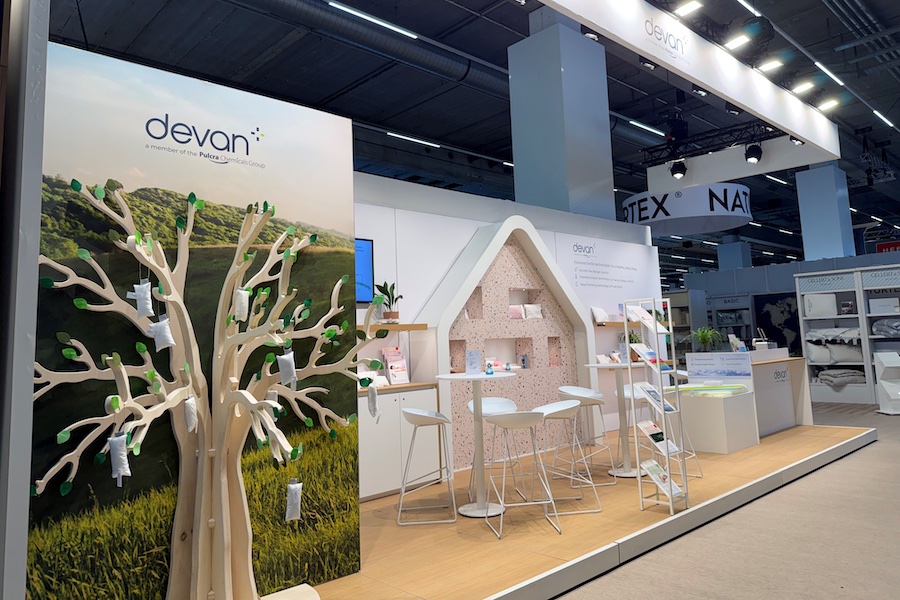
One of those innovations is BI-OME NTL (natural), a natural, bio-based antimicrobial solution that guarantees an optimal freshness and hygiene for textiles. The active ingredient is the well-known Linseed oil, obtained from the dried, ripened seeds of the flax plant. The active ingredients in BI-OME NTL are GMO free, Halal, Kosher and recyclable.

© Devan Chemicals
© Devan Chemicals


More News from Devan Chemicals

#Textile chemistry

Devan unveils innovative textile solutions to enhance comfort during sleep at Heimtextil 2026

From 13 to 16 January 2026, Devan was exhibiting at Heimtextil in Frankfurt, the world’s leading international trade fair for home and contract textiles. The event brought together key players from across the global textile value chain, providing the ideal platform for Devan to present its latest innovations.

#Textile chemistry

Devan Chemicals launches new sleep promoting technology at Heimtextil 2025

Devan, a global leader in sustainable textile finishes, launched an innovative sleep promoting technology, “Devan Sleep Tight”, at Heimtextil 2025. This technology enhances sleep quality and overall quality of life, as confirmed by an independent clinical trial.

#Chemical industry

Devan Chemicals presents “Devan Stain Release”, a PFC-free release technology for water and oil based stains

Devan Chemicals, a global leader in innovative textile solutions, proudly announces the launch of its latest breakthrough in textile finishing technology “Devan Stain Release”. With a focus on sustainability and performance, the company is proud to launch a release technology that ensures that both water and oil based stains can easily be washed off.

#HEIMTEXTIL 2024

Devan Chemicals is proud to present its latest Innovations at Heimtextil 2024

Devan Chemicals, a renowned pioneer in sustainable textile finishes, is excited to announce its upcoming participation in Heimtextil 2024. Devan invites attendees to explore their booth in Hall 11.0, booth A21, and experience firsthand the latest sustainable textile finishes that Devan has developed.

More News on Textile chemistry

#Techtextil 2026

Covestro to exhibit solutions for a more sustainable and productive textile industry at Techtextil 2026

Covestro will present a broad portfolio of material innovations for textile coatings, adhesive films and thermoplastic polyurethanes (TPUs) at Techtextil 2026 (Hall 11.0, Booth C79). The exhibits will demonstrate how advanced solutions can enhance durability, recyclability and manufacturing efficiency across applications such as automotive, infrastructure, protective apparel and sportswear. A particular focus will be on more sustainable coating technologies, including antimicrobial systems based on INSQIN® in combination with AGXX from Heraeus Precious Metals, as well as the integration of Pontacol® thermoplastic adhesive films into Covestro’s offering.

#Textile chemistry

Orta and Archroma launch denim collection dyed with wool waste

Archroma, a global leader in specialty chemicals, and Orta Anadolu, the premium Türkiye-based denim manufacturer behind the ORTA brand, today announced a collaboration to bring circular dye chemistry into commercial denim production.

#Denim

Archroma expands denim possibilities at Kingpins Amsterdam

Archroma, a global leader in specialty chemicals, will present a portfolio of six sustainable denim innovations at Kingpins Amsterdam from April 15-16, 2026. Under the theme “Creating Possibilities in Denim”, the showcase reflects Archroma’s commitment to giving brands and mills solutions that are as commercially compelling as they are environmentally responsible.

#Techtextil 2026

TANATEX to spotlight compliance-driven innovation at Techtextil 2026

At Techtextil 2026, TANATEX Chemicals will present a focused innovation story built around a clear market need: helping textile manufacturers meet increasingly demanding sustainability and compliance requirements without compromising critical performance.

Latest News

#Raw Materials

New study shows low environmental impact by Cotton made in Africa Organic Cotton from Tanzania

Today, the Aid by Trade Foundation (AbTF) is announcing the results of a comprehensive life-cycle analysis (LCA) for cotton produced in Tanzania under the Cotton made in Africa Organic (CmiA Organic) standard. The study emphasises the small ecological footprint of CmiA Organic verified cotton. This can largely be traced back to the absence of synthetic pesticides, artificial fertilisers, and artificial irrigation. Consequently, CmiA Organic cotton can help the textile industry meet regulatory requirements as well as science-based targets. The results also show that the consequences of climate change threaten the livelihoods of these cotton farmers, even though the type of agriculture they practise barely contributes to climate change.

#Raw Materials

Better Cotton Initiative strengthens regenerative focus in standard update

The Better Cotton Initiative (BCI) has strengthened the regenerative focus of its field-level standard with the launch of a new version of its Principles & Criteria (P&C), which marks the next step in the organisation’s journey to becoming a regenerative standards system.

#Man-Made Fibers

Selenis and Kintra Fibers partner to scale 100% bio-based synthetic fiber technology

Selenis, a leading global specialty polyester manufacturer, today announced a strategic manufacturing partnership with materials science company Kintra Fibers to scale Kintra’s patented fiber-grade PBS resin - a 100% bio-based and biodegradable material designed for textile applications.

#Functional Fabrics

PERFORMANCE DAYS proves its relevance as the industry’s key meeting point

Held on March 18–19, 2026, PERFORMANCE DAYS once again confirmed its position as a leading international platform for functional textiles. A total of 3.366 trade visitors and around 560 exhibitors gathered in Munich, with the event already kicking off successfully on DAY 0, which received highly positive feedback for its interactive format. Despite challenging conditions caused by the public transport strike in Munich, the event saw strong attendance and a consistently high level of activity across both exhibition days.

TOP