[pageLogInLogOut]

#Textile chemistry

Garmon introduces smart foam, the technology that makes water saving easy as blowing bubbles

Result of a collaboration between three leading companies across the garment finishing market, smart foam simplifies the sustainable practices, helping suppliers of any segment achieve their sustainability goals.

Garmon, the brand for chemical solutions for the denim and fashion industry owned by Kemin Industries, launches smart foam at The Kingpins Show in Amsterdam.

Through an innovative patented technology, smart foam has the goal of revolutionizing garment finishing. The system is designed to minimize natural resource consumption, making sustainable garment production easy and accessible.

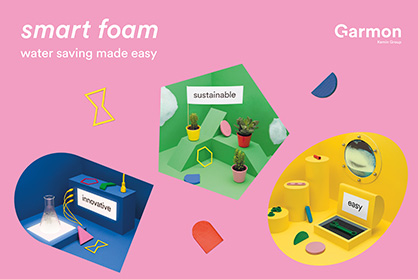
Innovative

smart foam is a patented technology, a result of a collaboration of Garmon, Itaclab and Mactec, three leading companies across the garment finishing industry.

With smart foam the chemical carrier is not water, but a special foam created with a combination of new technologies:

  • Garmon’s tested and selected range of chemicals
  • easyfoam and easyfoam pro, Garmon’s special foaming agents
  • foam generating equipment recommended by Garmon

The smart foam system can be used to create everything from traditional finishes to unique fashion concepts and styles.

Sustainable

The main benefit of smart foam is the great reduction of water and energy consumption.

Compared to traditional washing processes, the application of chemicals through smart foam allows savings of up to 80% of water. All the treatments are performed at room temperature, therefore reducing the energy required.

Moreover, when combined with Garmon certified chemicals, smart foam can be used to perform treatments fully compliant with greenofchange®requirements.

Overall, smart foam helps suppliers of any segment achieve their sustainability goals, to better serve the fast-moving fashion industry.


(c) 2019 Garmon
(c) 2019 Garmon


Easy

smart foam has been designed to be the easiest and most affordable system to save water in garment finishing, making the technological investment accessible to any industrial laundry.

Compared to nebulization systems, smart foam is up to 3 times faster to load chemicals in the washing machine, and it doesn’t require a sealed equipment, allowing technicians to interrupt finishing treatments and check garments with safety and ease. For this reason, any type of washing machine - from the traditional to the advanced - can be utilized with the smart foam equipment and process.

More News from Garmon & Bozzetto Srl

More News on Textile chemistry

#Textile chemistry

bluesign updates chemical reference lists with stronger PFAS restrictions

bluesign has published the 2026 editions of its three core chemical reference lists, introducing updated substance limits and testing requirements in line with the latest scientific findings and regulatory developments.

#Textile chemistry

Fashion for Good launches DW(O)R-X to navigate the emerging landscape of PFAS-free finishes

Fashion for Good announced the launch of Project DW(O)R-X, a collaborative initiative designed to benchmark PFAS alternative durable water- and oil-repellent (DW(O)R) chemistries. Responding to growing market demand for alternatives to PFAS‑based finishes, the project aims to generate reliable, comparable data that can support informed sourcing decisions and the assessment of emerging chemistries.

#Sustainability

Indovinya advances sustainable solutions with agreement for the supply of renewable Oxygen from Air Liquide

Indovinya, the specialty chemicals and surfactants division of Indorama Ventures, has entered into an agreement with Air Liquide — a world leader in gases, technologies, and services for industry and healthcare — for the supply of renewable oxygen. The agreement represents a strategic advancement in Indovinya’s commitment to sustainability, as it increases the share of renewable raw materials in the production of ethylene oxide, one of its key products.

#Textile chemistry

DyStar releases FY2025 sustainability report, marking a new milestone towards its 2030 targets

DyStar, a leading specialty chemicals company with more than a century of expertise in product development and innovation, today announced the release of its FY2025 Sustainability Report, marking a significant milestone in its sustainability journey and reinforcing its commitment to long-term value creation.

Latest News

#Functional Fabrics

PERFORMANCE DAYS announces new focus topic & forums for October 2026

With its upcoming October 13–14, 2026 edition, PERFORMANCE DAYS is placing the spotlight on one of the textile industry’s most important transformations: “Bio-Based Materials – From Fiber to Fabric”, a two-part Focus Topic exploring the future of bio-based innovation across the textile value chain. Part 1, presented in October 2026, will focus on fibers and next-generation material developments, while Part 2 at the March 2027 edition will shift the perspective toward dyeing, finishing, additives, and processing technologies.

#Nonwoven machines

MENANG rapidly resumes production with new ANDRITZ airlay line after major fire

MENANG, a Malaysian manufacturer of nonwoven automotive components, has resumed production after a major fire severely damaged its airlay line in mid-March 2026. A new airlay line supplied by ANDRITZ enabled production to restart within only four months.

#Exhibitions & Events

Febratex 2026 to be the largest edition of the leading textile trade fair in the Americas with 10 exhibition halls

Febratex 2026 will be the largest edition in the history of the leading textile trade fair in the Americas. Dedicated to the textile and apparel manufacturing industries, the event will take place from August 18–21, 2026, in Blumenau, Santa Catarina, Brazil, with a strong focus on technology, sustainability, and business generation.

#Raw Materials

Cotton Brazil Dialogues field trip brings international stakeholders closer to Brazil’s cotton production chain

How do you build trust across the global textile value chain? By opening the farm gates. This is the principle behind the Cotton Brazil Dialogues. At the end of July, the programme welcomed its first group of international participants for a five-day immersion into Brazilian cotton production, combining field visits with technical workshops to showcase the quality, sustainability, innovation and traceability behind one of the world’s leading cotton origins.

TOP