[pageLogInLogOut]

#Denim

Kemin Textile Auxiliaries’ Garmon Studio and Stella Blu release sustainable and recyclable capsule collection

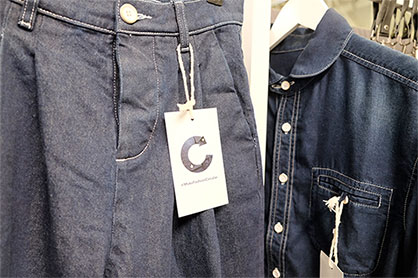
Kemin Industries, a global ingredient manufacturer that strives to sustainably transform the quality of life every day for 80 percent of the world with its products and services, has announced that Garmon Studio, the application laboratory of Garmon Chemicals, Kemin’s textile auxiliaries business unit and the chemical solutions brand for the denim and fashion industry, joined with Stella Blu, a denim fabric manufacturer that aims to be the resource for innovative, novel and exciting indigo fabrications, to create a completely sustainably and recycleable capsule collection, celebrating The Jeans Redesign’s July 2021 updated guidelines for denim circularity.

The collection uses denim circularity principles to demonstrate how to achieve sustainability in the denim industry’s supply chain

The collaborative effort honors the mission of The Jeans Redesign, a project of the Ellen MacArthur Foundation that provides a framework for the denim industry to scale practices for a circular economy. The capsule collection was developed using all the principles of denim circularity to give a tangible example of how the denim supply chain can achieve greater sustainability.

The capsule collection was presented at Denim Première Vision, an event dedicated to the world of denim, its trends, its market and its unique community. Held in Milan at Superstudio Più, Denim Première Vision is the first in-person event after nearly two years of pandemic-induced digital-only events, making it the ideal setting to announce the collaboration.

In line with the latest needs for traceability and transparency in the denim industry, Garmon Studio and Stella Blu worked together to present a capsule collection that is durable, recyclable and made with safe materials and processes. This included the following components of fabric and confectioning and washing:

Fabric and confectioning:

• Stella Blu fabric # 5S053 is used for the shirt style. The fabric is a yarn-dyed indigo 2/2 S Twill weighing 4.6 ounces and is 100% Tencel-certified from Lenzing. Tencel fibers are produced by environmentally responsible processes from sustainably sourced natural wood. Given their botanic origin, they are completely biodegradable and gentle on skin, with long-lasting softness that contributes to breathability and color retention.? 

• Prosperity fabric # A4017A is used for the pant style. It is a 3/1 Z Twill rope-dyed indigo weighing 12 ounces with 99% GOTS-certified Organic cotton and 1% spandex. GOTS-certified Organic cotton is grown without the use of synthetic pesticides, herbicides or fertilizers. Instead, organic production uses farming techniques that focus on soil and plant health, including crop rotation, companion planning, local plant varietals and beneficial insects. Organic cotton uses less energy, releases less greenhouse gas, does not contaminate groundwater and, due to improved soil quality, uses significantly less water.? 

• Each garment’s construction and confectioning were developed using the maximum possible reduction of leftovers and sewn with 100% cotton thread, allowing for complete recyclability of the whole garment. The backpatch has been removed in favor of lasered logos, and the completely removable buttons are not treated with the electroplating process. Garmon Studio and Stella Blu also phased out the use of metal rivets. Instead, the shirt buttons are made of wood and not treated with solvents or dangerous chemicals, making them fully compostable in just six months when treated properly.


Washing:

• The washes are aligned with The Jeans Redesign principles: no pumice stones and no potassium permanganate or any other dangerous chemicals. The treatment used obtained an Environmental Impact Measuring (EIM) software score of 24 (green). All the finishing chemicals are Scivera and Bluesign certified and, consequently, classified as ZDHC Level 3. The washes are also made with the Smart Foam technology to dramatically reduce the water consumption of the finishing treatment. With Garmon’s patent-pending technology, foam is used as the carrier of chemicals to the garment, which can reduce water use by up to 80% without compromising the look and durability.? 
© Garmon Chemicals / Kemin Industries


• The care label has been completely removed and engraved on the inner side of the garment using laser technology. All the necessary information to extend the life of the garment (i.e. washing less and using cold water) is part of a lasered QR code that allows consumers, recyclers, up-cyclers and re-makers to have all the information on the garment and how to handle it after being discarded.? 

This capsule collection, based on the The Jeans Redesign guidelines with the ultimate goal to produce jeans that last longer and are easily recyclable, preserving our planet and its living beings, is a true demonstration of alignment, transparency and real circularity in the denim industry.

For more information on Garmon Studio services and the sustainable solutions of Garmon Chemicals, go to http://www.garmonchemicals.com or contact your local sales agent.



More News from Garmon & Bozzetto Srl

More News on Denim

#Denim

Jeanologia celebrates its 30th anniversary transforming how jeans are produced worldwide

Jeanologia celebrates its 30th anniversary reaffirming the mission it was born with in 1994, to transform the textile industry into a more sustainable, efficient, and human-centered sector. Three decades later, that vision has become a global reality. Today, more than 40 percent of all jeans produced worldwide are made using technologies developed by the Valencia-based company.

#ITM 2026

The Technology Hub for global denim trends: ITM 2026

The ITM 2026 International Textile Machinery Exhibition, to be held at the Tüyap Fair and Congress Center in Istanbul from June 9–13, 2026, brings together groundbreaking technologies in denim production. From smart production systems to eco-friendly raw materials, from digital washing solutions to laser effect technologies, innovations that will shape the future of denim will be showcased for the first time at ITM 2026.

#Denim

ISKO’s SS27 collection and latest collaboration with Adriano Goldschmied land in Milan at Denim Première Vision

ISKO returns to Denim Première Vision to present a powerful showcase of next-generation denim innovation. At booth D17, visitors will discover a full spectrum of ISKO’s latest developments, including the brand-new SS27 collection, its advanced material collaborations with RE&UP, and the much-anticipated design project with Adriano Goldschmied: Moonskin Denim.

#Denim

Officina39 brings “Shades of Sunset” to Kingpins Amsterdam

At the Winter edition of Kingpins Amsterdam (October 15–16, SugarFactory), Officina39 unveils Shades of Sunset, the new creative collection where color becomes a language for emotions. Inspired by the shifting hues of the sky at dusk, both on calm days and during dramatic storms, this interpretation of Spring–Summer 2027 embraces the imperfect beauty of nature and turns it into expressive, wearable storytelling. From serene and sun-washed gradients to intense contrasts and moody undertones, each piece reflects a unique “sunset state of mind.”

Latest News

#Research & Development

Innovation center for textile circular economy inaugurated

Just over eight months after the foundation stone was laid, the new Innovation Center for Textile Circular Economy was officially inaugurated today at TITK Rudolstadt. Thuringia's Minister President Mario Voigt, TITK Director Benjamin Redlingshöfer, and other guests of honor cut the ribbon to the modern building complex and viewed the premises, which are now ready for occupancy. The “DICE – Demonstration and Innovation Center for Textile Circular Economy” is TITK's largest single investment to date. The Free State of Thuringia supported the total cost of €11.5 million with €8 million in GRW and FTI funding.

#Research & Development

Sustainable design of Geosynthetics and roof underlayments made from recyclates

Is it possible to recover plastic recyclates from previously unused waste streams in order to produce high-quality fibers and films? How can bio-based polymer fibers be manufactured so as to allow adjustable biodegradability? These are the questions being addressed by researchers from the Fraunhofer Cluster of Excellence Circular Plastics Economy CCPE in the Zirk-Tex project.

#Associations

Waste2Fashion: FTTH Committed to advancing Circular Fashion in the Mediterranean

As an official partner of the Waste2Fashion project, the Tunisian Federation of Textile and Apparel (FTTH) participated in the Kick-off Meeting held on 10–11 December in Spain. The event brought together project partners from across the Mediterranean, including Spain, Italy, Egypt, Lebanon, and Tunisia, to align on a shared vision and initiate the first implementation steps.

#Associations

AATCC announces 2025 Herman & Myrtle Goldstein Graduate Student Paper Competition winners

The American Association of Textile Chemists and Colorists (AATCC) recognized the winners of the 2025 Herman & Myrtle Goldstein Graduate Student Paper Competition. Founded in 1982 to give student members the chance to conduct and present original research, the competition was renamed in 1994 in honor of Herman and Myrtle Goldstein, following their US$60,000 endowment. Their gift is a lasting remembrance of their dedication to young people in the textile industry.

TOP