[pageLogInLogOut]

#Technical Textiles

IAA 2025: Redefining Mobility Through Innovation and Sustainability
The IAA MOBILITY 2025 in Munich is all about transformation. With its key themes of mobility, technology, sustainability and smart infrastructure, the trade fair is setting the tone for the future of mobility. As the global leader in acoustic and thermal management for vehicles, Autoneum contributes to these developments with innovative and resource-efficient solutions – from material development to series production. In addition to its standard product portfolio, the company is now also developing specialized components for battery-powered mobility – with a focus on occupant protection and battery safety.
© 2025 Autoneum
© 2025 Autoneum


The automotive industry is facing a profound transformation that goes far beyond electrification. Key future trends include software-defined vehicles, autonomous driving, connected mobility and the ongoing decarbonization of supply chains.

Autoneum is responding to these developments with a clear focus on innovation and sustainability. The company’s products are not only suitable for all types of drive systems, but also for the requirements of software-based vehicle architecture. With NVH solutions for quiet interiors, thermal shielding for battery modules, and fully recyclable materials, Autoneum is helping to make the mobility of tomorrow safer, more comfortable and more resource efficient.

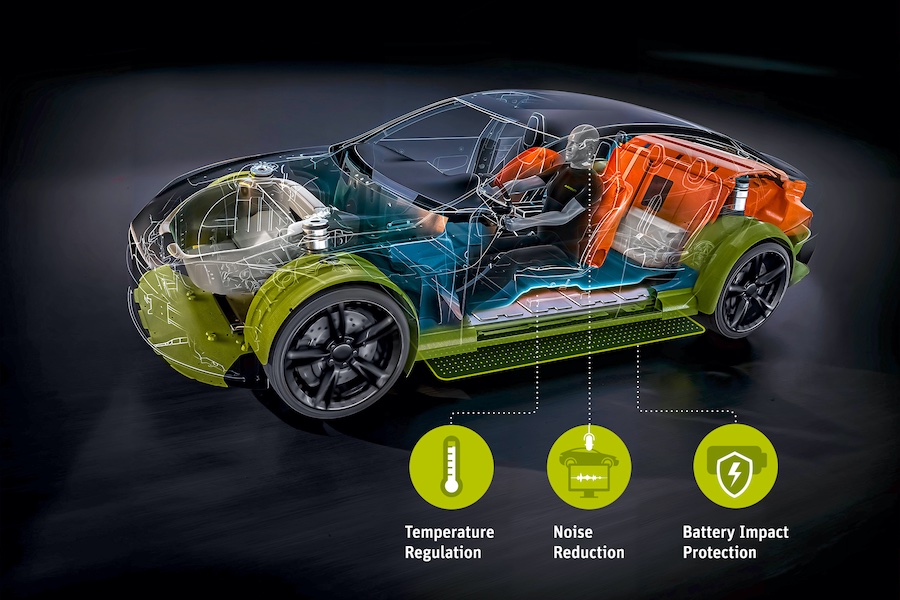
Illustration of Autoneums products in a car

Sustainability – circular economy in action

Sustainability is a key focus. Autoneum processes over 30,000 tons of recycled PET annually – equivalent to around three billion 0.25-liter bottles. Products such as Flexi-Light PET, Di-Light, and the fully recyclable N-Join1 carpet consist of over 90% recycled material and thus make a measurable contribution to decarbonization and resource conservation.

Flexi-Light PET, a particularly malleable and durable polyester-based acoustic material, provides effective sound insulation in the vehicle interior and is fully recyclable. Thanks to its thermal formability and structural properties, Di-Light not only offers good noise insulation for vehicle carpets, but also a high degree of design freedom – ideal for large-area applications. With N-Join1, Autoneum has also developed a mono-material system that does not require any latex or adhesives. It is made entirely from recycled materials and can be easily recycled at the end of its product life cycle.

“Sustainability is an integral part of our strategy,” says Eelco Spoelder, Chief Executive Officer (CEO) of Autoneum. “With innovative materials and resource-saving processes, we are actively contributing to the transformation of the automotive industry – and demonstrating that economic success and ecological responsibility go hand in hand.”

New mobility needs new materials

According to forecasts, global sales of electric vehicles will rise to around 20 million units in 2025 – an increase of 35 percent over the previous year. The industry’s transition is also reflected in Autoneum’s product strategy. By 2024, more than 115 electric models worldwide were equipped with Autoneum components – and this figure is expected to rise to almost 150 in 2025. Sixty percent of all new orders last year were for purely electric vehicles; a significant increase compared to 35 percent in 2023.

The company develops highly specialized components for the next generation of vehicles – especially for electric vehicles with new battery architectures. With components such as the Impact Protection Plate, the mica-free E-Fiber Shield, and the acoustically efficient Ultra-Silent, Autoneum demonstrates how safety, lightweight construction and sustainability can be combined in forward-looking materials that meet the requirements of modern electric vehicles.

The Impact Protection Plate is a newly developed protective plate made of composite materials that combines mechanical strength with thermal insulation. It protects battery systems from impact and contributes to the safety and efficiency of electric vehicles. The E-Fiber Shield is a mica-free flame-retardant material that increases the safety of vehicle occupants in the event of thermal runaway of the battery. It offers high heat resistance (up to 1400°C), electrical insulation, and geometric flexibility. And Ultra-Silent is a robust, lightweight material for frunks and underbodies that consists of up to 70 percent recycled fibers. It combines high acoustic performance with sustainability.

“Our innovative strength is evident where sustainability and technology come together: in materials that conserve resources, increase safety and address the requirements of modern electric vehicles. In this way, we are making a practical contribution to the mobility transition – and creating real added value for our customers,” summarizes Spoelder.

To keep pace with this dynamic, Autoneum has its own New Mobility team in 2023 and established a new research and technology center in Shanghai, China, in 2024. This complements the existing innovation centers in Winterthur, Switzerland, and Bocholt, Germany, and strengthens global development expertise.

Local production for global resilience

In an increasingly challenging market environment, Autoneum relies on proximity to customers as a strategic success factor. With its “local-for-local” strategy, the company manufactures at around 70 locations worldwide, right where the vehicles are produced – efficiently, sustainably and independently of global supply chains. “Our local production strategy makes us resilient – even in an environment characterized by trade barriers,” emphasizes Spoelder. “Manufacturing directly in the market significantly minimizes cross-border risk and strengthens our operational stability.”

More News from

#Digital Printing

Where every detail counts: Experiential applications of DTF and UV-DTF printing

Personalisation has moved far beyond the traditional logo on a t-shirt. Today, brands want to create complete experiences, where every detail – from clothing and accessories to décor and packaging – feels distinctive and reflective of their identity.

#Europe

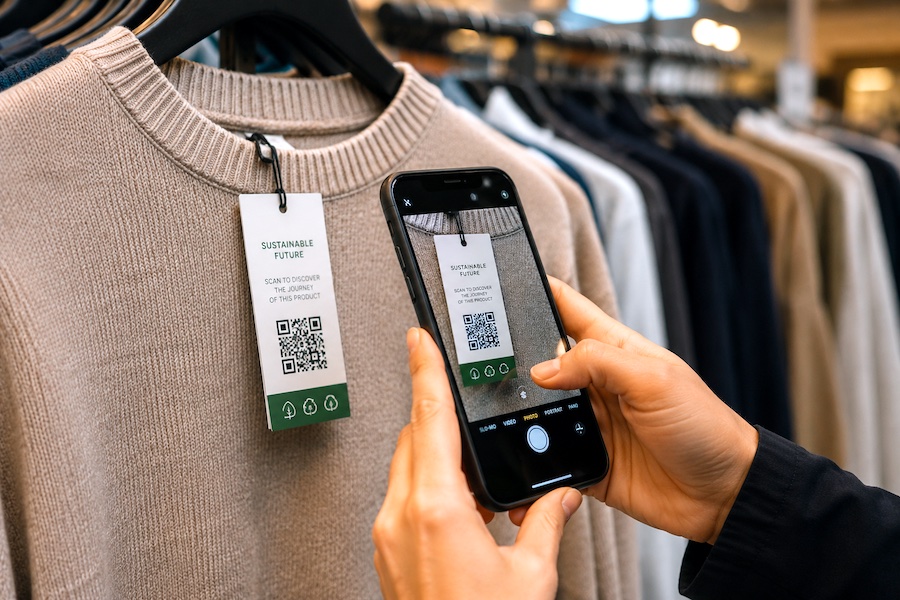
The Digital Product Passport registry is now live

On 20 July, the European Commission launched the Digital Product Passport Registry together with a testing environment, marking an important milestone in making the Digital Product Passport (DPP) a practical reality for businesses placing products on the EU market.

#Europe

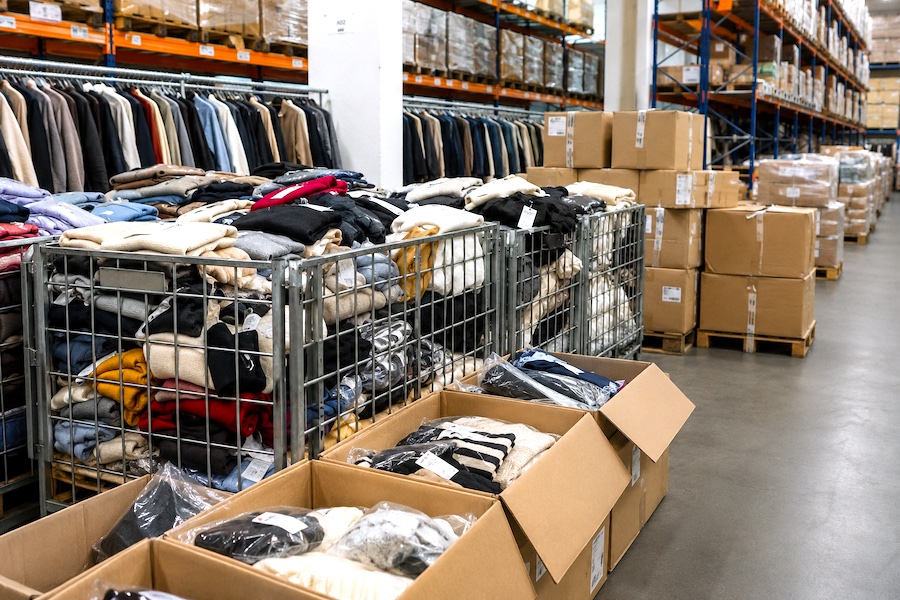
EU ban on destroying unsold clothing and footwear now in force

The European Union's ban on the destruction of unsold clothing, clothing accessories and footwear has entered into force. Since July 19, 2026, large companies across the EU have been prohibited from destroying unsold textile products, while medium-sized companies will be required to comply with the same rules from 2030.

#Recycled Fibers

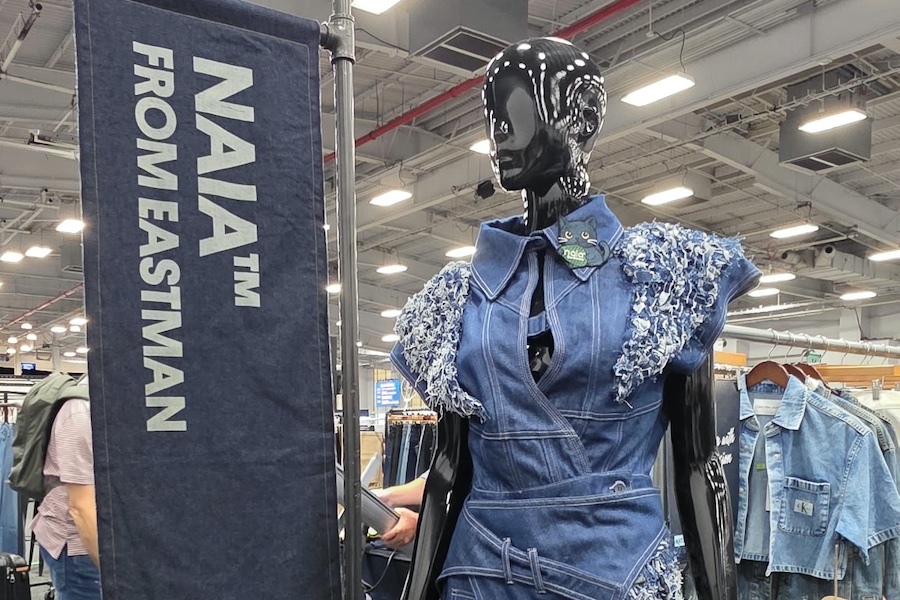
Eastman Naia™ brings its inside-out denim vision to Kingpins New York

Following its debut at Kingpins Amsterdam, Eastman Naia™ brings the next chapter of its denim story to Kingpins New York, taking place July 22–23. At Booth Green 7, Naia™ presents its denim proposition built around three complementary design directions: Performance Denim, Fashion Denim and Authentic Denim.

More News on Technical Textiles

#Recycling / Circular Economy

Pirelli, Pyrum, Synthos and BASF partner to transform end‑of‑life and scrap tyres into recycled materials for new products

Pirelli, Pyrum, Synthos and BASF are jointly advancing a tyre-to-tyre circular economy initiative in Europe, driving the development of an industrial ecosystem designed to increase the use of recycled materials derived from end-of-life and scrap tyres.

#Dyeing, Drying, Finishing

Contactless measurement of coating for Technical Textiles with PLEVA AF 310 and AF 120

Textiles used for protection and defense must perform reliably – whether they are protective garments, tents, tarpaulins, covers, or technical carrier materials. Properties such as flame resistance, water repellency, weather resistance, or defined air permeability are often only achieved through precise coating, finishing, or printing processes.

#Research & Development

TERIS reaches milestone: Fraunhofer consortium develops new standards for tire analysis

In the “TERIS” project, the Fraunhofer institutes ICT, IGD, and IWM—led by the Fraunhofer Institute for Structural Durability and System Reliability LBF—have reached a decisive milestone. For the first time, the teams aim to generate, analyse, and predict tire wear in the laboratory in a standardized and practical manner. As part of this milestone, results are now available on reference abrasion, particle analysis, tribological models, AI-based surface analysis, a test bench concept, and methods for accelerated aging and VOC detection. The tire industry, testing services, and environmental agencies will in future benefit from reliable, rapid laboratory procedures for emissions assessment.

#Technical Textiles

FILTREX™ India 2026 to bring global filtration leaders together in New Delhi

EDANA, the voice of nonwovens, in partnership with the Business Coordination House (BCH), will welcome filtration professionals from across the world to FILTREX™ India 2026, taking place on 7–8 October 2026 at the Eros Hotel, New Delhi.

Latest News

#Recycling / Circular Economy

Circ launches first denim collection with H&M featuring TENCEL™ | Circ® with REFIBRA™ technology

Circ today announced that the first men's denim collection featuring TENCEL™ | Circ® with REFIBRA™ technology is now available at H&M, marking the commercial delivery of this unique pilot project first announced in October 2025. Featuring two styles available across the UK, Scandinavia, Central Europe, Eastern Europe, South Europe, Turkey, North America, Mexico, Canada, and the Middle East, the launch brings TENCEL™ | Circ® with REFIBRA™ technology into H&M's standard men's denim assortment for the first time.

#Sustainability

GOTS releases Version 8.1 with clarifications and editorial updates

Global Standard has released Version 8.1 of the Global Organic Textile Standard (GOTS), following the publication of Version 8.0 in March 2026.

#Recycling / Circular Economy

ReSpin joins TMAS to advance textile recycling technology

Swedish textile recycling company ReSpin has joined the Textile Machinery Association of Sweden (TMAS) as a new member. The company develops a patented mechanical recycling technology designed to transform textile waste into new fibres suitable for yarn production.

#Recycling / Circular Economy

Recover™ showcases textile recycling to European ambassadors in Bangladesh

Representatives of the European Union, the Netherlands and Spain have visited Recover™’s textile recycling facility in Bangladesh to discuss the implications of upcoming EU textile regulations and the role of textile-to-textile recycling in future supply chains.

TOP