[pageLogInLogOut]

#Sustainability

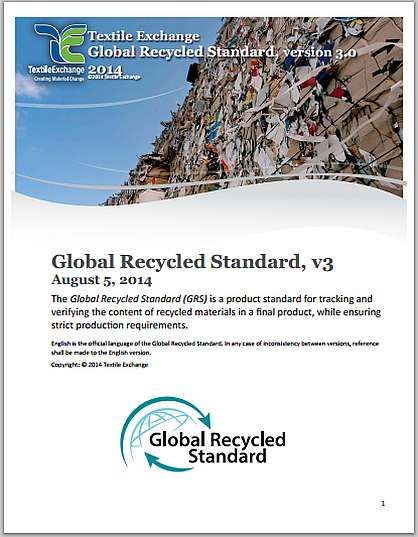
Textile Exchange releases “Global Recycled Standard, V3”

Textile Exchange, through the work of the GRS International Working Group, has released a new version of the Global Recycled Standard. The GRS provides companies with a tool to ensure the identity of recycled materials throughout the production stages, with additional processing requirements to create a full product standard.
The revision of the standard includes several significant changes. The input verification of reclaimed material prior to recycling, established by the Recycled Claim Standard, is now an integral part of the standard. The revision of the standard also includes stronger social and environmental requirements that apply to the entire certified facility. Perhaps the most significant change is the addition of chemical requirements.

GRS v3 includes restrictions on chemicals used in the production of GRS products. The restrictions are based on the assignment of hazard codes, rather than testing against an RSL.

The desired effect of the GRS is to provide brands with a tool to encourage innovation in the use of reclaimed materials, to encourage and reward a strong commitment to social and environmental improvements in production, to establish more transparency in the supply chain, and to provide better information to consumers. The International Working Group was composed of representatives from five certification bodies: Control Union, ICEA, IMO, Intertek, and SCS Global Services.

The group dedicated many hours of their time and expertise into the revision of the standard. An additional group of stakeholders reviewed the standard and provided valuable feedback in two separate public reviews prior to the release of the standard. The members of the International Working Group are exclusively open to apply for accreditation to the standard for a period of six months, after which time, all CBs may apply.
When CBs have been approved, companies may begin the process of third-party certification to the standard.

The Standard, related documents, and additional information are available at: http://GlobalRecycled.org.

More News from Textile Exchange

More News on Sustainability

#Sustainability

VAUDE eliminates PFAS from all products

PFAS (per- and polyfluoroalkyl substances) are now detectable worldwide – in drinking water, soil and the human body. These so-called “forever chemicals” are considered hazardous to health and potentially carcinogenic, as they do not break down and remain in the environment permanently. Despite these risks, PFAS are still used in a wide range of products. More than 15 years ago, VAUDE made a strategic decision to gradually eliminate PFAS from all product categories.

#Sustainability

OEKO-TEX® chooses TextileGenesis to advance digital traceability for organic cotton

OEKO-TEX® today announced a full collaboration with TextileGenesis, a Lectra company, to digitally trace and authenticate organic cotton, strengthening fraud prevention across the supply chain. This announcement follows a successful pilot and brings together OEKO-TEX®’s certification expertise and closed testing system with TextileGenesis’ digital traceability platform to deliver a secure, end-to-end solution for managing certified organic cotton flows.

#Europe

ICAC to support European Commission on pending PEF legislation

The International Cotton Advisory Committee (ICAC) is proud to announce that it has been included as a member of the European Commission’s Technical Advisory Board (TAB) on the Product Environmental Footprint methodology. The Commission developed the Product Environmental Footprint (PEF) to assess and communicate the life cycle environmental performance of products and organizations.

#Nonwovens

ENDURANCE Program: Driving operational sustainability at Magnera

As Magnera enters a new year, the company is reflecting on a key sustainability milestone from 2025: the launch of ENDURANCE, its global, employee-led initiative focused on waste reduction and sustainable innovation. Launched on Earth Day 2025, this initiative has generated more than 250 improvement submissions from team members across Magnera’s global operations, demonstrating strong engagement and shared accountability for sustainability across the organization.

Latest News

#Functional Fabrics

“Action helps us change what we do!”

DAY 0 takes place deliberately before PERFORMANCE DAYS begins. It is conceived as a space for reflection, dialogue and active engagement — a moment to pause before the fair, rethink established systems and address sustainability not as a trend, but as a fundamental transformation challenge. Under the guiding metaphor “Turn the Tap Off”, DAY 0 focuses on root causes rather than symptoms, systemic change rather than isolated solutions, and collective responsibility rather than individual silos.

#Textiles & Apparel / Garment

Pets in fashion: functional and sustainable textiles find new market at Intertextile Apparel

China’s pet economy is booming, especially amongst younger generations, and pet apparel – from designer outfits to functional garments – was a RMB 3.5 billion (over USD 500 million) market in 2024, growing more than 20% annually¹. To help exhibitors harness this trend, Intertextile Shanghai Apparel Fabrics – Spring Edition 2026 will launch the Pet Boutique, presenting a range of innovative, sustainable materials that prioritise both functionality and comfort for pets.

#Man-Made Fibers

Lenzing AG to become majority owner of TreeToTextile AB and accelerates industrialization of new fibers

The Lenzing Group is taking another strategic milestone by acquiring a controlling majority in the Swedish innovation company TreeToTextile AB. This step strengthens Lenzing’s position as a leading provider of sustainable, wood‑based specialty fibers and expands its innovation pipeline with a highly scalable, patent‑protected technology platform. The transaction is executed through the issuance of new shares.

#Raw Materials

Better Cotton Initiative marks certification anniversary with progress update and accreditation

One year since becoming a certification scheme, the Better Cotton Initiative (BCI) has announced that more than 3,000 supply chain actors have been certified. At farm level, more than 30% of farms and producer units supplying BCI Cotton have received a positive audit outcome.

TOP