[pageLogInLogOut]

#Sustainability

Coats commits to circularity with textile-to-textile thread innovation
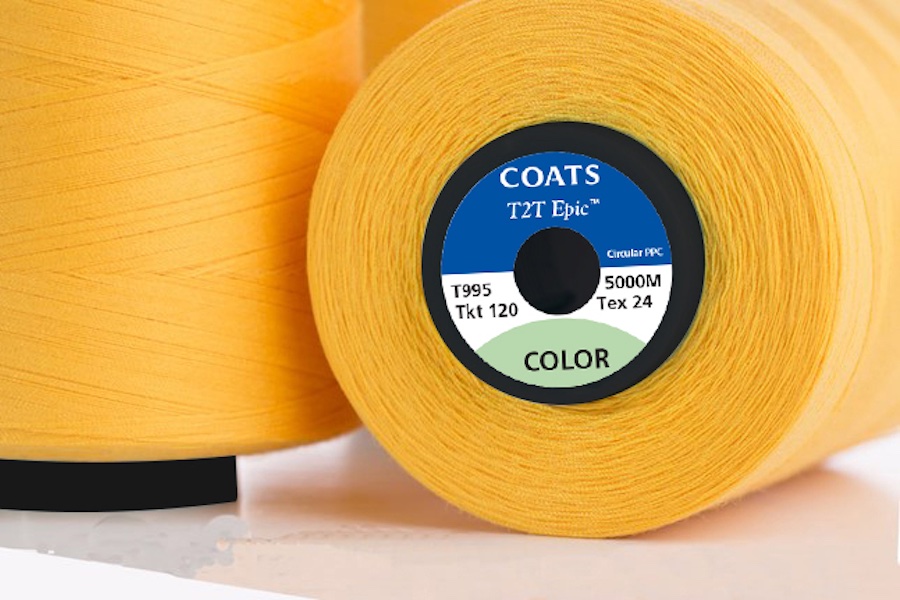
Proof-of-concept innovation aligns with Company’s broader sustainability goals, aiming to reduce Scope 3 emissions by cutting down on waste to landfill across its value chain.
COATS T2T Epic © 2025 COATS


Coats Group plc, a world-class Tier 2 manufacturer and trusted partner for the Apparel and Footwear industries, is introducing its latest innovation at the Textile Exchange Conference in Lisbon, Portugal: Coats Textile-to-Textile sewing threads.

Available in T2T Epic and T2T Gramax variants, these “proof-of-concept” threads are made from textile waste using a chemical recycling process. They deliver the same strength, durability, and colour fastness as standard Coats threads and can be switched out on the sewing machine lines with no downtime.

If used at scale, these innovative threads could help divert millions of garments from landfill each year.

“At Coats, circularity is no longer a concept; it’s a commitment,” said Adriana Morasco, Senior Vice President, Apparel Commercial. “Our Textile-to-Textile threads show that sustainability and performance can go hand in hand. They are designed to fit seamlessly into existing production lines, helping brands move faster toward their circularity goals.”

This marks a major milestone for the textile industry, driven by Coats’ commitment to innovation. Developed at the company’s Sustainability Hub in India, Coats Textile-to-Textile threads are made from post-industrial and post-consumer waste. This initiative is a key step in addressing textile waste, helping divert it from landfills and repurposing it into high-quality sewing threads, reducing environmental impact and advancing a circular economy.

By 2026, Coats will increase its preferred raw materials to 60%, up from 31% in 2022 and 46% in 2024. This innovation helps brand partners accelerate their own material transitions, making circular content possible for one of a garment's most critical components: the thread.


Coats in Lisbon

Coats invites visitors to discover its Textile-to-Textile threads at the Textile Exchange Conference, taking place from October 13–17, 2025, in Lisbon, Portugal. At the booth, attendees can experience the innovation in action and learn how Coats supports the transition toward a circular future.



More News from Coats Digital

#Software

Tunicotex Group boosts OTDP to 85%, cuts planning time by 25% & expands production capacity by 40%

Coats Digital is delighted to announce that following the implementation of FastReactPlan, leading Tunisian premium knitwear manufacturer, Tunicotex Group, has significantly improved its on-time delivery performance from 75% to 85%, reduced planning time by 25%, minimised delays and penalty costs, and unlocked 40% additional capacity to take on more customer orders and support sustained business growth.

#Industry 4.0 / Digitalization

Suzhou Tianyuan boosts costing accuracy to 98% with Coats Digital’s GSDCost

Coats Digital is delighted to announce that Suzhou Tianyuan Garments Co., Ltd., a leading manufacturer of high-quality sportswear and functional apparel for global brands such as Adidas, FILA, ANTA, and The North Face, has achieved remarkable productivity and cost management improvements following the implementation of Coats Digital’s award-winning method-time-cost optimisation solution, GSDCost.

#Software

Embee International Selects Coats Digital’s GSDCost Solution to Drive Accuracy, Efficiency, and Global Competitiveness

Coats Digital is pleased to announce that leading global apparel manufacturer, Embee International Industries, has implemented Coats Digital’s GSDCost solution across its operations to eliminate inaccurate costing, streamline production processes, and boost competitiveness in international markets. The move forms a key part of Embee International’s digital transformation strategy to drive greater efficiency, improve quality, and strengthen partnerships with its portfolio of top global brands.

More News on Sustainability

#Sustainability

Ying McGuire becomes new CEO of Cascale

Cascale today announced the appointment of Ying McGuire as Chief Executive Officer, effective June 1, 2026.

#Sustainability

VAUDE eliminates PFAS from all products

PFAS (per- and polyfluoroalkyl substances) are now detectable worldwide – in drinking water, soil and the human body. These so-called “forever chemicals” are considered hazardous to health and potentially carcinogenic, as they do not break down and remain in the environment permanently. Despite these risks, PFAS are still used in a wide range of products. More than 15 years ago, VAUDE made a strategic decision to gradually eliminate PFAS from all product categories.

#Sustainability

OEKO-TEX® chooses TextileGenesis to advance digital traceability for organic cotton

OEKO-TEX® today announced a full collaboration with TextileGenesis, a Lectra company, to digitally trace and authenticate organic cotton, strengthening fraud prevention across the supply chain. This announcement follows a successful pilot and brings together OEKO-TEX®’s certification expertise and closed testing system with TextileGenesis’ digital traceability platform to deliver a secure, end-to-end solution for managing certified organic cotton flows.

#Europe

ICAC to support European Commission on pending PEF legislation

The International Cotton Advisory Committee (ICAC) is proud to announce that it has been included as a member of the European Commission’s Technical Advisory Board (TAB) on the Product Environmental Footprint methodology. The Commission developed the Product Environmental Footprint (PEF) to assess and communicate the life cycle environmental performance of products and organizations.

Latest News

#Textiles & Apparel / Garment

VIATT 2026 to debut German Pavilion, strengthening European participation alongside key Asian textile hubs

Vietnam’s textile and garment sector continues to be a major contributor to the country’s economic growth, with export revenues expected to reach USD 46 billion in 2025, a 5.6% increase from 2024 . From 26 – 28 February, the Vietnam International Trade Fair for Apparel, Textiles and Textile Technologies (VIATT) is set to contribute to economic growth opportunities by accelerating digital transformation and green transition across the entire textile value chain. The upcoming edition will respond to the rising demand for advanced technologies and sustainable materials with the introduction of the German Pavilion, alongside strong exhibitor participation from key Asian sectors, as well as several high-profile fringe events.

#Technical Textiles

Sustainable, lightweight, and sound absorbing: Polyester-based front trunk solution for BEVs

As car manufacturers look to further reduce their carbon footprint, Autoneum has developed an innovative front trunk solution for battery electric vehicles (BEVs), made entirely from polyester-based textile. The Ultra-Silent Frunk offers significant weight reduction, improved acoustic and thermal insulation, and uses up to 70 percent recycled material, supporting sustainable and efficient vehicle design. Autoneum, global technology leader in acoustic and thermal management for vehicles, has already received orders for the new frunk from three major OEMs in Asia and Europe to be built in three BEV models. Series production for two BEVs has been underway in China and Germany since last year.

#Raw Materials

Modern testing methods for raw cotton

The 38th International Cotton Conference Bremen will take place from 25 to 27 March 2026 at the Bremen Parliament. This conference has traditionally stood for in-depth expertise and international exchange. The program will focus on technical innovations, market trends, and regulatory frameworks across the entire value chain – from agriculture to the circular economy. With high-profile speakers, the conference is regarded as the key meeting point for the global cotton industry. Today’s focus: Cotton quality and testing methods.

#Spinning

Rieter responds to higher raw material prices

Global political and economic developments have been leading to rising raw material and energy costs for some time. The textile machinery industry is also affected by this trend. Rieter machines and components consist to a large extent of steel, copper, aluminum and electronics. These materials in particular have seen higher demand and higher prices in recent months.

TOP