[pageLogInLogOut]

#Sustainability

Jeanologia celebrates World Water Day with a milestone: 20 million m³ of polluted water saved from the planet
The company presents its Ecological Profit and Loss Account with record-breaking figures that support the viability of a more eco-efficient industrial model in the textile sector.
“The future of fashion depends on a greater integration of circular and efficient solutions,” says Enrique Silla, CEO of Jeanologia © 2025 Jeanologia

On the occasion of World Water Day, Jeanologia reaffirms its commitment to dehydrating and detoxifying the textile industry by presenting its Ecological Profit and Loss Account—a pioneering report that quantifies the positive impact of its innovative solutions in terms of water savings and emissions reduction.

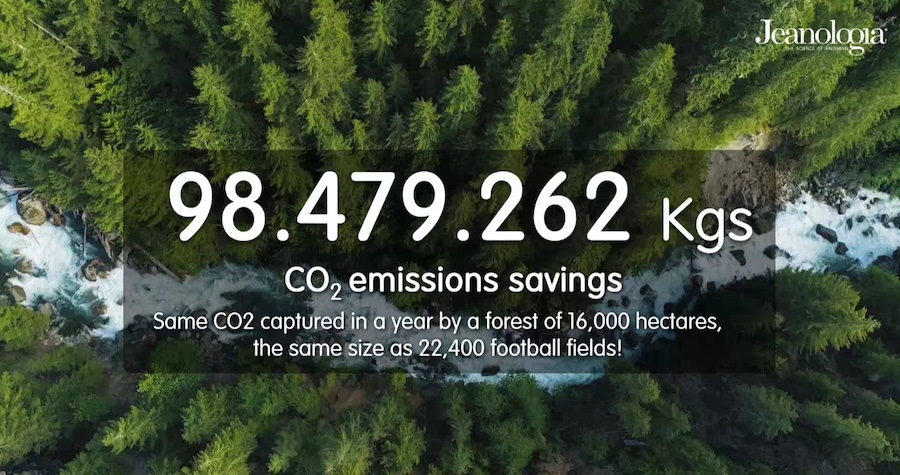
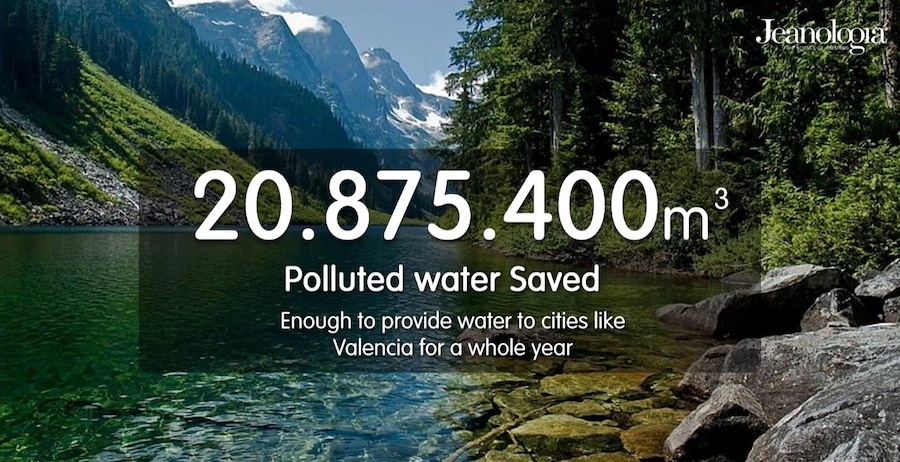
The figures for 2024 speak for themselves: 20,875,400 cubic meters of polluted water saved and a reduction of 98,4 million kilograms of CO? emissions—a contribution equivalent to the annual water consumption of a city the size of Valencia and the carbon capture in a year by a forest of 16,000 hectares, the same size as 22,400 football fields. This means millions of liters of wastewater have been prevented from reaching rivers and seas, and millions of kilograms of CO? from polluting the atmosphere.

Water scarcity: the textile industry’s challenge and the urgency to act

The fashion industry, one of the most water-intensive and waste-generating sectors, faces a critical challenge. Each year, it is estimated to use 93 billion cubic meters of water and generate 20% of the world’s wastewater, mostly due to processes like dyeing and garment finishing. This scenario highlights the urgent need for transformation.

The global water crisis demands concrete solutions. Jeanologia has proven that it is possible to produce fashion responsibly, significantly reducing environmental impact without compromising quality, authenticity, creativity, or profitability.

As Enrique Silla, CEO of Jeanologia, points out, “The textile industry faces a historic opportunity to reinvent itself and prove that fashion can be produced without harming the planet.” He adds, “The future of the sector relies on the deeper integration of circular and efficient solutions,” underlining the need to adopt technologies that enable a shift towards more sustainable production.

Eco-efficient technologies: the key to zero-discharge production

The denim revolution is driven by innovation. Since its founding three decades ago, Jeanologia has developed a integrated ecosystem of technologies that enable zero discharge and minimal water usage. Among its specialized solutions for the denim industry are:

+ Laser: A pioneering technology that replaces traditional abrasion methods, eliminating the use of water and harmful chemicals.

+ eFlow: Uses nanobubbles to transport chemicals precisely to fabrics, minimizing water usage and ensuring zero discharge.

+ Airwash Tech (G2 Indra): Replaces conventional water-based garment washing with air, significantly reducing both water and chemical consumption.

+ H2Zero: A closed-loop water recycling system that recovers up to 95% of water used during production.

Jeanologia has implemented these technologies in over 80 countries, working with leading global manufacturers to completely transform how jeans are made. Sustainability in the textile sector is no longer a promise—it’s a measurable reality.

“There’s no innovation without implementation. Every cubic meter of water we save from pollution, every kilogram of CO? we prevent, proves that the industry can—and must—be part of the solution,” says Silla.

Jeanologia as a driver of change: a call to the industry

Jeanologia has established itself as a strategic partner to brands, retailers, and manufacturers seeking to align fashion and sustainability in a genuine way. Its Mission Zero initiative continues moving forward with a clear goal: textile production with no excessive water use and no pollutant discharge.

“The challenge is global, and the response must be collective. We invite the industry to join this real transformation, where innovation and sustainability go hand in hand,” Silla concludes.

This World Water Day, Jeanologia presents not just data, but a clear message: change is possible—and it’s already happening.
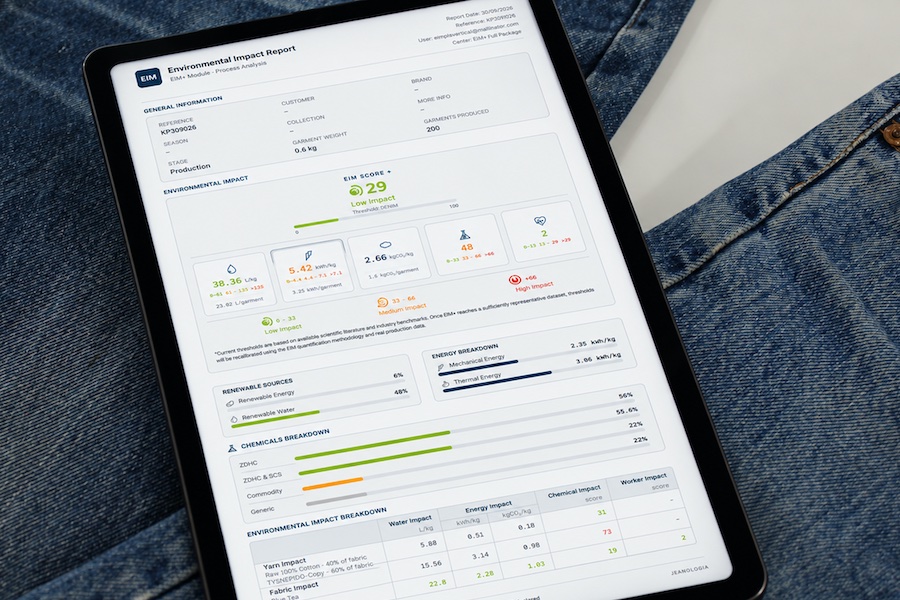
Jeanologia has proven that it is possible to manufacture fashion responsibly without compromising the planet © 2025 Jeanologia


More News from JEANOLOGIA S.L.

#Denim

Jeanologia shapes the denim of the future at Kingpins with ‘Mediterranean Soul’

Jeanologia, the global leader in sustainable technologies for the textile industry, returns to Kingpins Amsterdam with its new collection “Mediterranean Soul”, blending nature, creativity, and technology to prove that authentic denim can be designed and produced with efficiency and minimal environmental impact.

#Denim

Guess Jeans and Jeanologia bring the future of denim to Tokyo

From July 4 to 12, Harajuku, Tokyo’s iconic fashion district, will host “The Next 40 Years of Denim”, an immersive exhibition presented by GUESS to celebrate the past and future of denim. This unique experience blends heritage, innovation, and sustainability to mark the beginning of a new chapter, the era of air.

#Textile processing

Jeanologia brings the creative revolution of denim to Kingpins China

The city of Hangzhou hosts a new edition of Kingpins, Asia’s leading denim trade show, on May 22 and 23. Jeanologia, a global leader in sustainable textile finishing technologies, is taking part in this major industry event with a disruptive proposal that leads the way into a new era of denim, driven by creativity, sustainability, and digitalization.

#Denim

Jeanologia takes laser technology to new creative heights at Kingpins Amsterdam

Jeanologia, a global leader in technological innovation for the textile industry, introduce its new concept “ONE TECHNOLOGY. ALL POSSIBILITIES” at Kingpins Amsterdam. This statement of intent emphasizes laser technology as a tool for expression, efficiency, and transformation. One system, infinite possibilities to redefine denim and bring any creative vision to life.

More News on Sustainability

#Research & Development

The region of renewable raw materials: Central German Alliance for Bioplastics

The development of sustainable plastic solutions is rapidly gaining importance in light of global environ- mental pollution, dwindling fossil resources and ambitious climate protection targets. As part of the re- gional alliance RUBIO, which brings together 18 partners from central Germany and the Berlin-Branden- burg area, the bio-based and biodegradable plastic polybutylene succinate (PBS) was comprehensively investigated, starting with the raw material, through the manufacturing process, to industrial application.

#Textile chemistry

Archroma funds development of sustainable textile laboratory at Mumbai’s Institute of Chemical Technology

Archroma, a global leader in specialty chemicals focused on sustainable solutions, has supported the Institute of Chemical Technology (ICT), Mumbai, India in the renovation and development of a sustainable laboratory facility as part of its Corporate Social Responsibility (CSR) program.

#Sustainability

Peak Sustainability Ventures & Arvind launch India’s first industrial-scale cotton-stalk torrefaction project, decarbonizing textile manufacturing in Gujarat

Arvind Limited, one of India’s leading textile-to-retail conglomerates, and Peak Sustainability Ventures, a Mumbai-based global climate investment firm, have entered into a partnership to build a large-scale cotton stalk torrefaction plant in Gujarat, with a capacity of 40,000+ tonnes per year, to accelerate Arvind’s decarbonization goals and promote torrefaction at scale in India.

#Sustainability

Textile Exchange evolves its membership structure to unlock the next stage of collective action for climate and nature

Textile Exchange is excited to announce that it is evolving its membership structure to a more action-oriented, impact-driven model designed to provide clearly defined pathways that help organizations respond to the climate and nature crisis.

Latest News

#Recycling / Circular Economy

Advanced Recycling Conference 2025 fuels innovation across key waste streams

The Advanced Recycling Conference (ARC) 2025 brought together nearly 220 experts from 28 countries to spotlight pioneering advancements and foster industry collaboration in recycling across diverse waste streams including plastics, textiles, automotive and other materials.

#Dyeing, Drying, Finishing

Navis TubeTex announces U.S. partnership with Icomatex

Navis TubeTex, a global leader in advanced dyeing and finishing machinery solutions, is pleased to announce a new partnership with Icomatex (www.icomatex.com), a respected European manufacturer of high-quality stenters and textile finishing equipment. Under this agreement, Navis TubeTex will exclusively represent the Icomatex stenter line in the United States.

#Recycling / Circular Economy

ADVANSA launches ADVA®tex: A new step toward textile-to-textile recycling

ADVANSA has introduced ADVA®tex, a new filling fibre made entirely from recycled pre-consumer textile waste, positioning the material as a significant step forward in textile-to-textile (T2T) recycling. The fibre is designed for use in duvets, pillows, mattresses, and furniture applications and is available in three versions.

#Knitting & Hosiery

KARL MAYER celebrates 35 years of EL pattern drive

KARL MAYER is celebrating an anniversary this year: on 30 November 1990, the first warp knitting machine with electronic guide bar control, the KS 4 EL, was delivered – another milestone for patterning. As early as 1980, the SU gearbox with the MRS42SU had initiated the transition from mechanical chains to digital data.

TOP