#Sustainability
Epson research reveals more people cite climate change as a critical global issue than any other – as technology seen as an enabler to solve the crisis
Epson Research reveals more people cite climate change as a critical global Issue than any other - as technology seen as an enabler to
People born since the first COP – the COP Generation - optimistic about a solution but sensitive to cost
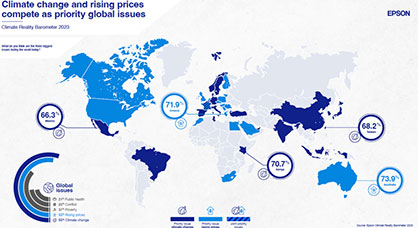
Now in its third year, the Barometer is published as evidence grows of catastrophic climate change: with record high sea temperatures; record low levels of Arctic and Antarctic sea ice; and extreme climate events across the world. Increasingly adverse events are likely to explain more people citing “Climate Change" (55%) than any other global issue, including “Rising Prices” (53%), “Poverty” (37%) and “Conflict” (23%).
Yasunori Ogawa, global president of Epson, said, “As adverse impacts accelerate, now more than ever, we need to understand attitudes towards ongoing climate change. Epson is fully committed to achieve UN Sustainable Development Goal 13 through positive climate action - and to delivering solutions that enrich lives and build a better world.
“The Climate Reality Barometer has enabled us to reach out across geographies, generations and economies, and has given us insights into how climate change transforms the ways we live – and how we can all combat it. We believe that listening to the younger generation will help governments, communities and companies better align positive action to support those for whom climate change has been a lifelong reality.”
The COP Generation – optimism from climate change natives
With the 28 thCOP fewer than 50 days away, Epson shines a spotlight on the attitudes of people born since the first COP in 1995. Currently 29 years old and under, this is the COP Generation (Gen COP). They are climate change natives who have lived their whole lives in the shadow of increasingly adverse weather events – and their experiences and insights need to be central to effective solutions.
While there may be regional differences, the Climate Reality Barometer reveals that globally Gen COP is the joint most optimistic age group (equal with 35-44) – with close to half (49%) believing that we will solve the climate crisis within their lifetime. This contrasts with the 45-54 and 55+ age groups, which register the lowest optimism at 42% and 32% respectively.
Groups invested in the decades ahead – either for themselves or through their children – show the highest levels of optimism about our ability to solve the crisis. While Gen COP is the most optimistic age range, the most optimistic group of all (55%) consists of parents of children under the age of 18 – the world’s ‘Mom & Pop’.
Extending this comparison, however, it’s clear that optimism leads to different outcomes. When asked what positive climate actions they already take, Gen COP records: lower levels of action than the global average in nine of the 14 categories; and lower levels of action than Mom & Pop in 12 of the 14 categories (see the climate actions table in notes to editors below).
There are likely multiple reasons for this. Gen COP have grown up with climate change and the increasing focus on the environment, while older age groups may recognise increasing volatility over time. It’s also interesting to note that Gen COP sees “Rising Prices” as a bigger issue than “Climate Change” (51% v 47%), so affordability of often more expensive sustainable choices is also a likely cause.
Climate action – and inaction
While climate positive action is widespread, there are groups of respondents who state that they will never act across key areas. As an example, globally, 38% report that they have already reduced international business and leisure travel, and a further 30% that they plan to do so. Almost one person in six, however, states that “I will never do this” (17%).
This reluctance to act on international travel is significantly higher in markets such as Singapore, Spain and the UK (21%), Japan and the Netherlands (22%), Canada and Germany (23%), Australia and Serbia (26%) and Israel (31%). As a counterpoint, fewer people from countries such as South Korea (9%), China (10%), Egypt and Turkey (11%) and Morocco and UAE (12%) say they will never reduce international travel.
Globally, the “I will never do this” response is also particularly noticeable in areas such as “Reduce consumption of animal products“ (18%), “Boycott unsustainable brands” (15%), and “Encourage friends and family to learn about the climate crisis” (10%).
Reasons for resistance to action will be complex, including geographic, cultural, and economic factors and faith in humanity’s ability to solve the issue without having to take individual action.
Technology as an enabler
Barometer respondents see technology as the most important weapon in the fight against catastrophic climate change.
When asked what they believed was the most important thing that a business could do to tackle the issue, 48% cited investment in environmental technologies. This was closely followed by improvements in the recycling and reuse of products (45%), with reductions in the use of resources (28%), encouraging employee participation in environmental activities (21%) and offsetting carbon and plastic impact (21%) making up the top five.
Henning Ohlsson, Epson Europe’s director of sustainability, said, “Epson’s Climate Reality Barometer ensures that all voices – including those of the often-overlooked COP Generation – are heard as the world moves to tackle climate change. It has surfaced issues such as familiarity and affordability as possible barriers to action for millions of younger people. It shows us that some people continue to ignore catastrophic climate change and refuse, or feel unable, to act.
“These issues, however, are not problems confined to specific groups: they are challenges for us all. If we are to solve the climate crisis, we must act as one.
“Epson’s Barometer also shows us the way forward as people look to companies to take the lead on the green transition. Epson sees technology as an enabler, with products that are designed to use fewer resources in production and use, last for longer, are more easily repairable, can be re-used and are more easily recycled. Together, we can create the solutions that people need as they act to mitigate climate impact.”