[pageLogInLogOut]

#Sustainability

Government of Cuba signs first memorandum of understanding with U.S.-based non-governmental organization

From left to right. Back row: Angel Braestrup (TOF Board of Directors), Olha Krushelnytska (TOF Board of Directors), Nguyen Trung Quynh (Counselor, Head of Science and Technology Office, Embassy of Vietnam), Elliot Cafritz (TOF Board of Directors), Alejandra Navarrete (TOF), Dr. Gonzalo Cid (International Activities Coordinator, National Marine Protected Areas Center & NOAA), Russell Smith (TOF Board of Directors), Nguyen Thanh Binh (First Secretary of the Embassy of Vietnam). Front row: Mark J. Spalding (TOF President), Her Excellency Ambassador Mrs. Lianys Torres Rivera (Cuban Charge d’Affaires to the United States) © 2023 The Ocean Foundation
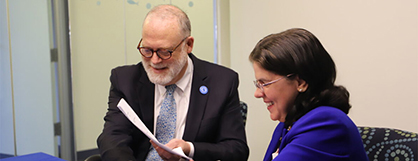
The Government of Cuba and The Ocean Foundation signed a Memorandum of Understanding (MoU) today; one that marks the first time the Government of Cuba has signed a MoU with a non-governmental organization in the United States.

The MoU draws on over thirty years of collaborative ocean science and policy work between the organization and Cuban marine research institutions and conservation agencies. This collaboration, facilitated through The Ocean Foundation’s nonpartisan platform, focuses primarily on the Gulf of Mexico and Western Caribbean and among the three countries that border the Gulf: Cuba, México and the United States. 
© 2023 The Ocean Foundation


The Trinational Initiative, an effort to advance collaboration and conservation, began in 2007 with the goal of establishing a framework for ongoing joint scientific research to preserve and protect our surrounding and shared waters and marine habitats. ?In 2015, during the rapprochement between Presidents Barack Obama and Raúl Castro, scientists from the US and Cuba recommended the creation of an Marine Protected Area (MPA) network that would transcend 55 years of exceptionally limited bilateral engagement. The leaders of the two countries saw environmental cooperation as the first priority for reciprocal cooperation. As a result, two environmental agreements were announced in November 2015. One of those, the Memorandum of Understanding on Cooperation in the Conservation and Management of Marine Protected Areas, created a unique bilateral network that facilitated joint efforts concerning the science, stewardship, and management across four protected areas in Cuba and the United States. Two years later, RedGolfo was founded in Cozumel in December 2017 when Mexico added seven MPAs to the network – making it a truly Gulf wide effort. The other agreement set the stage for continued cooperation in marine conservation between the US State Department and the Cuban Ministry of Foreign Relations. Both agreements regarding the exchange of information and research on weather and climate issues, remain in force despite a temporary downturn in bilateral relations that started in 2016.

The MoU with Cuba is being executed by the Cuban Ministry for Science, Technology and Environment (CITMA). The MoU states the need to protect the marine and coastal biological diversity shared by both countries, which, as a result of the Gulf Stream and a geographical distance of only 90 nautical miles is considerable when it is well established that most of Florida’s fish and benthic habitat such as corals are replenished from stocks to the immediate south. It also upholds the Trinational Initiative and RedGolfo as effective networks to advance cooperation in the study and protection of marine resources, and takes into account the important role of Mexico. The MoU covers the study of migratory species; connectivity between coral reef ecosystems; restoring and sequestering carbon dioxide in mangrove, seagrass, and wetland habitats; sustainable resources use; adaptation and mitigation of climate disruption; and finding new financing mechanisms for multilateral cooperation given a history of mutual adversity. It also reinforces the study of shared US-Cuban organisms and coastal habitats such as manatees, whales, corals, mangroves, seagrasses, wetlands, and sargassum.


Prior to the signing, Ambassador Lianys Torres Rivera, the first woman to ever head Cuba’s mission in Washington, provided an overview of the history of work between Cuba and The Ocean Foundation and the importance of the precedent setting partnership. She notes that:

“This has been one of the few areas of academic and research exchange that has been sustained for decades, despite adverse political contexts. In a prominent way, The Ocean Foundation has played a decisive role in the establishment of authentic links of bilateral scientific cooperation, and created the basis to reach the agreements that exist today at the government level.”

Ambassador Lianys Torres Rivera

Mark J. Spalding, President of The Ocean Foundation, explained how the only community foundation for the ocean is uniquely positioned to collaborate with the Government of Cuba as part of their work in Ocean Science Diplomacy:

“TOF stands by its commitment of over three decades to use science as a bridge; to emphasize the protection of shared marine resources. We are confident that agreements like this can set the stage for enhanced cooperation between our governments on coastal and ocean science, including severe weather preparedness.”

Mark J. Spalding | President, The Ocean Foundation

Dr. Gonzalo Cid, International Activities Coordinator, National Marine Protected Areas Center & NOAA – Office of National Marine Sanctuaries; and Nicholas J. Geboy, Economic Officer, Office of Cuban Affairs, US Department of State attended the event.

The memorandum was signed at The Ocean Foundation’s office in Washington, D.C.


More News from TEXDATA International

#Texprocess 2026

Texprocess 2026: Automation, digitalisation and AI redefine textile processing

Making investment decisions in textile processing has become significantly more demanding. Increasing energy costs, a shortage of skilled labour and ongoing geopolitical uncertainties are compelling companies to focus on technologies that deliver clear gains in efficiency and process reliability. This applies equally to apparel manufacturing and to the processing of technical textiles and high-performance materials. As a result, modernisation initiatives are assessed more carefully – even as the need to upgrade production systems continues to intensify.

#Techtextil 2026

Techtextil 2026: Between innovation pressure & market reality

From 21 to 24 April 2026, Techtextil in Frankfurt am Main will once again become the central meeting point for the international technical textiles and nonwovens industry. Running in parallel, Texprocess will focus on the industrial implementation of textile processing technologies as the leading platform in this field. Together, the two trade fairs form a closely integrated presentation and working platform along the entire textile value chain – from material development to finished applications.

#Techtextil 2026

Between geopolitical pressure and industrial resilience

In this interview, Dr. Janpeter Horn (VDMA) discusses the current challenges facing textile machinery manufacturers, shaped by geopolitical tensions, regulatory developments and subdued investment. He also outlines why innovation strength, integrated solutions and strategic positioning remain key to global competitiveness.

#Texprocess 2026

Between investment restraint and modernization pressure

Texprocess 2026 takes place in a complex market environment shaped by uncertainty and innovation pressure. In this interview, Elgar Straub (VDMA) explains why the trade fair is particularly relevant this year and which technologies are driving efficiency and competitiveness.

More News on Sustainability

#Sustainability

A new standard to combat plastic waste in forests

With DIN SPEC 35808 “Tree Shelter for Forestry Applications,” the testing and research service provider Hohenstein, in collaboration with Rottenburg University of Forestry, as well as forestry authorities and industry partners, has established a clear framework for bio-based and fully biodegradable tree shelters. The pre-standard defines requirements and practical testing methods designed to reduce plastic waste in forests and strengthen the long-term protection of soil and the environment.

#Denim

Denim moves towards sustainability

EIM (Environmental Impact Measurement), the global reference platform for measuring the environmental impact of garment finishing, presents the second edition of its annual report Denim Industry Progress & Insights 2025. The study analyses over 100,000 real denim finishing processes, providing an accurate and up-to-date view of the industry’s evolution towards more sustainable models.

#Recycling / Circular Economy

Europe’s textile future at a turning point: New 2030 Circularity Blueprint aims to scale recycling and unlock investment opportunities

The EU textile system is at a critical crossroads. Today, less than 1% of discarded garments are recycled into new garments, despite EU-wide obligations for separate collection. In response, Global Fashion Agenda (GFA) is launching the 2030 Circularity Blueprint, in partnership with ReHubs. This ambitious initiative is designed to support the transformation of the EU textile ecosystem to advance textile-to-textile recycling and drive the transition to a circular economy.

#Sustainability

Number of GOTS-certified facilities grow 15% globally as demand for credible sustainability standards continues to strengthen

Global Organic Textile Standard (GOTS) certification continued to grow in 2025, with nearly 18,000 certified facilities worldwide, despite ongoing geopolitical uncertainty and rapidly evolving regulatory requirements across global textile supply chains.

Latest News

#INDEX 2026

ANDRITZ at INDEX ’26: Driving sustainability with next-generation nonwoven technologies

From May 19-22, ANDRITZ Nonwoven & Textile is presenting its innovative solutions for the nonwoven & textile industry in Geneva, Switzerland. ANDRITZ will focus on technologies for sustainable and durable nonwovens, converting, sustainable fiber processes, textile recycling, and life-cycle services on booth 2114 in hall 02.

#INDEX 2026

INDEX™26: World’s leading nonwovens exhibition presents groundbreaking product launches, exclusive seminars and immersive experiences

From 19 to 22 May 2026, 620 exhibitors from 44 countries will gather in Geneva at Palexpo for INDEX™26. The exhibition aims to demonstrate how the future of technical materials will increasingly be shaped by collaborative supply chains and integrated innovation across the nonwovens industry. This year’s edition focuses not only on individual technological advances, but also on how cooperation throughout the value chain can enhance the performance, sustainability and value of nonwoven solutions.

#INDEX 2026

The LYCRA Company launches LYCRA® ADAPTIV fiber for nonwovens, advancing comfort and fit in disposable hygiene at INDEX™ 26

The LYCRA Company, a leader in innovative and sustainable fibers for apparel and personal care, today announced the official global launch of LYCRA® ADAPTIV fiber for nonwovens at INDEX™ 26, in Geneva, Switzerland, May 19–22. This breakthrough stretch fiber, already trusted by leading global apparel brands, now ushers in a new era of comfort, fit, and performance for baby diapers, disposable hygiene products, adult incontinence, and feminine care.

#INDEX 2026

Innovations for today – solutions for tomorrow: Trützschler Nonwovens at INDEX™ 2026

From 19 to 22 May, Trützschler Nonwovens will present itself at booth 1641 as a long-term partner to its customers. The focus will be on new products for all nonwoven processes, further developments of the digital working environment T‑ONE, and an expanded service portfolio.

TOP