[pageLogInLogOut]

#Sustainability

Recover prepared for France's new eco-labelling law
© Recover Textile Systems
In April 2022, the French Decree n° 2022-748, formerly known as the Loi AGEC (anti-waste law for a circular economy) was published. This Decree regulates and mandates certain information provided to consumers and will come into play this January 2023. The aim of this regulation is to provide consumers with information about the environmental qualities and characteristics of waste-generating products, including textiles.

Who's affected?

This regulation will apply to all producers, importers, distributors, or other parties with an annual turnover >50M€ who are responsible for placing at least 25,000 pieces of waste-generating consumer products on the French market.

An exception is made for products where the last units are placed on the market between 1st January 2023 and 31st March 2023.

In 2024, the law will extend to an annual turnover of more than 20 million euros and at least 10,000 pieces on the French market. And in 2025 the decree will extend to an annual turnover of more than 10 million euros and 10,000 pieces on the French market. 

What information is required?

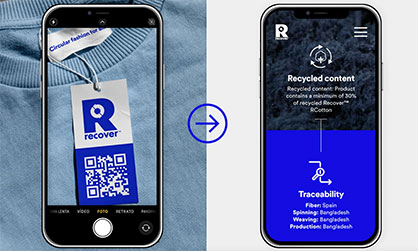
Recycled content. The statement “product containing at least X% recycled materials” must be displayed on the product. The incorporation of recycled materials must also be communicated to consumers for packaging used to market products consumed or used by households, including those consumed outside the home.

Traceability. Companies will need to provide traceability information for a product. Brands must disclose where each stage of production takes place. So, for textiles: cutting and sewing, knitting and weaving, dyeing, and printing.

© Recover Textile Systems


Microplastics. Companies are required to disclose information on the presence of plastic microfibers if a textiles product contains more than 50% of synthetic fibers.

Hazardous substances. The presence of hazardous chemicals must be communicated if the concentration is more than 0.1% of the mass in a substance, mixture, or article in line with Article 3 of EU REACH regulation.

Recyclability. Information on a product or packaging’s recyclability should be expressed in the statement “mostly recyclable product” or “mostly recyclable packaging”.

  • The regulation states that for a product to be recyclable, it must cover the following 5 elements:
  • Can be efficiently collected locally through the population’s access to local collection points.
  • Can be sorted, for instance it can be directed to recycling channels.
  • Does not contain substances that will disrupt sorting, recycling or limit the use of recycled material.
  • Recycled material produced by recycling processes used must represent more than 50% of the bulk waste collected.
  • Can be recycled in practice and on an industrial scale, through a guarantee that the quality of the recycled material obtained is sufficient to guarantee the sustainability of the outputs. The recycling chain must also demonstrate sufficient ability to take charge of the products that can be integrated into it.

Reusability. Statements such as “reusable packaging” or “refillable packaging” must be displayed on the packaging.

Prohibited environmental terms. Under this decree, the terms “biodegradable”, “Respectful of the environment”, or any equivalent allegation are prohibited from being used on a product or its packaging.


How will brands communicate this information?

The information on the environmental characteristics of a product should be provided in an easily accessible digital format at the time of purchase.

A step in the right direction.

Recover™ supports transparency and regulatory measures meant to combat greenwashing across the board. In that sense, France’s new eco-labeling decree hopes to:

  • Increase consumer trust
  • Improve equity between companies
  • Reinforce environmental information online for consumers
  • Incentive eco-design by creating the demand

And while France’s new law is a commendable first step, it isn’t without potential complications.

Is the French eco-labeling law compatible with the EU's Green Claims Initiative?

While Recover applauds and supports comprehensive measures to hold brands accountable, they believe that it’s important that efforts are aligned industrywide.
© Recover Textile Systems


As France has released this decree prior to the European Union’s upcoming anti-greenwashing regulations (the Green Claims Initiative) it’s not yet clear whether the two will be compatible.

In other words: companies might have to do the work... twice.

In the interim while the EU adopts its own rules, companies operating in France could have to invest in measures to adhere to French regulations. But once the EU Green Claims Initiative is adopted, companies would have to reevaluate and adjust to the EU’s standards.




More News from TEXDATA International

#Recycling / Circular Economy

textile.4U publishes special edition “Top 100 Textile Recycling Companies 2025”

With a comprehensive 176-page special edition, textile.4U is dedicating its latest issue entirely to one of the most dynamic and influential topics in today’s textile industry: textile recycling. The new issue, published exclusively in high-quality print, presents the Top 100 textile recycling companies researched and selected by TexData – organizations that already play a key role in the transition to circular textiles or are expected to have a significant impact in the near future.

#Recycling / Circular Economy

Responsible Textile Recovery Act of 2024 signed by Governor

Senator Josh Newman (D-Fullerton) is proud to announce that Senate Bill 707 (SB 707), the Responsible Textile Recovery Act of 2024, has been signed into law by the Governor of California, Gavin Newsom. This groundbreaking legislation establishes the country’s first Extended Producer Responsibility (EPR) textile recycling program, marking a significant step forward in the state’s efforts to combat waste and promote sustainability.

#Textiles & Apparel / Garment

Modtissimo promotes sustainability with 28 coordinates in the Green Circle

Modtissimo is proving more and more to be a textile and clothing show that delivers the latest innovations in the area of sustainability, with the iTechStyle Green Circle being the main showcase for companies' creations. In this 60+4 edition, taking place on 12 and 13 September, 28 coordinates will be exhibited in a section organised by CITEVE and curated by Paulo Gomes.

#Europe

The EU and Egypt team up to mobilise private sector investments at Investment Conference and sign a Memorandum of Understanding underpinning €1 billion in macro-financial assistance for Egypt

At the EU-Egypt Investment Conference, co-organised by the EU and the Government of Egypt on 29-30 June, the EU and Egypt are teaming up to intensify private sector investments in Egypt. They are also signing a Memorandum of Understanding (MoU) for the disbursement to Egypt of up to €1 billion in Macro-Financial Assistance.

More News on Sustainability

#Yarns

Textile Exchange publishes the final criteria for its new Materials Matter Standard, marking a pivotal shift in connecting certification to impact

Textile Exchange has published the final criteria for its Materials Matter Standard—a major milestone in the organization’s multi-year transition toward a unified, impact-driven standards system for raw material production and primary processing. 

#Nonwovens

EDANA wraps up its Sustainability & Policy Forum 2025: Uniting the industry and EU policymakers to navigate the future of nonwovens

Against a backdrop of rapidly evolving environmental legislation, the EDANA Sustainability & Policy Forum 2025 concluded the past week in Brussels, marking a step forward in the dialogue between the nonwovens industry and European policymakers. Held from 9-10 December at the historic Residence Palace, the two-day event successfully brought together business leaders, sustainability experts, and EU officials to address the dual challenges of circularity and industrial competitiveness.

#Sustainability

YKK recognized with Top ‘A’ rating by CDP for climate change leadership for third consecutive year

YKK Corporation announced its achievement of the highest “A List” rating in the 2025 Climate Change survey conducted by the global environmental disclosure nonprofit, CDP . This marks the third consecutive year YKK has received this prestigious recognition.

#Weaving

Itema announces strategic partnership with Ivy Decarb to accelerate decarbonization in weaving process

Itema is pleased to announce the strategic partnership with Ivy Decarb, the digital platform helping textile companies measure and reduce their carbon footprint.

Latest News

#Heimtextil 2026

Eastman Naia™ expands All-Night Comfort at Heimtextil 2026

New fill solutions and the debut of sleepwear highlight the versatility and performance of Naia™ Renew, its circular fiber, for home textile applications.

#Heimtextil 2026

Stability in volatile markets: Heimtextil 2026 launches with 3,000 exhibitors and design expertise from Patricia Urquiola

Heimtextil opens the new season with 3,000 exhibitors from 66 countries – maintaining stability while becoming even more international. The new hall layout increases visibility and connects supply and demand even more efficiently. At the opening, architect and designer Patricia Urquiola and Rosa Bertoli, Global Design Director of Wallpaper magazine, talk about AI, innovative materials and future-oriented design for modern living environments.

#Research & Development

Innovation center for textile circular economy inaugurated

Just over eight months after the foundation stone was laid, the new Innovation Center for Textile Circular Economy was officially inaugurated today at TITK Rudolstadt. Thuringia's Minister President Mario Voigt, TITK Director Benjamin Redlingshöfer, and other guests of honor cut the ribbon to the modern building complex and viewed the premises, which are now ready for occupancy. The “DICE – Demonstration and Innovation Center for Textile Circular Economy” is TITK's largest single investment to date. The Free State of Thuringia supported the total cost of €11.5 million with €8 million in GRW and FTI funding.

#Research & Development

Sustainable design of Geosynthetics and roof underlayments made from recyclates

Is it possible to recover plastic recyclates from previously unused waste streams in order to produce high-quality fibers and films? How can bio-based polymer fibers be manufactured so as to allow adjustable biodegradability? These are the questions being addressed by researchers from the Fraunhofer Cluster of Excellence Circular Plastics Economy CCPE in the Zirk-Tex project.

TOP