[pageLogInLogOut]

#Research & Development

Innovation center for textile circular economy inaugurated
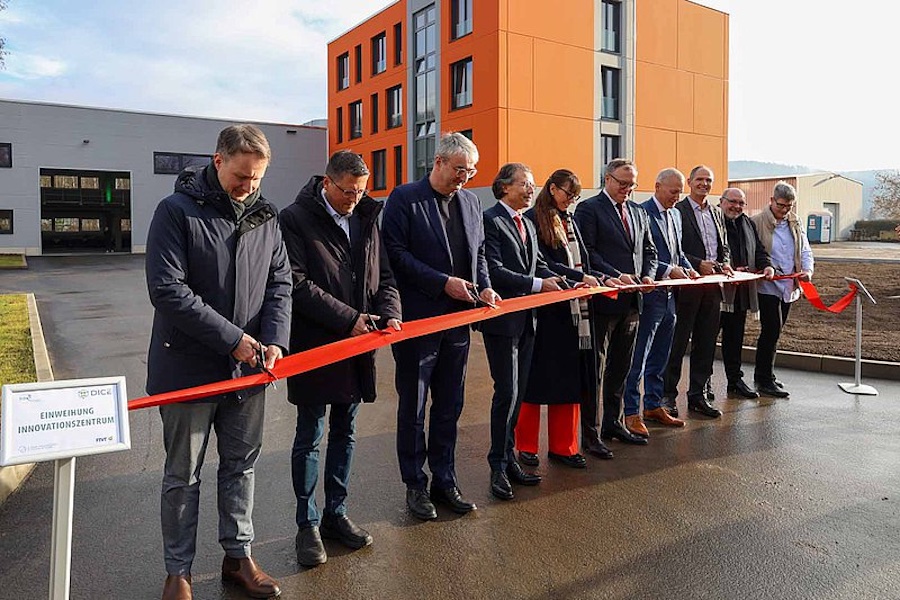
Official ribbon cutting for the new innovation center with (from left to right): State Parliament member Andreas Bühl, State Parliament member Maik Kowalleck, District Administrator Marko Wolfram, State Secretary for Economic Affairs Mario Suckert, Member of the Bundestag Diana Herbstreuth, Minister President Mario Voigt, TITK Director Benjamin Redlingshöfer, Zuse President Martin Bastian, Mayor Jörg Reichl, and TITK Department Head Ute Schubert. (Image rights: TITK / Steffen Beikirch)
Just over eight months after the foundation stone was laid, the new Innovation Center for Textile Circular Economy was officially inaugurated today at TITK Rudolstadt. Thuringia's Minister President Mario Voigt, TITK Director Benjamin Redlingshöfer, and other guests of honor cut the ribbon to the modern building complex and viewed the premises, which are now ready for occupancy. The “DICE – Demonstration and Innovation Center for Textile Circular Economy” is TITK's largest single investment to date. The Free State of Thuringia supported the total cost of €11.5 million with €8 million in GRW and FTI funding.

The rapid progress of construction on the institute's grounds has been a source of amazement for the employees of the TITK Group since spring. “We were always on schedule and within budget,” says TITK Director Benjamin Redlingshöfer. His announcement shortly after the laying of the foundation stone on March 31 that invitations to the inauguration would be sent out before the end of the year initially elicited skeptical smiles from some. But the promise was kept: “That was real ‘Thuringia speed,’” says Redlingshöfer proudly. The construction project was carried out by companies from the Free State.

Minister President Mario Voigt says: "The DICE is a strong signal for Thuringia's innovative strength: research is put into practice here, ideas become industrial solutions. In just eight months, visions have been turned into a center for visions. The rapid implementation shows that we in Thuringia not only have commitment and expertise, but also set a clear direction for the future with speed and efficiency. Innovative, sustainable, and competitive. The Free State of Thuringia has deliberately provided significant support for this forward-looking project because we want to further strengthen Thuringia as a location for research and development. I would like to express my sincere thanks to all those involved—the construction workers, the planners, those responsible at TITK, and all funding and project partners—who made this success possible. They have all set out to further advance the Green Heart of Germany and make it future-proof for the citizens of our state." 

The result is a four-story laboratory and office building and a test hall, each with a floor space of around 1,000 square meters. The barrier-free new building will house a biology laboratory and a pulp laboratory, among other things. The hall will focus on two main areas: polyester recycling and cotton recycling. In addition, research and testing of alternative pulp suppliers will also be a focus. Thanks to DICE, the TITK Group will have its own pulp cooking system in the future. This plant is currently still under construction in Saxony and is scheduled to go into operation in 2026.

The TITK director is convinced: “DICE will be the leading national and international innovation and demonstration center for research and development of environmentally friendly processes for the production of chemical pulp, the production of sustainable cellulose fibers, and the development of the necessary solution spinning technologies.” Redlingshöfer sees this as further proof that Thuringia is increasingly setting the pace for the German innovation landscape. “We have nothing to hide here.” 
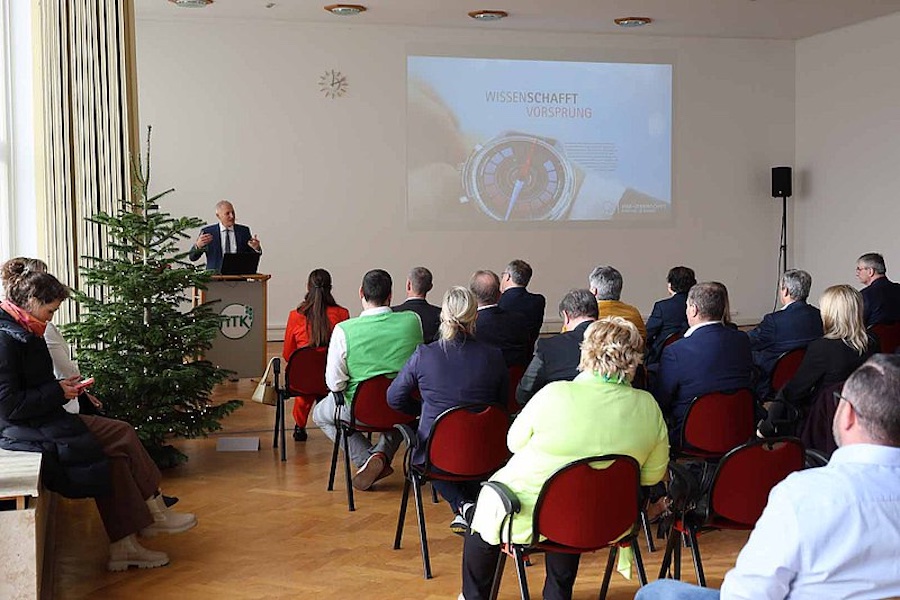
TITK Director Benjamin Redlingshöfer welcomed around 60 guests from politics, business, and research to the inauguration ceremony. (Image rights: TITK / Steffen Beikirch)


Important contribution to the transformation of the textile value chain

For more than 30 years, TITK has been dedicated to sustainable cellulose-based textile fibers. These Lyocell fibers have already undergone significant further development: they no longer use only wood pulp, but also, for example, fast-growing hemp, which consumes few resources. This year, the institute has taken a major step forward in developing innovative solutions for practical and holistic textile recycling: at the World Expo in Osaka (Japan), Redlingshöfer personally presented the world's first polo shirt made from triple-recycled hemp Lyocell fiber (Lyohemp®). 

The Rudolstadt-based institute aims to make an important contribution to the transformation of the textile value chain. The recycling of mixed textiles in particular is a key challenge that the new DICE innovation center will address. “Closed regional material cycles are our goal,” says Redlingshöfer. “But they must be ecologically and economically viable in order to guarantee market success.” The focus of the innovation center does not end with sustainable fibers for clothing textiles, but also explicitly includes technical textiles for high-performance applications in the automotive, aerospace, and defense sectors, for example. “Here, regionality also represents a resilience factor,” says the institute director. 

To date, 63 partners have agreed to cooperate with DICE, including well-known companies such as Adidas, Vaude, Continental, and Head, as well as other research institutions, associations, and networks.

During a tour of the new test hall: TITK Director Benjamin Redlingshöfer (right) explains further plans to guests. From left: State Secretary for Economic Affairs Mario Suckert, Minister President Mario Voigt, Mayor Jörg Reichl, and Martin Bastian, President of the Zuse Association. (Image rights: TITK / Steffen Beikirch)


More News from TITK Rudolstadt ( Thüringisches Institut für Textil- und Kunststoff-Forschung Rudolstadt e.V. )

More News on Research & Development

#Research & Development

Bio-based fibers with good flame retardancy

Fibers made from bio-based plastics reduce dependence on fossil raw materials and promote the circular economy. The covalent bonding of flame-retardant additives can open the way for these fibers to enter the mass market.

#Research & Development

Exchange data between textile companies openly, securely and cost-effectively without a central platform – ITA makes it possible

The Institut für Textiltechnik (ITA) of RWTH Aachen University has launched a new demonstrator for an open and secure data space in the textile industry at the Digital Innovation Centre Europe (DICE). For the first time, the demonstrator shows directly and clearly how companies can share their data securely with each other without the need for a central platform. Data exchange is based on shared, freely usable technical foundations.

#Research & Development

Sustainable athletic wear made from bio-based Polyethylene

Conventional sports textiles made from petroleum-based synthetic fibres are to be replaced in the future by sustainable, bio-based, cooling textiles. Polyethylene, previously used mainly in the packaging industry, is thus qualified for use in textiles and, as a bio-based drop-in solution, offers a cost-effective, sustainable alternative for the future.

#Research & Development

Sustainable design of Geosynthetics and roof underlayments made from recyclates

Is it possible to recover plastic recyclates from previously unused waste streams in order to produce high-quality fibers and films? How can bio-based polymer fibers be manufactured so as to allow adjustable biodegradability? These are the questions being addressed by researchers from the Fraunhofer Cluster of Excellence Circular Plastics Economy CCPE in the Zirk-Tex project.

Latest News

#Knitting & Hosiery

SHIMA SEIKI to exhibit at GMMSA Expo India

Leading Japanese computerized flat knitting technologist SHIMA SEIKI MFG., LTD. of Wakayama, Japan, together with its Indian sales representative Universal MEP Projects & Engineering Services, Ltd., will participate in the upcoming Garments Machinery Manufacturers & Suppliers Association (GMMSA) Expo India 2026 exhibition to be held in Ludhiana, India next month. Through its lineup at GMMSA, SHIMA SEIKI aims to further strengthen its presence within the Indian market with an exhibit that caters to diverse needs, consisting of seam-free WHOLEGARMENT® knitting technology as well as a brand-new shaping machine with high productivity and excellent cost performance.

#Nonwovens

ENDURANCE Program: Driving operational sustainability at Magnera

As Magnera enters a new year, the company is reflecting on a key sustainability milestone from 2025: the launch of ENDURANCE, its global, employee-led initiative focused on waste reduction and sustainable innovation. Launched on Earth Day 2025, this initiative has generated more than 250 improvement submissions from team members across Magnera’s global operations, demonstrating strong engagement and shared accountability for sustainability across the organization.

#Digital Printing

Maximising print efficiency exploring ink saving features for modern print production

In today’s print industry, balancing quality, efficiency, and environmental responsibility is a growing priority. With increasing pressure on margins and sustainability, solutions that streamline production without sacrificing results are more relevant than ever.

#Knitting & Hosiery

KARL MAYER opens a new TEXTILE INNOVATION CENTRE – a new era of textile innovation begins

KARL MAYER is opening its new TEXTILE INNOVATION CENTRE (TIC), sending a strong signal that it is driving textile innovation forward and opening up new perspectives for the textile industry. The TIC brings together the latest developments in Warp Knitting, Technical Textiles and Warp Preparation – KARL MAYER’s core areas of expertise.

TOP