[pageLogInLogOut]

#Sustainability

Global brands drive momentum on transition to forest-friendly supply chains
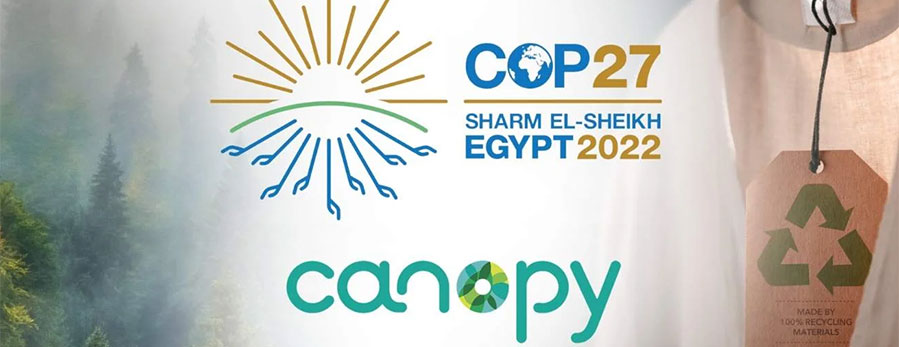
© 2022 Canopy
Today, during COP27, leading companies including, H&M, Inditex, Stella McCartney, Ben & Jerry’s, HH Global, and Kering announced a collective commitment to purchase over half a million tonnes of low-carbon, low-footprint alternative fibers for fashion textiles and paper packaging. It is a move that will support the protection of the world’s vital forests and ecosystems and lower forest degradation pressures from the fashion and packaging supply chains.

Leading companies pledge to purchase 550,000 tonnes of sustainable alternatives to materials sourced from Ancient and Endangered Forests

Spearheaded by environmental nonprofit Canopy, this commitment towards more sustainable, lower-carbon alternatives — known as Next Generation Solutions — reflects a building urgency across industries to accelerate the transition to nature-positive business models. This market pull is essential to attract the investment necessary to scale these game-changing Next Generation alternatives on ecologically meaningful timelines.

At last year’s UN Climate Change Conference, protecting nature was at the center of commitments to deliver on global climate targets. Today one-third of the world’s most influential companies have yet to make forest conservation commitments[1], despite the scientific community’s warnings that at least 50% of the world’s forests need to be conserved or restored by 2030 to ensure global temperature rises stay below 1.5 °C.

Every year, over 3.2 billion trees are cut down to produce fiber for packaging and clothing, releasing vast amounts of CO2 into the atmosphere. Alternatives to wood — such as agricultural residues and recycled textiles — are readily available and can be scaled in order to prevent the logging of these forests at this untenable rate. Moving to Next Generation Solutions could help avoid almost 1Gt of CO2 emissions between now and 2030.

“We are thrilled to advance this commitment with forward-looking partners who are willing to challenge the status quo and in doing so provide a breakthrough for these game-changing technologies,” said Canopy Founder and Executive Director, Nicole Rycroft. “This commitment will allow us to take a historic leap closer to the $64 billion of investments in sustainable alternatives needed to ensure forest conservation for our planet’s climate and biodiversity stability.”

Today’s commitment will help unlock the investment needed to build 10 – 20 new low-footprint, Next Generation pulp mills; provide farm communities and cities with new markets to replace the burning of straw residue and textile landfilling; and prevent an estimated 2.2 million tonnes of GHG emissions from going into the atmosphere relative to the equivalent production of virgin forest fiber.

“At H&M Group, we are committed to becoming a circular business, in which moving towards more sustainable alternatives for our materials is crucial. Canopy has showed true leadership by bringing the fashion and regenerated cellulosic industries together with the purpose of reducing fashion’s dependency on forests,” said Madelene Ericsson, Environmental Sustainability Business Expert H&M Group. “ Innovative low-carbon solutions, such as regenerated cellulosic fibers from waste textiles, microbial cellulose or agricultural residues, will play a vital role to help us reduce our impact on climate and protect forests, so no ancient and endangered forests are put at risk to make fashion. These next generation solutions and collaborations like Canopy’s help us taking strong steps towards our goal for all our materials to be either recycled or sourced in a more sustainable way by 2030.”

The signatories have also committed to ensuring their respective supply chains are free of Ancient and Endangered Forests and are calling on industry peers to follow suit by shifting towards sustainable Next Generation alternatives – such as fibers made from agricultural residue or recycled textiles.


When compared to forest fibers, Next-Generation Solutions have on average:

  • 95% to 130% less CO2 emissions
  • 18% to 70% less fossil energy resource depletion
  • 88% to 100% fewer land-use impacts
  • at least 5x lower impact on biodiversity/threatened species


”At Kering, we aim at reducing our footprint on biodiversity, and contribute to preserving and restoring critical ecosystems,” said Yoann Régent, Head of Sustainable Sourcing & Nature Initiatives. “We are excited to be joining our long-time partner Canopy to support a rapid scale-up of sustainable Next Generation materials production as well as uptake of low-carbon, low-footprint alternative fibers for textiles and paper packaging.”

“We are collaborating with Canopy to accelerate the development and adoption of Next Generation Solutions within supply chains rooted in forests. I am proud to say we have been partnering with Canopy since 2014 and have been a zero-deforestation brand since 2017 — never sourcing from ancient, endangered or protected forests. We must take action today in order to protect our forests for tomorrow,” said Stella McCartney.

“We are so pleased to be a part of this initiative to keep precious forests standing and to help speed the switch to low impact, circular alternatives for forest fiber,” said Kevin Dunckley, Chief Sustainability Officer at HH Global. “Now is the time for all of us — businesses, governments, and individuals, to do all we can to keep our climate stable. We hope today’s announcement starts a trend toward supply chain shifts across all sectors and hope this announcement will inspire many other companies to join.”

“We’re proud to be working with Canopy to create a more sustainable sourcing strategy for our fiber-based packaging. Moving away from virgin fiber is part of our larger strategy to reduce the footprint of our operations,” said Ben & Jerry’s Global Sustainability Manager, Jenna Evans. “While it’s clear that rapidly ending the age of fossil fuels is required to avoid catastrophic climate change, companies still must do the hard work to ensure their packaging isn’t contributing to deforestation as well.”



More News from TEXDATA International

#Recycling / Circular Economy

textile.4U publishes special edition “Top 100 Textile Recycling Companies 2025”

With a comprehensive 176-page special edition, textile.4U is dedicating its latest issue entirely to one of the most dynamic and influential topics in today’s textile industry: textile recycling. The new issue, published exclusively in high-quality print, presents the Top 100 textile recycling companies researched and selected by TexData – organizations that already play a key role in the transition to circular textiles or are expected to have a significant impact in the near future.

#Recycling / Circular Economy

Responsible Textile Recovery Act of 2024 signed by Governor

Senator Josh Newman (D-Fullerton) is proud to announce that Senate Bill 707 (SB 707), the Responsible Textile Recovery Act of 2024, has been signed into law by the Governor of California, Gavin Newsom. This groundbreaking legislation establishes the country’s first Extended Producer Responsibility (EPR) textile recycling program, marking a significant step forward in the state’s efforts to combat waste and promote sustainability.

#Textiles & Apparel / Garment

Modtissimo promotes sustainability with 28 coordinates in the Green Circle

Modtissimo is proving more and more to be a textile and clothing show that delivers the latest innovations in the area of sustainability, with the iTechStyle Green Circle being the main showcase for companies' creations. In this 60+4 edition, taking place on 12 and 13 September, 28 coordinates will be exhibited in a section organised by CITEVE and curated by Paulo Gomes.

#Europe

The EU and Egypt team up to mobilise private sector investments at Investment Conference and sign a Memorandum of Understanding underpinning €1 billion in macro-financial assistance for Egypt

At the EU-Egypt Investment Conference, co-organised by the EU and the Government of Egypt on 29-30 June, the EU and Egypt are teaming up to intensify private sector investments in Egypt. They are also signing a Memorandum of Understanding (MoU) for the disbursement to Egypt of up to €1 billion in Macro-Financial Assistance.

More News on Sustainability

#Sustainability

Ying McGuire becomes new CEO of Cascale

Cascale today announced the appointment of Ying McGuire as Chief Executive Officer, effective June 1, 2026.

#Sustainability

VAUDE eliminates PFAS from all products

PFAS (per- and polyfluoroalkyl substances) are now detectable worldwide – in drinking water, soil and the human body. These so-called “forever chemicals” are considered hazardous to health and potentially carcinogenic, as they do not break down and remain in the environment permanently. Despite these risks, PFAS are still used in a wide range of products. More than 15 years ago, VAUDE made a strategic decision to gradually eliminate PFAS from all product categories.

#Sustainability

OEKO-TEX® chooses TextileGenesis to advance digital traceability for organic cotton

OEKO-TEX® today announced a full collaboration with TextileGenesis, a Lectra company, to digitally trace and authenticate organic cotton, strengthening fraud prevention across the supply chain. This announcement follows a successful pilot and brings together OEKO-TEX®’s certification expertise and closed testing system with TextileGenesis’ digital traceability platform to deliver a secure, end-to-end solution for managing certified organic cotton flows.

#Europe

ICAC to support European Commission on pending PEF legislation

The International Cotton Advisory Committee (ICAC) is proud to announce that it has been included as a member of the European Commission’s Technical Advisory Board (TAB) on the Product Environmental Footprint methodology. The Commission developed the Product Environmental Footprint (PEF) to assess and communicate the life cycle environmental performance of products and organizations.

Latest News

#Technical Textiles

Sustainable, lightweight, and sound absorbing: Polyester-based front trunk solution for BEVs

As car manufacturers look to further reduce their carbon footprint, Autoneum has developed an innovative front trunk solution for battery electric vehicles (BEVs), made entirely from polyester-based textile. The Ultra-Silent Frunk offers significant weight reduction, improved acoustic and thermal insulation, and uses up to 70 percent recycled material, supporting sustainable and efficient vehicle design. Autoneum, global technology leader in acoustic and thermal management for vehicles, has already received orders for the new frunk from three major OEMs in Asia and Europe to be built in three BEV models. Series production for two BEVs has been underway in China and Germany since last year.

#Raw Materials

Modern testing methods for raw cotton

The 38th International Cotton Conference Bremen will take place from 25 to 27 March 2026 at the Bremen Parliament. This conference has traditionally stood for in-depth expertise and international exchange. The program will focus on technical innovations, market trends, and regulatory frameworks across the entire value chain – from agriculture to the circular economy. With high-profile speakers, the conference is regarded as the key meeting point for the global cotton industry. Today’s focus: Cotton quality and testing methods.

#Spinning

Rieter responds to higher raw material prices

Global political and economic developments have been leading to rising raw material and energy costs for some time. The textile machinery industry is also affected by this trend. Rieter machines and components consist to a large extent of steel, copper, aluminum and electronics. These materials in particular have seen higher demand and higher prices in recent months.

#Weaving

Stäubli demonstrates how innovation translates into real benefits for weaving mills at SITEX 2026

One of India’s most prominent textile industry events, SITEX 2026, is held from February 21 to 23 in Surat. Committed to empowering Indian weaving mills with state‑of‑the‑art solutions tailored to regional needs, Stäubli will present a selection of solutions designed for performance, reliability, and power efficiency. Through its weaving preparation, cam and dobby shedding solutions and Jacquard technologies, Stäubli highlights its global expertise tailored to the specific needs of the local market.

TOP