[pageLogInLogOut]

#Sustainability

Borealis Strategy 2030: Re-inventing essentials for sustainable living

Borealis announces the introduction of the Borealis Strategy 2030. At the core of this strategic evolution is sustainability, which is supported by the strong Borealis foundation of dedication to safety first, its people, innovation and technology, and performance excellence.

This foundation powers continued geographic expansion and the ongoing transformation towards the circular economy. The strategy stipulates new and more ambitious sustainability targets with regard to greenhouse gas (GHG) emissions reductions, energy consumption, and the circular economy. Underlying the Borealis Strategy 2030 is an evolved purpose, “Re-inventing Essentials for Sustainable Living,” whose intent and spirit is shared across the OMV Group.

  • Strategy and purpose affirm Borealis Group vision to be a global leader in advanced and sustainable chemicals and material solutions
  • Sustainability at the centre of all activities, supporting OMV Group’s ambition for a net zero business by 2050
  • Strong foundation supports continued geographic expansion with enhanced focus on Middle East and Asia, North America

A strategic evolution centred on sustainability

The Borealis Strategy 2030 affirms that sustainability forms the core of all its current and future operations. The sustainability targets stipulated in the strategy cover GHG emissions, energy use, flaring, and circular economy products and solutions for Borealis Polyolefins and Hydrocarbons businesses.
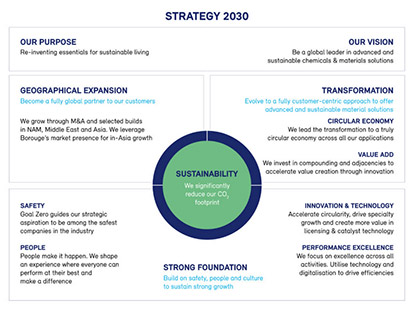
Borealis’ strategy 2030 © Borealis


Greenhouse gas (GHG) emissions:

Borealis aims to reduce its Scope 1 and Scope 2* emissions from 5.1 million tons (base year 2019) to less than 2 million tons by 2030. The emission reduction portfolio includes increased use of electricity from renewable sources throughout the decade and carbon capture projects which will come on stream in the second half of this decade. The reduction target also includes the announced divestment of the Borealis nitrogen business, which comprises fertilizers, technical nitrogen, and melamine.

Energy consumption:

In 2021, around 25% of the electricity Borealis used in its own operations was derived from renewable energy sources such as wind and solar power. By 2025, the share of renewables in the electricity mix will increase to 40%. By 2030, 100% of the electricity used in its Polyolefins and Hydrocarbons operations shall be of renewable origin.


Circular economy products and solutions:

Around 100 kilotons of products currently manufactured by Borealis in Europe are circular. These include recycled and renewable polymers and chemicals as well as renewable hydrocarbons. By 2025, Borealis targets a six-fold increase in the share of circular products and solutions, or 600 kilotons. By 2030, the volume of circular products and solutions is set to reach 1.8 million tons globally, turning today’s plastic waste into a valuable resource to be reused. Moving from a linear towards a circular economy will also significantly reduce the Borealis Group’s Scope 3** emissions.

Borealis Strategy 2030 driven by expansion and transformation – and powered by people

Geographic expansion and the transformation towards circular and value add materials are key pillars of the Borealis Strategy 2030. Both will be made possible thanks to the strong foundation of Borealis values, corporate culture, spirit of innovation and technology, and its people.

The Borealis Group's aspiration to become a truly global player serving its customers around the world has already begun with its

in global growth projects, including Borouge 4 (UAE), Baystar (US) and Kallo (Belgium). The Strategy 2030 emphasises the importance of serving the rapidly growing Asian market and expanding the Borealis Group footprint in North America. Additional strategic partnerships as well as mergers and acquisitions are planned. Organic growth opportunities in the form of newly established operational facilities are also under consideration.

As an industry pioneer in the transformation of the plastics economy from a linear to a circular one, Borealis accelerates the development towards becoming a fully customer-centric producer of advanced, sustainable material solutions in all business areas, from energy and infrastructure to consumer products, healthcare to mobility, and from pipes and fittings to advanced polymer solutions. The Borealis commitment to Value Creation through Innovation will continue to drive progress in the circular sphere. Borealis will build on the success of the proprietary and transformative ™ technology, which gives polyolefin-based, post-consumer waste a new life; and ™, its portfolio of premium circular polyolefins based on renewable feedstocks.

The strong foundation of it all is the Borealis culture and values: above all, a dedication to safety and a commitment to putting its people first; the mind-set deeply rooted in innovation and technology which accelerates circularity, drives specialty growth, and creates more value in licensing and catalyst technology; and finally, the Borealis Group’s relentless focus on performance excellence.

“The Borealis Strategy 2030 is our roadmap to making life more sustainable for future generations. Our significantly expanding footprint in value-added and circular chemicals and material solutions is rooted in our dedication to innovation and customer focus,” says Borealis CEO Thomas Gangl. “Re-inventing essentials for sustainable living is our commitment to do our part to address global climate change and our guide for our own sustainable success in a carbon net-zero world.”

* Scope 1 are direct GHG emissions that occur at the source and are controlled by Borealis. Scope 2 are GHG emissions stemming from the generation of energy purchased by the company.

** Scope 3 are indirect GHG emissions that are a consequence of company activities but occur from sources outside or not controlled by the company.



More News from TEXDATA International

#Techtextil 2026

Textile Chemicals & Dyes: Innovation in Textile Chemistry moves into focus at Techtextil 2026

From PFAS-free finishes and water-saving dyeing technologies to advanced coatings and recycling-compatible formulations, innovation in textile chemistry is accelerating across the industry. Reflecting this development, Techtextil 2026 introduces Textile Chemicals & Dyes as a dedicated product segment, highlighting the growing role of chemical solutions in shaping the next generation of technical textiles.

#Recycling / Circular Economy

textile.4U publishes special edition “Top 100 Textile Recycling Companies 2025”

With a comprehensive 176-page special edition, textile.4U is dedicating its latest issue entirely to one of the most dynamic and influential topics in today’s textile industry: textile recycling. The new issue, published exclusively in high-quality print, presents the Top 100 textile recycling companies researched and selected by TexData – organizations that already play a key role in the transition to circular textiles or are expected to have a significant impact in the near future.

#Recycling / Circular Economy

Responsible Textile Recovery Act of 2024 signed by Governor

Senator Josh Newman (D-Fullerton) is proud to announce that Senate Bill 707 (SB 707), the Responsible Textile Recovery Act of 2024, has been signed into law by the Governor of California, Gavin Newsom. This groundbreaking legislation establishes the country’s first Extended Producer Responsibility (EPR) textile recycling program, marking a significant step forward in the state’s efforts to combat waste and promote sustainability.

#Textiles & Apparel / Garment

Modtissimo promotes sustainability with 28 coordinates in the Green Circle

Modtissimo is proving more and more to be a textile and clothing show that delivers the latest innovations in the area of sustainability, with the iTechStyle Green Circle being the main showcase for companies' creations. In this 60+4 edition, taking place on 12 and 13 September, 28 coordinates will be exhibited in a section organised by CITEVE and curated by Paulo Gomes.

More News on Sustainability

#Sustainability

GOTS version 8.0 released: advanced supply chain accountability, from fibre to finished product

Global Standard is pleased to announce the release of GOTS Version 8.0, the latest update to the world's leading processing standard for organic textiles. The updated Standard strengthens requirements for air emissions and waste management, as well as criteria for product safety. It introduces new provisions on circularity, microfibre management and updates in residue testing. Version 8.0 also elevates due diligence obligations and formalises governance requirements, including ESG disclosure, anti-corruption policies and conflict-of-interest safeguards, to support credible, responsible business conduct.

#Sustainability

The nova-Institute establishes new Renewable Feedstock Department to lay the groundwork for industrial defossilisation

The transition from fossil-based to renewable carbon – sourced from biomass, CO₂ utilisation and recycling – is the cornerstone of a climate-neutral chemical industry. The nova-Institute’s new department is dedicated to providing the essential data, analyses and strategic roadmaps required to secure a reliable future feedstock supply and make this transition a commercial and ecological reality.

#Sustainability

Textile Exchange unveils commitment-based pathway for members to accelerate responsible raw material production

Textile Exchange has unveiled further details about its new membership structure, designed to guide the fashion, textile, and apparel industry in a collective course of action toward preferred production systems for raw materials and fibers.

#Textile chemistry

Jeanologia urges industry to accelerate PP Spray phase-out following ZDHC Watchlist update

Potassium permanganate has officially entered the Chemical Watchlist of the ZDHC Foundation, signaling increased scrutiny and potential phase-out of one of the most hazardous chemicals still used in denim finishing. The inclusion confirms an industry shift that Jeanologia anticipated more than a decade ago.

Latest News

#Techtextil 2026

DIENES at Techtextil 2026: Flexible pilot lines for bio-based fiber development

The growing relevance of bio-based materials in technical textiles is accompanied by increasing demands for reproducibility, high-quality data, and scalable process routes. Especially when working with cellulose and its derivatives, chitosan, lignin-based approaches, or bio-based PAN as a carbon-fiber precursor, R&D teams face variable feedstock quality, tighter process windows, and the need for reliable comparability across trials. This calls for flexible, data-driven experimental setups that can be reconfigured efficiently when recipes, solvents, and raw-material batches change.

#Texprocess 2026

Gunold showcases embroidery product range and services at Texprocess

At Texprocess 2026, GUNOLD will present numerous hands-on examples related to embroidery in Hall 8, Booth E20. The focus is on creative embroidery designs as well as the extensive product range of threads, nonwovens, and accessories for embroidery and embellishment. “Trade visitors can once again look forward to many new and creative embroidery designs. Of course, we will also showcase the matching products required to bring these ideas to life,” announces Marketing Manager Stephan Gunold.

#Nonwovens

EDANA and more than 70 industry organisations call for consistent exemptions in EU packaging regulation

EDANA, together with more than 70 industry associations and organisations, has issued a joint statement commenting on the European Commission’s Delegated Act under Article 29 of the Packaging and Packaging Waste Regulation (PPWR).

#Raw Materials

A Powerful Opening: Global thought leaders launch the International Cotton Conference Bremen

The International Cotton Conference Bremen will open on 25 March 2026 in the Parliament building of the Free Hanseatic City of Bremen with a keynote session of exceptional calibre. Distinguished international experts will set the stage for the conference by offering incisive perspectives on the most pressing challenges and the defining trends shaping the future of the global cotton trade. Their insights will span a broad spectrum — from geopolitically driven disruptions affecting global supply chains to the opportunities emerging from innovation-led agriculture capable of supporting a growing world population. Together, these opening keynotes will frame the dialogue of the conference, highlighting both the complexity of today’s market environment and the pathways toward a resilient and forward-looking cotton sector.

TOP