[pageLogInLogOut]

#Sustainability

Aid by trade foundation and partners invest EUR 2.8 Million in climate adaptation project

© 2022 Cotton made in Africa
Despite its key function in climate protection, soil management often falls by the wayside. The way we use our soil has significant implications for our climate, and it also plays a role in deciding whether unique species of plants and animals remain extant and whether humanity will be able to live from the soil in the future.

The livelihoods and continued survival of small-scale farmers in Africa largely depend on how changing climate conditions affect the fertility of their soil. To enable the farmers to develop resiliency and adapt to the changing climate, the Aid by Trade Foundation (AbTF), which administers Cotton made in Africa (CmiA), launched CAR-iSMa, a co-operative project with a total budget of around EUR 2.8 million. 

Promoting Climate Protection and Resilience for Small-Scale Farmers in Africa Through Sustainable Soil Management

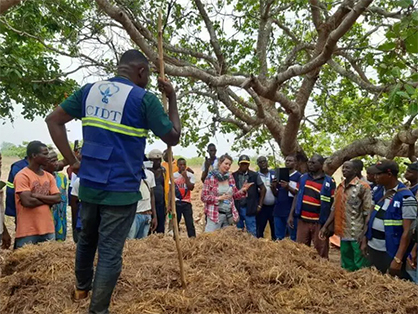
CAR-iSMa is short for “Climate Adaption and Resilience: A Pan-African Learning and Knowledge Exchange Project on Improved Soil Management”. Created at the initiative of the Aid by Trade Foundation, the project is being supported by Deutsche Gesellschaft für Internationale Zusammenarbeit (GIZ) with funding from the German Federal Ministry for Economic Cooperation and Development (BMZ) and is being implemented together with the agriculture organisation LDC Suisse and with three CmiA-verified cotton companies: CIDT from Côte d’Ivoire, JFS from Mozambique, and LDC from Zambia. This co-operative project’s primary objective is to improve soil management through sustainable production methods in order to better the livelihoods of small-scale farming families, reduce the effects of climate change for this target group, and strengthen their resilience. Soil & More Impacts (SMI), a company that provides services for sustainable agriculture with a focus on soil and composting, is supporting the project by offering advice on how to increase soil fertility. SMI is also working with three cotton associations in Africa to start providing small-scale farmers with training in composting and regenerative agriculture.
© 2022 Cotton made in Africa


“Through the CAR-iSMa project, we are making an important contribution to climate protection and are assisting small-scale farmers in Africa in developing strategies to counteract the effects of climate change. Our goal is to enable both current and future generations of farmers to earn a living from the cotton produced in their soil. To achieve this goal, it is crucial to sustainably manage soil as a natural resource, which is why that is our primary focus in this project,” summarises Tina Stridde, the managing director of the Aid by Trade Foundation. “Soil is crucial to the livelihoods of many small-scale farming families. The farmers are suffering as climate change renders the soil increasingly parched and infertile, and they have little access to the knowledge and means they need in order to adapt accordingly. Through an on-site assessment, we were able to confirm that the cotton farmers are interested in learning more about composting and other aspects of regenerative agriculture because they want to reduce erosion, conserve soil fertility, and ensure the long-term productivity of their soil,” adds Britta Deutsch. As the foundation’s head project manager for CAR-iSMa, Ms Deutsch travelled to Côte d’Ivoire to set up the project. The West African country is one of three project countries and a long-time CmiA partner country.


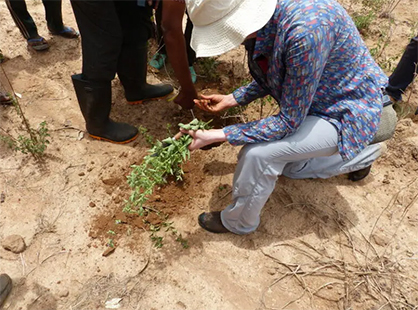
A total of around 100,000 people working in cotton production are expected to benefit from the project activities. The focus is on the small-scale farmers supported by local, CmiA-verified cotton companies. This co-operative project is also planned to include a qualification programme for soil-management trainers as well as training material for agricultural consultants. Innovative approaches like self-cultured compost microbes and pyrolysis—which produces vegetable carbon, thereby capturing carbon in the soil for the long term as well as improving the soil structure and water-retention capacity—are planned to be tested as part of the project before being rolled out in CmiA’s wider network if possible. The plan is to enhance 92,000 hectares of land by improving soil fertility; this is roughly equivalent in size to greater Berlin. Another area of focus is a transnational and inter-organisational knowledge exchange between the participating cotton associations. To scale up the long-term benefits of the lessons learnt and of the positive experiences, successful approaches should be implemented throughout the CmiA network in Africa after the end of the project. In this way, AbTF aims to continue improving the small-scale farmers’ production practices.
© 2022 Cotton made in Africa


The CAR-iSMa project is part of the Sub-Saharan Cotton Initiative, which supports four public–private partnerships under a global programme pursuing sustainability and value creation in agricultural supply chains under the umbrella of SEWOH, a German special initiative for a world without hunger. At the behest of the Federal Ministry for Economic Cooperation and Development (BMZ), the programme promotes sustainability in a selection of agricultural supply chains.



More News from TEXDATA International

#Texprocess 2026

Texprocess 2026: Automation, digitalisation and AI reshape textile processing

Investment decisions in textile processing have become increasingly complex. Rising energy prices, labour shortages and geopolitical uncertainties are forcing companies to prioritise technologies that deliver measurable improvements in efficiency and process stability. This applies not only to apparel production, but also to the processing of technical textiles and high-performance materials. Modernisation projects are therefore being evaluated more selectively – but the pressure to upgrade production systems continues to grow. Texprocess 2026 reflects this tension between cautious investment behaviour and increasing technological demand.

#Techtextil 2026

Textile Chemicals & Dyes: Innovation in Textile Chemistry moves into focus at Techtextil 2026

From PFAS-free finishes and water-saving dyeing technologies to advanced coatings and recycling-compatible formulations, innovation in textile chemistry is accelerating across the industry. Reflecting this development, Techtextil 2026 introduces Textile Chemicals & Dyes as a dedicated product segment, highlighting the growing role of chemical solutions in shaping the next generation of technical textiles.

#Recycling / Circular Economy

textile.4U publishes special edition “Top 100 Textile Recycling Companies 2025”

With a comprehensive 176-page special edition, textile.4U is dedicating its latest issue entirely to one of the most dynamic and influential topics in today’s textile industry: textile recycling. The new issue, published exclusively in high-quality print, presents the Top 100 textile recycling companies researched and selected by TexData – organizations that already play a key role in the transition to circular textiles or are expected to have a significant impact in the near future.

#Recycling / Circular Economy

Responsible Textile Recovery Act of 2024 signed by Governor

Senator Josh Newman (D-Fullerton) is proud to announce that Senate Bill 707 (SB 707), the Responsible Textile Recovery Act of 2024, has been signed into law by the Governor of California, Gavin Newsom. This groundbreaking legislation establishes the country’s first Extended Producer Responsibility (EPR) textile recycling program, marking a significant step forward in the state’s efforts to combat waste and promote sustainability.

More News on Sustainability

#Sustainability

Experts publish APAC policy priorities

Cascale today announced the publication of its APAC Policy Priorities Paper, developed by the Asia-Pacific (APAC) Policy Member Expert Team (MET) to identify key regional sustainability challenges and provide practical, aligned recommendations for policymakers and industry stakeholders across Asia-Pacific.

#Sustainability

GOTS version 8.0 released: advanced supply chain accountability, from fibre to finished product

Global Standard is pleased to announce the release of GOTS Version 8.0, the latest update to the world's leading processing standard for organic textiles. The updated Standard strengthens requirements for air emissions and waste management, as well as criteria for product safety. It introduces new provisions on circularity, microfibre management and updates in residue testing. Version 8.0 also elevates due diligence obligations and formalises governance requirements, including ESG disclosure, anti-corruption policies and conflict-of-interest safeguards, to support credible, responsible business conduct.

#Sustainability

The nova-Institute establishes new Renewable Feedstock Department to lay the groundwork for industrial defossilisation

The transition from fossil-based to renewable carbon – sourced from biomass, CO₂ utilisation and recycling – is the cornerstone of a climate-neutral chemical industry. The nova-Institute’s new department is dedicated to providing the essential data, analyses and strategic roadmaps required to secure a reliable future feedstock supply and make this transition a commercial and ecological reality.

#Sustainability

Textile Exchange unveils commitment-based pathway for members to accelerate responsible raw material production

Textile Exchange has unveiled further details about its new membership structure, designed to guide the fashion, textile, and apparel industry in a collective course of action toward preferred production systems for raw materials and fibers.

Latest News

#Techtextil 2026

Italian textile machinery innovation takes center stage in Frankfurt for Techtextil 2026

The Italian textile machinery industry is gearing up for a key event on the international trade fair calendar: Techtextil 2026, taking place from April 21–24 in Frankfurt, Germany. A prestigious representation of Italian companies will participate in the German exhibition—a global benchmark for technical and innovative textiles—to present cutting-edge technologies dedicated to an ever-expanding market.

#

Between innovation pressure and production readiness: Techtextil 2026 showcases market-ready defence textiles

EU defence spending reached a record level of around €381 billion in 2025. The importance of textile innovation in this context is underscored by the European Defence Fund’s 2026 Work Programme, which identifies “smart and multifunctional textiles” as a dedicated priority area. Techtextil translates this demand into industrial practice. From 21 to 24 April 2026, more than 10 per cent of over 1,500 exhibitors in Frankfurt am Main will present material innovations for protective textiles.

#Yarns

Yarn Expo Spring 2026 concludes, connecting buyers with innovative selection of sustainable yarns and fibres

Yarn Expo Spring 2026 wrapped up successfully on 13 March, as a record-high of over 600 exhibitors from 12 countries and regions welcomed more than 25,000 visitors from 113 countries and regions. Held across 27,000 sqm in Hall 8.2 of the National Exhibition and Convention Center (Shanghai), the fair highlighted the textile industry’s accelerating shift toward a lower-impact, more functional future. Exhibitors presented eco-friendly organic, regenerated and recycled yarns and fibres, alongside innovative options such as sweat-resistant and high-performance materials. A comprehensive fringe programme further enriched the event, offering practical market insights and new networking opportunities.

#Techtextil 2026

ANDRITZ at Techtextil 2026: Sustainability and advanced technologies

International technology Group ANDRITZ will be presenting its innovative nonwovens production and textile solutions at Techtextil in Frankfurt, Germany, from April 21 to 24, 2026 (Hall 12, B95). ANDRITZ will focus on technologies for durable and technical nonwovens, sustainable fiber processes, textile recycling, and life-cycle services.

TOP