[pageLogInLogOut]

#Sustainability

Unlocking the Trillion-Dollar fashion decarbonisation opportunity
© 2021 Fashion For Good
Recent studies estimate more than 2% of the global greenhouse gas emissions stem from the fashion industry. With the global average temperatures projected to rise by 3 degrees Celsius this century – well beyond the 1.5 degrees Celsius goal of the Paris Agreement – disruptive solutions and unprecedented actions are needed to curb emissions and achieve net-zero by 2050.

New Report Details Financing to Drive the Industry to Net-Zero

A new report, co-authored by Fashion for Good and Apparel Impact Institute and sponsored by HSBC, for the first time charts a trajectory for the industry to meet the net-zero ambition, mapping the integral levers across existing solutions, such as renewable energy, and innovative solutions, such as next generation materials. Estimating an investment opportunity of $1 trillion to finance the transition, the report breaks down the funding needed by solution category and identifies the types of funders best placed to take advantage of the opportunity and benefit from the positive returns.

“Unlocking The Trillion-Dollar Fashion Decarbonisation Opportunity: Existing And Innovative Solutions” builds on existing research, as well as the knowledge and expertise of Fashion for Good and Apparel Impact Institute. The report estimates the emissions reduction of existing and innovative solutions, and calculates the finance needed to bring them to scale and drive the industry to net-zero by 2050; a critical step to mapping the path and actions for the fashion industry in the decades to come. The findings in the report are significant – analysis shows an estimated $1 trillion is required to finance the decarbonisation of the fashion industry by 2050.

Financing mix across solution categories – Source: Aii and FFG analysis


“Reducing carbon emissions will be one of, if not the, defining challenge of our generation and indeed the fashion industry. The good news is that a strong pipeline of solutions – both disruptive and ready to be implemented – can drastically decarbonise the industry. This report highlights that not only are the opportunities plentiful and financially attractive, but they are key to getting us to a net-zero, circular industry.” – Katrin Ley – Managing Director, Fashion for Good

Though $1 trillion may appear to be substantial, the majority of this spend is allocated to projects that offer an attractive financial, as well as environmental, return on investment and can therefore be funded by financial capital. More than $35 trillion of financial capital is available globally for good return Environmental, Social, and Governance (ESG) investments, a figure expected to exceed $50 trillion by 2025 according to insights from Bloomberg Intelligence. However, critical barriers to unlocking the financial capital needed remain. With input from key industry stakeholders, the report highlights those barriers and presents examples of financing opportunities.

“This report reframes decarbonisation as an investment opportunity rather than a cost. These proven, investable solutions require a tremendous amount of capital, and we now need to create the pathways for all forms of financial capital in order to bring them to scale.” – Lewis Perkins – President, Apparel Impact Institute

The financing opportunity is multi-faceted and will require a committed and coordinated effort by brands, manufacturers, philanthropy, government, and industry organisations. The report splits up the amount of finance required per emission-reduction solution across the different financiers, appealing to different risk appetites and profiles, and providing a nuanced and detailed pathway to achieving net-zero.


“The fashion industry is becoming increasingly aware of its environmental impact and of the need to swiftly transition to net-zero. This report shows that, while there are challenges to overcome, this transition is possible and will open up new opportunities for businesses in this sector. Collective action is critical. The financial system must play its part by providing the investment to fund net-zero solutions at scale.” – Zoë Knight – Managing Director and Group Head of the HSBC Centre of Sustainable Finance

The full report, and findings can be downloaded and read here:

https://reports.fashionforgood.com/wp-content/uploads/2021/11/REPORT-Unlocking-The-Trillion-Dollar-Fashion-Decarbonisation-Opportunity-Fashion-for-Good-Aii.pdf
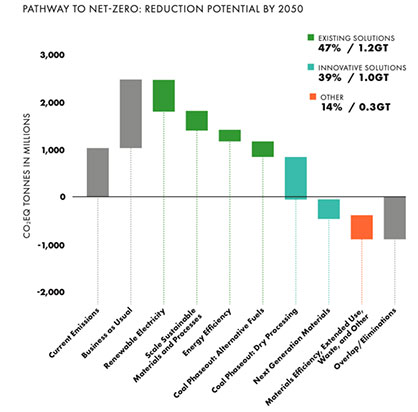

Solution Categories that enable a net-zero fashion industry – Source: Aii and FFG analysis


Some key findings from the report

• “Unlocking the Trillion-Dollar Fashion Decarbonisation Opportunity” estimates 47% of CO2 reductions come from implementing existing solutions, while 39% comes from scaling innovative solutions, and 14% from other solutions – including reducing overproduction, material efficiency improvements, and scaling circular business models.

• The report evaluates 7 solutions to reach net-zero in the fashion industry by 2050, including a shift to renewable energy, sustainable materials and processes, accelerating the development of next generation materials, and phasing out coal, amongst others.

• The total cost to implement these solutions and achieve net-zero is $1.04 trillion, including:

- $639 billion towards existing solutions (61%)

- $405 billion towards innovative solutions (39%)

• Philanthropic and government grants represent $50 billion (only 5% of the total), but are critical for catalysing industry and financial capital

• The report covers insights, key actions and recommendations to unlock the $1 trillion financing opportunity, including:

- the cost breakdown by financier groups needed to accelerate the transition to a net-zero industry.

- for governments to strengthen policy framework and mechanisms to catalyse private investment.

- for philanthropies to encourage coordination and explore blended capital approaches.

- for brands to pursue stronger engagement and commitment to innovation and suppliers

- for manufacturers to adopt a strategic capital improvement plan that is aligned with brand partners

- for banks and lenders to prioritise key production regions and innovative financing opportunities

- for equity investors to become familiar with the increasingly large array of investment opportunities.




More News from TEXDATA International

#People

Happy Holidays!

Dear reader, the year 2025 is drawing to a close. We are entering what we hope will be a peaceful holiday season, spending time with our families and taking a moment to pause and reflect. We hope we have been able to support you once again this year with relevant news and articles, and we look forward to surprising you with many innovations in the coming year. Enjoy the festive season, stay healthy, and we wish you a happy and joyful holiday season.

#Recycling / Circular Economy

textile.4U publishes special edition “Top 100 Textile Recycling Companies 2025”

With a comprehensive 176-page special edition, textile.4U is dedicating its latest issue entirely to one of the most dynamic and influential topics in today’s textile industry: textile recycling. The new issue, published exclusively in high-quality print, presents the Top 100 textile recycling companies researched and selected by TexData – organizations that already play a key role in the transition to circular textiles or are expected to have a significant impact in the near future.

#Recycling / Circular Economy

Responsible Textile Recovery Act of 2024 signed by Governor

Senator Josh Newman (D-Fullerton) is proud to announce that Senate Bill 707 (SB 707), the Responsible Textile Recovery Act of 2024, has been signed into law by the Governor of California, Gavin Newsom. This groundbreaking legislation establishes the country’s first Extended Producer Responsibility (EPR) textile recycling program, marking a significant step forward in the state’s efforts to combat waste and promote sustainability.

#Textiles & Apparel / Garment

Modtissimo promotes sustainability with 28 coordinates in the Green Circle

Modtissimo is proving more and more to be a textile and clothing show that delivers the latest innovations in the area of sustainability, with the iTechStyle Green Circle being the main showcase for companies' creations. In this 60+4 edition, taking place on 12 and 13 September, 28 coordinates will be exhibited in a section organised by CITEVE and curated by Paulo Gomes.

More News on Sustainability

#Yarns

Textile Exchange publishes the final criteria for its new Materials Matter Standard, marking a pivotal shift in connecting certification to impact

Textile Exchange has published the final criteria for its Materials Matter Standard—a major milestone in the organization’s multi-year transition toward a unified, impact-driven standards system for raw material production and primary processing. 

#Nonwovens

EDANA wraps up its Sustainability & Policy Forum 2025: Uniting the industry and EU policymakers to navigate the future of nonwovens

Against a backdrop of rapidly evolving environmental legislation, the EDANA Sustainability & Policy Forum 2025 concluded the past week in Brussels, marking a step forward in the dialogue between the nonwovens industry and European policymakers. Held from 9-10 December at the historic Residence Palace, the two-day event successfully brought together business leaders, sustainability experts, and EU officials to address the dual challenges of circularity and industrial competitiveness.

#Sustainability

YKK recognized with Top ‘A’ rating by CDP for climate change leadership for third consecutive year

YKK Corporation announced its achievement of the highest “A List” rating in the 2025 Climate Change survey conducted by the global environmental disclosure nonprofit, CDP . This marks the third consecutive year YKK has received this prestigious recognition.

#Weaving

Itema announces strategic partnership with Ivy Decarb to accelerate decarbonization in weaving process

Itema is pleased to announce the strategic partnership with Ivy Decarb, the digital platform helping textile companies measure and reduce their carbon footprint.

Latest News

#Weaving

Lindauer Dornier announces leadership transition in weaving machine business

After more than ten successful years at Lindauer DORNIER GmbH, Mr Wolfgang Schöffl will leave the family-owned company at the end of the year to enter well-deserved retirement.

#Heimtextil 2026

Texpertise Focus AI: Messe Frankfurt puts Artificial Intelligence centre stage at its international textile and apparel trade fairs

Under the banner 'Texpertise Focus AI, Messe Frankfurt will place a strong emphasis on Artificial Intelligence (AI) across its international textile and apparel trade fairs from 2026 onwards, setting a future-shaping signal for the industry. The initiative highlights the responsible use of AI along the entire textile value chain, from fibre production to the point of sale. The programme will launch at Heimtextil in Frankfurt in January 2026.

#Technical Textiles

Autoneum and Polestar set new benchmarks for passenger experience and sustainability

As the global market leader in sustainable acoustic and thermal management, Autoneum is a key supplier of interior and exterior components for the highly anticipated Polestar 5 model. The successful collaboration between Autoneum and Polestar marks a significant milestone in sustainable automotive engineering: the electric grand tourer sports car features several innovations in lightweight, fully recyclable polyester-based components that ensure a superior driving experience. Polestar 5 was revealed at the IAA Mobility 2025 in Munich and is available in 24 markets.

#Natural Fibers

Cashmere producers stress the importance of The Good Cashmere Standard®

At the invitation of the Aid by Trade Foundation (AbTF), over 70 experts from the cashmere production and supply chain, as well as other specialists, met at the GCS Unit Meeting in Shanghai, China to discuss the progress and new objectives of The Good Cashmere Standard (GCS). The meeting focused on implementation and verification of the standard, important aspects of animal welfare and the importance of the standard in the global textile market.

TOP