[pageLogInLogOut]

#Sustainability

Corporate action on toxic chemicals in clothing: Target leads, Amazon lags according to new company scorecard

A new report found that top U.S. clothing retailers and brands need to do better on toxic chemical management policies. The “Toxic Textiles” report by Green America provides a company-by-company breakdown of 15 major corporations and shows significant room for improvement across the sector on hazardous chemicals use, workplace conditions, and transparency.

While individual clothing brands outperformed larger retailers overall, the report details how both areas of the industry can do better to protect consumers and workers from toxic chemicals used in textile manufacturing and found in clothing itself. Retailer and brand scorecards illustrated the top-level findings of the report.

Charlotte Tate, Labor Justice Campaigns director at Green America, said: “Looking at the success of some companies on the scorecard, there is simply no reason for a company to not, at a minimum, have a restricted substances list and a manufacturing restricted substances list. In just a few years, we’ve seen some companies take major steps in the right direction, and now, we must see retailers -- some of which, notably Amazon, have had hugely profitable years -- step it up on chemical management in apparel.”

Other key findings of the report include:

• Target is the clear retail leader. Target has both an online platform and stores, and sells many apparel items under its own brands, which demonstrates it is feasible for every retailer included in the scorecard to improve its chemical management policies. Target has a publicly available restricted substances list (RSL) and a publicly available manufacturing restricted substances list (MRSL). It also has clearly stated goals of eliminating hazardous classes of chemicals.

• Amazon must do better. Amazon is a retailer and also an apparel brand with numerous private labels. Amazon has no public information about its chemical management for apparel, despite being the largest US retailer of apparel, and it has disclosed no RSL or MRSL. The report calls on Amazon to address the impacts of own-branded products and to encourage sellers on its platform to step up on chemical management.

• Nike, Gap, Adidas and H&M beat out other clothing brands. Each of these brands have a public RSL and MRSL and have committed to eliminate or reduce the use of hazardous chemicals.

• Beware token plans and greenwashing. Companies often incorporate one policy on a single issue in the supply chain, and then use it to claim overall sustainability. And many companies claim to have policies addressing environmental or labor issues but have not followed through with specific goals, metrics, or timelines.

• The industry is far from sustainable. This scorecard examined chemical management policies that were publicly available. But there are many factors that contribute to whether a company is sustainable or not. For example, some leading fast fashion brands (H&M and Zara) performed well on the scorecard. However, due to the business model of fast fashion brands (creating short-lived clothing, for example), it is NOT possible for these companies to be sustainable.


Following the previous edition of the Toxic Textiles report and a campaign by Green America that generated over 30,000 comments, Carter’s, the largest U.S. retailer of baby clothes, took important first steps towards limiting toxic chemicals in its supply by instituting an RSL to help protect consumer health. Carter’s is now working to expand its offering of clothing with the OEKO-TEX Certification, which addresses some of the hazardous chemicals used in apparel. 
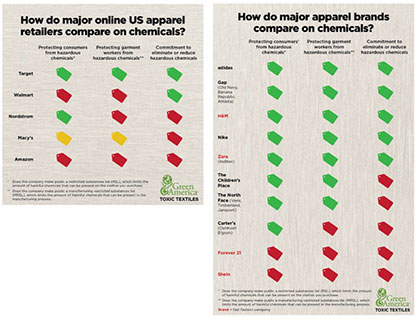
"Toxic Textiles Scorecard" (Photo: Business Wire)


Todd Larsen, executive co-director of Consumer and Corporate Engagement at Green America, said: “Consumers demand that companies improve their toxic chemical and sustainability policies, and we’re starting to see retailers and brands respond. While it is important for consumers to make informed decisions in their shopping habits, it is even more crucial for companies to take responsibility for the huge role they play.”




More News from TEXDATA International

#Recycling / Circular Economy

textile.4U publishes special edition “Top 100 Textile Recycling Companies 2025”

With a comprehensive 176-page special edition, textile.4U is dedicating its latest issue entirely to one of the most dynamic and influential topics in today’s textile industry: textile recycling. The new issue, published exclusively in high-quality print, presents the Top 100 textile recycling companies researched and selected by TexData – organizations that already play a key role in the transition to circular textiles or are expected to have a significant impact in the near future.

#Recycling / Circular Economy

Responsible Textile Recovery Act of 2024 signed by Governor

Senator Josh Newman (D-Fullerton) is proud to announce that Senate Bill 707 (SB 707), the Responsible Textile Recovery Act of 2024, has been signed into law by the Governor of California, Gavin Newsom. This groundbreaking legislation establishes the country’s first Extended Producer Responsibility (EPR) textile recycling program, marking a significant step forward in the state’s efforts to combat waste and promote sustainability.

#Textiles & Apparel / Garment

Modtissimo promotes sustainability with 28 coordinates in the Green Circle

Modtissimo is proving more and more to be a textile and clothing show that delivers the latest innovations in the area of sustainability, with the iTechStyle Green Circle being the main showcase for companies' creations. In this 60+4 edition, taking place on 12 and 13 September, 28 coordinates will be exhibited in a section organised by CITEVE and curated by Paulo Gomes.

#Europe

The EU and Egypt team up to mobilise private sector investments at Investment Conference and sign a Memorandum of Understanding underpinning €1 billion in macro-financial assistance for Egypt

At the EU-Egypt Investment Conference, co-organised by the EU and the Government of Egypt on 29-30 June, the EU and Egypt are teaming up to intensify private sector investments in Egypt. They are also signing a Memorandum of Understanding (MoU) for the disbursement to Egypt of up to €1 billion in Macro-Financial Assistance.

More News on Sustainability

#Yarns

Textile Exchange publishes the final criteria for its new Materials Matter Standard, marking a pivotal shift in connecting certification to impact

Textile Exchange has published the final criteria for its Materials Matter Standard—a major milestone in the organization’s multi-year transition toward a unified, impact-driven standards system for raw material production and primary processing. 

#Nonwovens

EDANA wraps up its Sustainability & Policy Forum 2025: Uniting the industry and EU policymakers to navigate the future of nonwovens

Against a backdrop of rapidly evolving environmental legislation, the EDANA Sustainability & Policy Forum 2025 concluded the past week in Brussels, marking a step forward in the dialogue between the nonwovens industry and European policymakers. Held from 9-10 December at the historic Residence Palace, the two-day event successfully brought together business leaders, sustainability experts, and EU officials to address the dual challenges of circularity and industrial competitiveness.

#Sustainability

YKK recognized with Top ‘A’ rating by CDP for climate change leadership for third consecutive year

YKK Corporation announced its achievement of the highest “A List” rating in the 2025 Climate Change survey conducted by the global environmental disclosure nonprofit, CDP . This marks the third consecutive year YKK has received this prestigious recognition.

#Weaving

Itema announces strategic partnership with Ivy Decarb to accelerate decarbonization in weaving process

Itema is pleased to announce the strategic partnership with Ivy Decarb, the digital platform helping textile companies measure and reduce their carbon footprint.

Latest News

#Associations

Driving innovation in technical textiles, digitalisation and testing

Members of the British Textile Machinery Association (BTMA) can look back on 2025 as a year marked by notable technological advances and continued progress in global trade, despite an uncertain and volatile market.

#Heimtextil 2026

Artificial Intelligence in focus: Heimtextil 2026 prepares global textile industry for the future with strong content programme

Artificial intelligence (AI) rapidly transforms the textile industry - from creation and production to pricing, distribution and communication. But how can AI be applied successfully, and where does it truly add value? Heimtextil addresses these questions from 13 to 16 January 2026: The comprehensive programme dedicated to the key future field AI strengthens the global industry and opens up new business opportunities as well as practical applications for design, retail, industry, architecture, interior design and contract furnishing.

#Weaving

Lindauer Dornier announces leadership transition in weaving machine business

After more than ten successful years at Lindauer DORNIER GmbH, Mr Wolfgang Schöffl will leave the family-owned company at the end of the year to enter well-deserved retirement.

#Heimtextil 2026

Texpertise Focus AI: Messe Frankfurt puts Artificial Intelligence centre stage at its international textile and apparel trade fairs

Under the banner 'Texpertise Focus AI, Messe Frankfurt will place a strong emphasis on Artificial Intelligence (AI) across its international textile and apparel trade fairs from 2026 onwards, setting a future-shaping signal for the industry. The initiative highlights the responsible use of AI along the entire textile value chain, from fibre production to the point of sale. The programme will launch at Heimtextil in Frankfurt in January 2026.

TOP