[pageLogInLogOut]

#Sustainability

Green Deal Textiles: German textile industry is a frontrunner when it comes to implementing the EU Commission's climate targets

Textile Research Council (Forschungskuratorium Textil - FKT) and Textile Machinery Association of the German Engineering Federation (Fachverband Textilmaschinen - VDMA) present solutions in the field of "Clean Water".

Berlin: The Green Deal Textile is going into the next round. VDMA and FKT joined experts from textile research institutes in Denkendorf, Chemnitz and Mönchengladbach to discuss global solutions for a clean water supply at the online seminar "Perspectives 2035: Clean Water - an Issue of Global Importance." The expert forum this Monday was attended by nearly 30 participants from numerous companies, research institutes and associations.

Johannes Diebel, head of the Forschungskuratorium Textil: "By 2030, it will be possible to produce textiles almost without water. This is the conclusion we reached in our future study "Perspectives 2035". Sustainable process technologies will be established, especially in the areas of dyeing and finishing. Our textile research institutes are making considerable development progress in this regard."

Ramona Jasny demonstrated this for the Niederrhein University of Applied Sciences (Hochschule Niederrhein) with the TextileMission research project. The project shows ways to reduce the formation of microplastic particles and thus protect the environment. The textile engineer also presented ways for the polyester industry to produce in a biobased and water-friendly way.

Textiles are highly effective in cleaning industrial wastewater, as Dr. Thomas Stegmaier of the German Institutes for Textile and Fiber Research Denkendorf (Deutschen Instituten für Textil- und Faserforschung Denkendorf - DITF) reported. "3D textiles are used in the biological treatment stage of various wastewater treatment plants. They serve as carriers for the biomass - microorganisms that are responsible for the degradation of pollutants. The biologically active area thus obtained is greatly increased compared to conventional methods and thus, of course, much more effective." It is not only industrial wastewater treatment plants that benefit from DITF's innovations. They can also be used in municipal wastewater treatment plants or in rainwater and swimming pool water treatment.

The Saxon Textile Research Institute (Sächsische Textilforschungsinstitut)  is also involved in several water treatment projects. One focus, for example, is on water purification with the help of biologically filtering organisms such as mussels, which are settled on textile growth surfaces. Jens Mählmann sees the advantages of these over conventional solutions in: "[...] the very effective elimination of suspended matter, algae or bacteria, as well as sedimentation rates that are up to 400 percent higher. During sedimentation, solids that cannot be removed are deposited at the bottom of the water body."


The event demonstrated the many ways in which textiles can be used for successful environmental management. The interdisciplinary exchange between the textile and mechanical engineering industries as well as companies from the water and wastewater technology sector is therefore to be continued and expanded.

The study Perspectives 2035 - A Guide to the Future (Perspektiven 2035 – Ein Leitfaden für die Zukunft) is available for download here

(GERMAN LANGUAGE ONLY)

https://textil-mode.de/de/forschung/zukunftsstrategie-perspektiven-2035/


(c) Forschungskuratorium Textil e. V.


More News from VDMA Fachverband Textilmaschinen

#Techtextil 2026

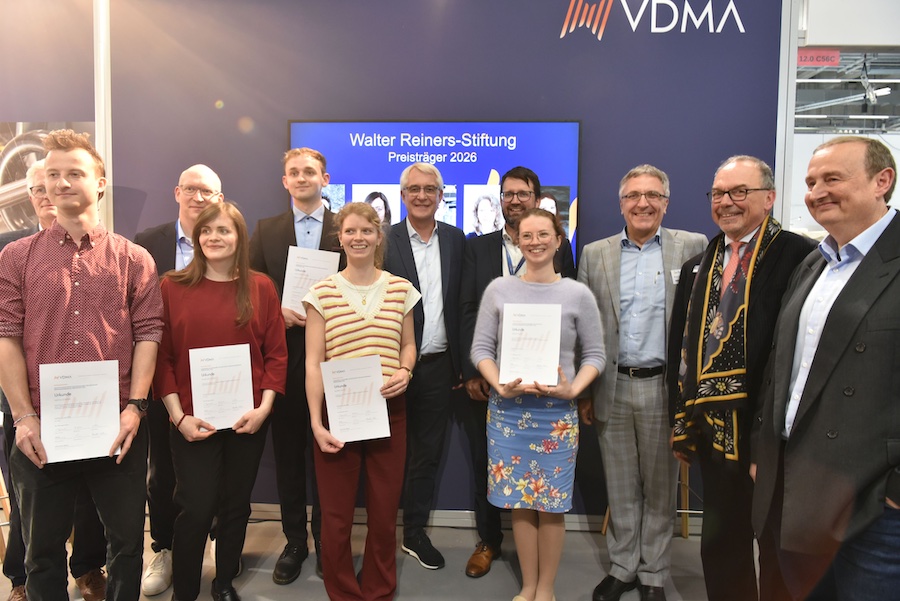
Young talents honoured – 60 years Walter Reiners Foundation

At the Techtextil trade fair in Frankfurt at the end of April, Peter D. Dornier, chairman of the VDMA’s Walter Reiners Foundation, presented awards to five successful young engineers. Promotion and sustainability awards were presented in the categories of bachelor’s/project theses and diploma/master’s theses. Academic theses are eligible for the sustainability awards if, for example, they develop solutions for resource-efficient products and technologies.

#Associations

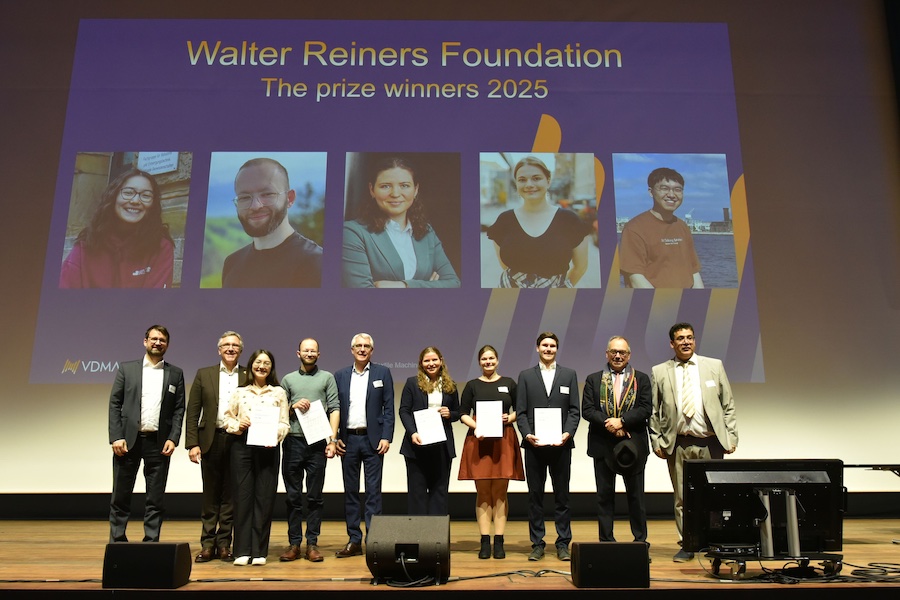
Young researchers recognised for cutting-edge work in recycling, fibre technology and textile mechanics

At the Aachen-Dresden-Denkendorf International Textile Conference held in Aachen at the end of November, Peter D. Dornier, Chairman of the Walter Reiners Foundation of the VDMA, honoured five successful young engineers. Promotion and sustainability prizes were awarded in the categories bachelor/project theses and diploma/master theses. Academic theses that develop solutions for resource-saving products and technologies, for example, are eligible for the sustainability awards.

#ITMA Asia + CITME Singapore 2025

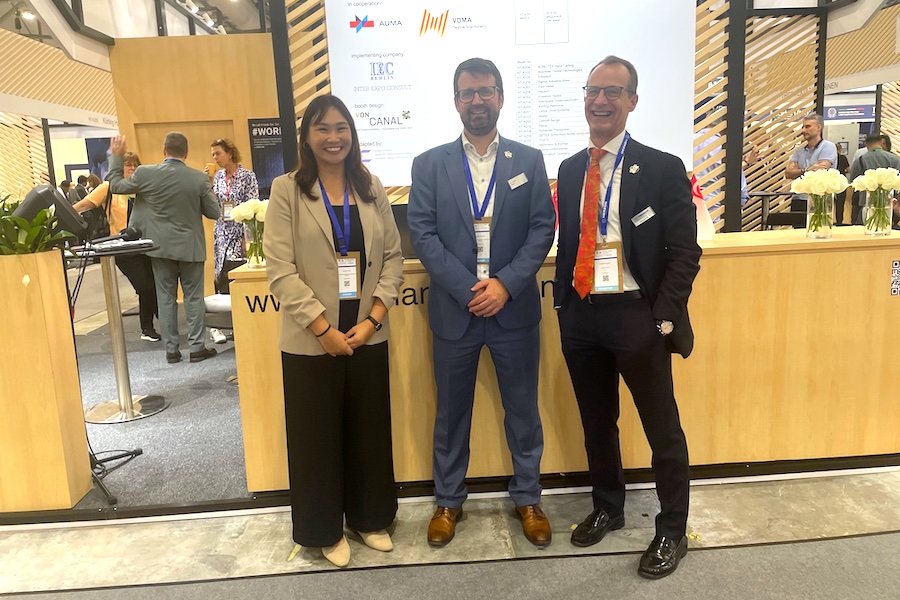
VDMA members at ITMA ASIA + CITME in Singapore

With 69 exhibiting member companies, ITMA ASIA + CITME 2025 is once again marked by a strong presence of VDMA companies. Altogether 82 companies from Germany will exhibit at the show, covering about 3,500 square meters of exhibition space, topped only by China and Italy. VDMA initiated a German Pavilion with two group stands (spinning in hall 4 and finishing in hall 7) with a total of 30 exhibitors.

#ITMA Asia + CITME Singapore 2025

VDMA member companies on display at ITMA ASIA

ITMA ASIA + CITME end of October in Singapore will see a strong participation of around 70 VDMA member companies. They will cover nearly all different machinery chapters along the textile value chain including spinning and man-made fibres, nonwovens, weaving, braiding, knitting & warp knitting, finishing & dyeing as well as technologies for textile recycling and processing of recycled material. VDMA initiated a German Pavilion with two group stands (spinning in hall 4 and finishing in hall 7) with a total of 30 exhibitors.

More News on Sustainability

#Recycling / Circular Economy

Arc'teryx introduces System 0™, a new framework for the future of product design and circularity

Arc'teryx Equipment, the global design company specializing in technical high-performance apparel and equipment, today introduced System 0™, a new framework that reimagines how products can be designed, manufactured, used, repaired, and ultimately regenerated. System 0 represents the next evolution for sustainability in the outdoor industry, as it embeds circular thinking across an entire product lifecycle while maintaining the uncompromising performance standards that define the Arc’teryx brand.

#Sustainability

Action Cohort: Textile Exchange’s new initiative designed to help scale preferred production systems

Textile Exchange has published new guidance to help brands and retailers participating in its Action Cohort prepare for upcoming reporting and target-setting requirements. Earlier this year, the organization evolved its membership to create more action-oriented pathways, designed to accelerate progress toward scaling preferred production systems that create beneficial impacts and resilient supply chains and livelihoods.

#Composites

WHILL selects Teijin’s tough, lightweight Carbon Fiber Composite for new last-mile mobility

Teijin Limited announced today that WHILL Inc., a global leader in inclusive mobility technology, has selected Sereebo® P CFP series, a carbon fiber-reinforced thermoplastic (CFRTP) material, for key structural components of the upcoming WHILL Model C Lite. Sereebo® P CFP series provides high strength, light weight, design flexibility and system cost advantages to the Model C Lite, which is a battery powered, single-seat, last-mile device. This new model combines maneuverability with light weight and one-handed folding to ensure ease of handling and operation.

#Sustainability

New guidance to help organizations deliver the Material Matter Standard’s human rights commitments

Textile Exchange has published new guidance and tools to help organizations better understand and implement the human rights and livelihoods requirements of the forthcoming Materials Matter Standard.

Latest News

#Industry 4.0 / Digitalization

Coats Digital launches AI-powered GSD RealMotion for motion analysis

Coats Digital has launched GSD RealMotion, an AI-powered solution designed to provide apparel manufacturers with greater visibility into factory-floor operations. By analysing shop-floor video and applying Coats Digital’s GSD methodology, the solution turns video recordings into structured, motion-by-motion method studies.

#Textile chemistry

Archroma and Lameirinho partner in pioneering deployment of InOneGO single-step dyeing

Archroma, a global leader in specialty chemicals, and Lameirinho, a leading home textiles manufacturer based in Portugal, are collaborating to bring InOneGO by Archroma, a new single-step dyeing process, into commercial production. Lameirinho’s first InOneGo bedlinens collection is now available worldwide.

#Knitting & Hosiery

KARL MAYER launches extra-wide HKS 3-M EL for increased productivity

KARL MAYER has launched a new extra-wide version of its HKS 3-M EL tricot machine, designed to increase productivity particularly in the manufacture of textiles for sports, activewear and athleisure applications.

#Research & Development

Reducing development times for technical textiles by accelerated thermo-oxidative aging in a high-pressure autoclave

Synthetic polymers used in technical textiles can be effectively protected against degradation caused by heat, oxygen, and water through the use of stabilizer systems. This enables service lives of several decades, extending to more than 50 years. As the use of durable technical textiles continues to grow, so does the demand for reliable methods to predict their service life within economically feasible testing periods. For the first time the German Institutes of Textile and Fiber Research Denkendorf (DITF) developed methods for robust service life prediction for textiles in an IGF research project.

TOP