[pageLogInLogOut]

#Sustainability

H&M Group leads the Fashion Transparency Index 2020

H&M Group has been named number one out of 250 fashion brands in the latest Fashion Transparency Index, which ranks companies according to how much information they disclose about their suppliers, supply chain policies and practices, and social and environmental impact.

The fashion industry has been known for having a complex and opaque supply chain. Transparency has been a cornerstone of H&M Group’s sustainability work. Back in 2013, H&M Group was one of the first global fashion retailers to make its supplier list public.

Since then, the group has been taking steps to make it more accessible for customers to know where their products are made. Customers at arket.com can check the suppliers and factories making their favourite items, while last year, hm.com started offering additional information in almost all of their products, such as production country, supplier and factory names and addresses, as well as the number of workers in the factory. In addition, customers can find out more about the materials used to make a specific garment and are reminded to recycle their garments.

“It is a great honor to be ranked as number one in the Fashion Transparency Index 2020 and a great recognition of our work.

We always aim to be as transparent as possible in our progress towards a more sustainable fashion future, as well as the challenges ahead, in order to keep driving industry change. We are committed to continue taking steps for greater transparency so customers can make informed decisions and drive a positive impact in the industry through our extensive work to become fully circular and climate positive, while being a fair and equal company,” says Hanna Hallin, Global Strategy Lead for Transparency at H&M Group.
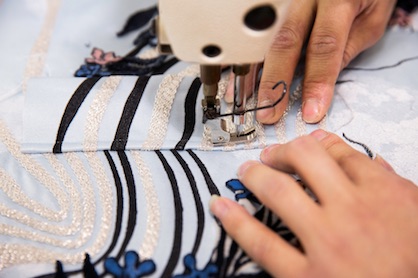
Sustainable production at the factory Hangzhou Suntex, China (c) 2020 H&M Group


The Fashion Transparency Index, launched during the Fashion Revolution Week, creates awareness on important issues for the whole textile industry, such as transparency, good working conditions in the supply chain and the need for shifting towards a circular economy.

Taking responsibility of how H&M Group’s products are made is fundamental to the group. Good working conditions, the impact on climate and health and safety, are areas in which the company has been working for many years, developing higher standards for its production. Even in extraordinary situations, such as the rapid spread of the COVID-19, the group stands by its responsible purchasing practices. H&M Group is well aware that the suppliers, and their employees, are extremely vulnerable in this situation. The group is in a close dialogue with several partners and industry stakeholders to see how it can and should support in this difficult situation with the aim of finding a joint industry solution.

Due to the limited resources of the planet and the climate crisis, the way we produce and consume fashion must change. As a global fashion retailer, H&M Group has a big role to play, which is why the group is transforming its whole business to become fully circular and climate positive. Being circular means having a different approach to how fashion is designed, produced and used, and how fashion should never be seen as waste. It should be treated as a valuable resource by reusing and recycling again and again.

 the company’s ambition to become circular includes, among others, offering its customers garment collecting options so a second life can be given through reusing and recycling, or increasing the use of recycled materials for its products, such as recycled polyester from old plastic bottles or recycled cotton from used garments.



More News from TEXDATA International

#Recycling / Circular Economy

textile.4U publishes special edition “Top 100 Textile Recycling Companies 2025”

With a comprehensive 176-page special edition, textile.4U is dedicating its latest issue entirely to one of the most dynamic and influential topics in today’s textile industry: textile recycling. The new issue, published exclusively in high-quality print, presents the Top 100 textile recycling companies researched and selected by TexData – organizations that already play a key role in the transition to circular textiles or are expected to have a significant impact in the near future.

#Recycling / Circular Economy

Responsible Textile Recovery Act of 2024 signed by Governor

Senator Josh Newman (D-Fullerton) is proud to announce that Senate Bill 707 (SB 707), the Responsible Textile Recovery Act of 2024, has been signed into law by the Governor of California, Gavin Newsom. This groundbreaking legislation establishes the country’s first Extended Producer Responsibility (EPR) textile recycling program, marking a significant step forward in the state’s efforts to combat waste and promote sustainability.

#Textiles & Apparel / Garment

Modtissimo promotes sustainability with 28 coordinates in the Green Circle

Modtissimo is proving more and more to be a textile and clothing show that delivers the latest innovations in the area of sustainability, with the iTechStyle Green Circle being the main showcase for companies' creations. In this 60+4 edition, taking place on 12 and 13 September, 28 coordinates will be exhibited in a section organised by CITEVE and curated by Paulo Gomes.

#Europe

The EU and Egypt team up to mobilise private sector investments at Investment Conference and sign a Memorandum of Understanding underpinning €1 billion in macro-financial assistance for Egypt

At the EU-Egypt Investment Conference, co-organised by the EU and the Government of Egypt on 29-30 June, the EU and Egypt are teaming up to intensify private sector investments in Egypt. They are also signing a Memorandum of Understanding (MoU) for the disbursement to Egypt of up to €1 billion in Macro-Financial Assistance.

More News on Sustainability

#Sustainability

VAUDE eliminates PFAS from all products

PFAS (per- and polyfluoroalkyl substances) are now detectable worldwide – in drinking water, soil and the human body. These so-called “forever chemicals” are considered hazardous to health and potentially carcinogenic, as they do not break down and remain in the environment permanently. Despite these risks, PFAS are still used in a wide range of products. More than 15 years ago, VAUDE made a strategic decision to gradually eliminate PFAS from all product categories.

#Sustainability

OEKO-TEX® chooses TextileGenesis to advance digital traceability for organic cotton

OEKO-TEX® today announced a full collaboration with TextileGenesis, a Lectra company, to digitally trace and authenticate organic cotton, strengthening fraud prevention across the supply chain. This announcement follows a successful pilot and brings together OEKO-TEX®’s certification expertise and closed testing system with TextileGenesis’ digital traceability platform to deliver a secure, end-to-end solution for managing certified organic cotton flows.

#Europe

ICAC to support European Commission on pending PEF legislation

The International Cotton Advisory Committee (ICAC) is proud to announce that it has been included as a member of the European Commission’s Technical Advisory Board (TAB) on the Product Environmental Footprint methodology. The Commission developed the Product Environmental Footprint (PEF) to assess and communicate the life cycle environmental performance of products and organizations.

#Nonwovens

ENDURANCE Program: Driving operational sustainability at Magnera

As Magnera enters a new year, the company is reflecting on a key sustainability milestone from 2025: the launch of ENDURANCE, its global, employee-led initiative focused on waste reduction and sustainable innovation. Launched on Earth Day 2025, this initiative has generated more than 250 improvement submissions from team members across Magnera’s global operations, demonstrating strong engagement and shared accountability for sustainability across the organization.

Latest News

#Functional Fabrics

“Action helps us change what we do!”

DAY 0 takes place deliberately before PERFORMANCE DAYS begins. It is conceived as a space for reflection, dialogue and active engagement — a moment to pause before the fair, rethink established systems and address sustainability not as a trend, but as a fundamental transformation challenge. Under the guiding metaphor “Turn the Tap Off”, DAY 0 focuses on root causes rather than symptoms, systemic change rather than isolated solutions, and collective responsibility rather than individual silos.

#Textiles & Apparel / Garment

Pets in fashion: functional and sustainable textiles find new market at Intertextile Apparel

China’s pet economy is booming, especially amongst younger generations, and pet apparel – from designer outfits to functional garments – was a RMB 3.5 billion (over USD 500 million) market in 2024, growing more than 20% annually¹. To help exhibitors harness this trend, Intertextile Shanghai Apparel Fabrics – Spring Edition 2026 will launch the Pet Boutique, presenting a range of innovative, sustainable materials that prioritise both functionality and comfort for pets.

#Man-Made Fibers

Lenzing AG to become majority owner of TreeToTextile AB and accelerates industrialization of new fibers

The Lenzing Group is taking another strategic milestone by acquiring a controlling majority in the Swedish innovation company TreeToTextile AB. This step strengthens Lenzing’s position as a leading provider of sustainable, wood‑based specialty fibers and expands its innovation pipeline with a highly scalable, patent‑protected technology platform. The transaction is executed through the issuance of new shares.

#Raw Materials

Better Cotton Initiative marks certification anniversary with progress update and accreditation

One year since becoming a certification scheme, the Better Cotton Initiative (BCI) has announced that more than 3,000 supply chain actors have been certified. At farm level, more than 30% of farms and producer units supplying BCI Cotton have received a positive audit outcome.

TOP