[pageLogInLogOut]

#Textiles & Apparel / Garment

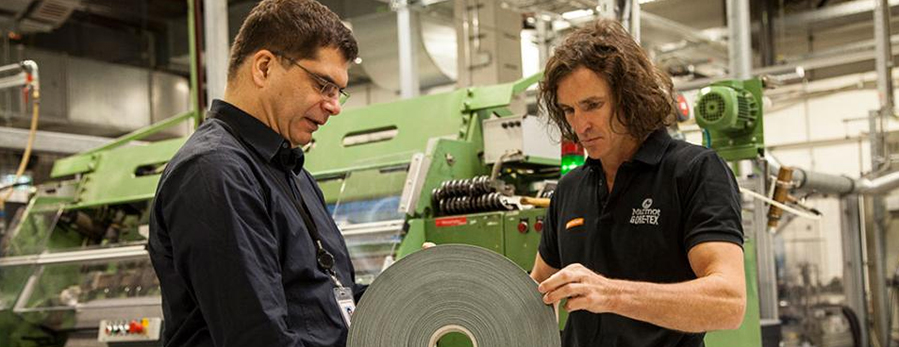
Gore manufacturing plant for fabrics products in Putzbrunn achieved ISO14001 certification
(c) 2020 Gore
W. L. Gore & Associates GmbH (Gore) announced today that its fabrics manufacturing plant in Putzbrunn, Bavaria, has been certified according to the environmental and quality management standard ISO 14001.

Now all fabrics manufacturing plants of Gore are certified according to ISO 14001

"With this certification, all three Gore-owned plants around the world that manufacture fabrics products are compliant with this globally accepted standard for environmental management systems. All our plants comply with equally high standards – for a smaller environmental footprint and safe working conditions. This ISO 14001 certification emphasizes our commitment to comply with the same high standards, partly going beyond legal requirement, in all plants of our Fabrics Division worldwide – for a smaller environmental footprint and safe working conditions.”

Environmental protection, together with social aspects, play a key role in the sustainability strategy of Gore Fabrics’ division. Worldwide accepted standards of environmental management, such as ISO 14001, help establish internationally consistent processes at the plants in order to identify potential improvements within Gore´s environmental management system and support its implementation.

Daniel Eckardt, Regional Quality Leader Europe for Gore fabrics products and in charge of the ISO 14001 introduction in Putzbrunn, says: “I am glad that we received this important certification. Our team did an excellent job, and I am proud of the fact that our manufacturing plant in Putzbrunn completed the range of ISO 14001 certified fabrics manufacturing plants of Gore around the world.”

ISO 14001 was presented by the International Organization for Standardization (ISO) in 1996. It specifies worldwide accepted requirements for environmental management systems that enable organizations, to improve its environmental footprint, comply with legal and other duties, and achieve its environmental goals. This international standard focusses on the concept of “continuous improvement”, based on the “plan-do-check-act” process cycle.

In 2010, Gore began establishing management systems at their manufacturing plants for fabrics products inspired by the ISO standard.


In order to obtain ISO 14001 certification, the plant in Putzbrunn was asked to fulfill a range of specific tasks and requirements similar to the Gore manufacturing plants for its fabrics products in Elk Mills, US and Shenzhen, China:

  • Identify significant environmental impacts such as gas or electrical energy usage and the waste from plants;
  • Monitor energy usage to achieve sustained energy reductions;
  • Measure environmental impact through greenhouse gas emissions;
  • Track projects to show progress;
  • Comply with all legal requirements relating to the environmental performance of Gore´s people, processes, plant and products (4Ps); an example would be, meeting the requirements of Gore´s environmental permit;
  • Follow operational controls, meaning that Gore follows proper procedures for handling and storage of chemicals, and has trained Associates for emergencies in place.

Daniel Eckardt shares the team´s high motivation to work hard on preparing for the audit and certification in Putzbrunn, and also knows about its reasons: “Ensuring that our impact on the environment becomes transparent was one of the most important steps to make all Gore Associates understand and accept the true value of our activities for improving our environmental footprint.”

Gore revolutionized the outerwear industry with waterproof, breathable GORE-TEX Fabric more than 40 years ago and remains a leading innovator of performance apparel. Gore fabrics products provide comfort and protection in challenging environments and in everyday life, enabling wearers to safely and confidently achieve and experience more. From hiking in downpours to defense operations and fighting fires, Gore’s deep understanding of consumer and industry needs drives development of products with meaningful performance advantages.?gore-tex.com and gore-workwear.com

More News from TEXDATA International

#Texprocess 2026

Texprocess 2026: Automation, digitalisation and AI redefine textile processing

Making investment decisions in textile processing has become significantly more demanding. Increasing energy costs, a shortage of skilled labour and ongoing geopolitical uncertainties are compelling companies to focus on technologies that deliver clear gains in efficiency and process reliability. This applies equally to apparel manufacturing and to the processing of technical textiles and high-performance materials. As a result, modernisation initiatives are assessed more carefully – even as the need to upgrade production systems continues to intensify.

#Techtextil 2026

Techtextil 2026: Between innovation pressure & market reality

From 21 to 24 April 2026, Techtextil in Frankfurt am Main will once again become the central meeting point for the international technical textiles and nonwovens industry. Running in parallel, Texprocess will focus on the industrial implementation of textile processing technologies as the leading platform in this field. Together, the two trade fairs form a closely integrated presentation and working platform along the entire textile value chain – from material development to finished applications.

#Techtextil 2026

Between geopolitical pressure and industrial resilience

In this interview, Dr. Janpeter Horn (VDMA) discusses the current challenges facing textile machinery manufacturers, shaped by geopolitical tensions, regulatory developments and subdued investment. He also outlines why innovation strength, integrated solutions and strategic positioning remain key to global competitiveness.

#Texprocess 2026

Between investment restraint and modernization pressure

Texprocess 2026 takes place in a complex market environment shaped by uncertainty and innovation pressure. In this interview, Elgar Straub (VDMA) explains why the trade fair is particularly relevant this year and which technologies are driving efficiency and competitiveness.

More News on Textiles & Apparel / Garment

#Textiles & Apparel / Garment

Texhibition Istanbul signals stability and global connectivity

From 4 to 6 March 2026, Texhibition Istanbul once again brought together the international textile industry at the Istanbul Expo Center. Organized by İTKİB Fuarcılık A.Ş. in cooperation with the Istanbul Textile Exporters Association (İTHİB), the fair confirmed its role as one of the most important international sourcing platforms for fabrics and textile innovation. With 500+ exhibitors across 5 halls on 42,850 sqm, the trade fair attracted 19,325 visitors. Among them, 5.565 international visitors represented Europe, Asia, the Middle East, North Africa, North America, and other regions, underlining the show’s expanding global reach.

#Textiles & Apparel / Garment

Val:ue Milan unveiled – a curated boutique business hub for high-end apparel textiles

Messe Frankfurt continues to expand its international textile network with the announcement of Val:ue Milan. Moving beyond the traditional trade fair model, Val:ue Milan debuts as a prestigious, boutique-style business hub exclusively dedicated to elected fabrics and accessories for apparel. Taking place from February 3 to 5, 2027, at The Mall in Porta Nuova, the event breaks away from conventional formats through a strictly curated environment designed for strategic networking. By bridging the gap between high-end international manufacturers and top-tier segment buyers, Val:ue Milan further strengthens the Group’s global portfolio with a unique, high-impact concept built around a refined and carefully selected offering.

#Recycling / Circular Economy

Solving the Feedstock Gap: Unlocking Post-consumer Feedstocks for Textile-to-Textile Recycling in Europe

Fashion for Good launches Project FAE (Feedstock Activation Europe) to develop the sorting and pre-processing infrastructure needed to channel non-rewearable post-consumer textiles into textile-to-textile (T2T) recycling at scale. The project is a practical response to one of the most pressing problems in textile circularity: making post-consumer waste a viable, commercially competitive raw material for recyclers.

#Sustainability

Practical toolkit to drive coordinated climate action launched

An open-access workshop toolkit enables brands, suppliers, policymakers and investors across the textile industry to apply the System Map in their own work, identifying leverage points to halve emissions and enable a just transition.

Latest News

#Heimtextil 2027

Heimtextil celebrates Milan Design Week honoring partnerships with Patricia Urquiola and Alcova Milano

Heimtextil is represented at Milan Design Week with its strong design partners Patricia Urquiola and Alcova. At Villa Pestarini, the leading trade fair spotlighted its dynamic collaborations with acclaimed designer Patricia Urquiola and Alcova Milano.

#Texprocess 2026

Kornit Digital expands digital production into footwear and technical textiles with Presto MAX PLUS

Kornit Digital (NASDAQ: KRNT) (“Kornit” or the “Company”), a global pioneer in sustainable, on-demand digital fashion and textile production, today unveiled the Kornit Presto MAX PLUS, a new roll-to-roll system expanding digital manufacturing into footwear, automotive interiors, military camouflage, high-performance sportswear, and high-end furnishings. Debuting at Texprocess 2026 in Frankfurt, Presto MAX PLUS enables entirely new applications for on-demand textile production.

#Textile processing

NATULON® zipper series surpasses 50% of YKK’s global zipper sales

YKK Corporation (Headquarters: Chiyoda-ku, Tokyo; President: Koichi Matsushima; hereafter, YKK) announces that the global sales share of its NATULON® zipper series—zippers that incorporate recycled materials—has exceeded 50%.

#Smart Textiles

Covestro, FILK Freiberg, and OUT e.V. develop flexible, conductive polymer smart textile system

As the smart textiles market continues to grow across healthcare, personal protection, sportswear, and automotive applications, developers are seeking new ways to integrate electronic functionality directly into textiles, without the rigidity and complexity of conventional wiring. To address this challenge, FILK Freiberg Institute, an independent research institution with expertise in polymer coatings for textile applications, collaborated with Optotransmitter-Umweltschutz-Technologie (OUT) e.V. The joint project, funded under the German Industrielle Gemeinschaftsforschung (IGF) program of the Bundesministerium für Wirtschaft und Energie (BMWE), focused on developing flexible, conductive polymer surfaces for next-generation smart textiles.

TOP