#Sustainability
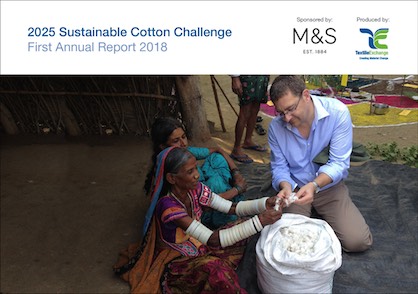
Textile Exchange releases first annual 2025 Sustainable Cotton Challenge Report
A catalyst to spur a shift in the market toward the use of more sustainable cotton
Those original 13 CEOs committed to work together to accelerate the use of sustainable cotton, which paved the way for other industry leaders to follow – resulting in 39 companies now committed to sourcing 100% sustainable cotton by 2025.
At the time of its inception, the 2025 Sustainable Cotton Challenge was known as the “Sustainable Cotton Communiqué” and its purpose was, and still is, to increase the uptake of organic and preferred cotton, therefore increasing the income of smallholder farmers, eliminating highly hazardous pesticides, eliminating or reducing the amount of pesticides and synthetic fertilizer used, reducing water use and improving water quality and soil health, which includes positive carbon impacts as a result of more sustainable practices.
Mike Barry, Director of Sustainable Business at M&S said, “There is growing recognition of the enormous social and environmental impact of the global fashion industry. The 2025 Sustainable Cotton Challenge shows how by working collaboratively the sector can scale rapidly solutions that are good for farmers, the environment and consumers alike.” Today, 19% of the world’s cotton is more sustainable. By 2025, it is the vision of this Challenge that more than 50% of the world’s cotton is converted to more sustainable growing methods.
Brands and retailers joining the challenge and committing to source more sustainable cotton, can choose from sources that are included on Textile Exchange’s list of recognized organic and sustainable cotton initiatives. These initiatives include:
- *ABRAPA •
- *BASF e3 •
- Better Cotton Initiative (BCI)
- *Cleaner Cotton
- Organic
- Recycled cotton (that is certified to an independently verifiable standard such as the Global Recycled Standard (GRS) or the Recycled Claim Standard (RCS))
- Cotton made in Africa (CmiA)
- Fairtrade
- *Fairtrade Organic
- *Field to Market
- *REEL Cotton
- *Regenerative Cotton
- *Transitional Cotton
- *ISCC
- *myBMP
* Denotes initiatives being Benchmarked starting in 2019.
This first annual report provides information and statistics on the achievements and impacts these programs are having on water, communities, soil quality, biodiversity and social considerations and regulations. By committing to use cotton from these initiatives and
standards, the brands are ensuring that the intentions of their sustainable sourcing strategies are maintained and the integrity of their commitments are uncompromised.
KEY FINDINGS
Of the 39 2025 Sustainable Cotton Challenge signatories, 30 participated in the 2018 Preferred Fiber and Materials Benchmark program to report on their progress towards their goal of 100% cotton being sourced from the approved initiatives by 2025:
- 10% of 2025 Sustainable Cotton Challenge signatories have achieved their 2025 target of 100% preferred cotton usage, all of which are organic.
- 37% have achieved a preferred cotton share of between 75-99%.
- 23% have achieved a preferred cotton share of between 50-74%.
- 7% have achieved a preferred cotton share of between 25-49%.
- 17% have achieved a preferred cotton share of less than 24%.
- 6% of cotton is not tracked yet.
From the niche to a market share of 19 percent, preferred cotton is gaining ground.
“The tide is turning on traditional supply chains, with demands for greater transparency generating a change from transactional relationships to transformational partnerships,” said Alison Ward, CEO for CottonConnect. In order for sustainable cotton to become standard business practice, the amount of sustainable cotton grown and bought must increase significantly. The 2025 Sustainable Cotton Challenge pledge sends a signal to millions of producers that there is a real demand for a more sustainable approach to cotton production that reduces the environmental and social costs.
Liza Schillo, Manager of Global Product Sustainability at Levi Strauss & Co. said, “Greater transparency across the supply chain and stronger, more strategic relationships between supply chain partners will be critical to the much- needed widespread adoption of sustainable farming practices around the world.”
TEXTILE EXCHANGE’S ROLE
In March 2018, the Prince’s International Sustainability Unit was closed and Textile Exchange became the initiative’s secretariat. Working under the guidance of a steering group with representatives from Marks & Spencer, Soil Association, Better Cotton Initiative, Levi Strauss & Co., and Kering, Textile Exchange continues to build on the momentum to secure a more sustainable cotton sector.
In recognition of the influential work HRH The Prince of Wales has done to start the 2025 Sustainable Cotton Challenge initiative, Textile Exchange received the honor of being selected by publisher St James’s House to appear in Our Future King: Prince Charles at 70, a coffee- table book celebrating a lifetime of achievement, and heralding his current and future roles and responsibilities. The inclusion of the 2025 Sustainable Cotton Challenge is featured on pages 138-139. The eBook version is available here:
https://textileexchange.org/2025-sustainable-cotton-challenge/