[pageLogInLogOut]

#Sustainability

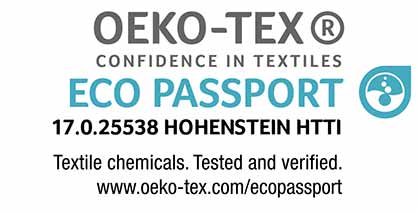
The ECO PASSPORT by OEKO-TEX® certification of textile chemicals

As an accredited test laboratory with over 1.000 staff worldwide, Hohenstein belongs to one of 18 institutes run by the OEKO-Tex® company and specialises in testing for toxic substances in textile products and textile components. Established two years ago, the ECO PASSPORT by OEKO-TEX® certification serves to examine textile chemicals used as aids in production. The article details the certification process using the example of Total’s Lissolfix coning oil.

The ECO PASSPORT by OEKO-TEX® certification

The ECO PASSPORT certification, conducted exclusively by Hohenstein in Germany, supplements the existing OEKO-TEX® certifications such as STANDARD 100 by OEKO-TEX®. For over 25 years, STANDARD 100 has been examining raw, intermediate and finished textile products for toxic substances and certifying textile products that pose no threat to health. The ECO PASSPORT certification follows a two-step process to analyse whether dyes, equipment, aids and other chemicals used in textile production can be classified as safe. Coning oils used to texture yarns may obtain ECO PASSPORT certification as production-specific aids.
© 2018 Hohenstein
© 2018 Hohenstein


The importance of the ECO PASSPORT by OEKO-TEX® certification

Two years on from the certification’s introduction, the OEKO-TEX® community has been able to certify more than 3000 products of over 400 customers worldwide. The certification makes it easier for companies manufacturing and selling textiles in accordance with STANDARD 100 by OEKO-TEX® to procure textile aids. It enables them to meet the market requirements for safe, non-toxic textiles, ensures that their textile-production staff are protected, help protecting the environment and the end consumer. For Total as an oil producer, the ECO PASSPORT certification means one extra step to adapt to the industry’s requirements and offer eco-friendly oils in order to set itself apart from its competitors.

ECO PASSPORT by OEKO-TEX® certification process

Hohenstein and the applicant work in close consultation throughout every stage of the certification. If possible, the applicant should have an existing quality-assurance system complying with ISO standards. The textile chemicals are tested in two to three stages at Hohenstein’s testing laboratory. 

Stage I: Compliance screening

In the case of initial certifications, applicant queries are clarified before the application is lodged. Once the application has been checked, safety data sheets and the composition of the product to be certified are analysed and examinations conducted to determine whether any prohibited substances are used in production. If they are, the manufacturer is given an opportunity to adjust the composition accordingly. In the case of Total’s Lissolfix coning oils, no regulated substances are used meaning the composition did not need to be adjusted.

The test specimens are checked for toxins in the laboratory. <br />
© Hohenstein
The test specimens are checked for toxins in the laboratory. © Hohenstein


Qualified staff prepare the test specimens examination. © Hohenstein


Stage II: Analytical verification

If there are no abnormalities during the initial test, a laboratory test is conducted comparing the components with the limit values regarding toxic substances in textile products. If, for example, the test specimen’s packaging has resulted in contaminants, a new test specimen may be sent to the laboratory for examination. The parameters of the examination vary according to the product. In the case of Total’s Lissolfix APZX 1350 / 1500 / 4800 coning oils, the test specimen was checked for parameters such as heavy metals, formaldehyde, phthalates, and chlorinated, organotin and volatile organic compounds. 

Stage III: Sustainability check

The summer of 2018 sees a third stage added to the process. In the interests of sustainability, this stage will address environmental protection and OHS and involves on-site checks at the producer’s premises. It will initially only be conducted at the applicant’s request.

Validity of the ECO PASSPORT certification by OEKO-TEX®

The ECO PASSPORT by OEKO-TEX® certification is valid for one year. Extensions may be requested no earlier than three months prior to the certification’s expiry. This will involve re-assessment of the documents and a simplified laboratory test in order to ensure quality has remained consistent. The toxins’ limit values or the textile chemicals’ production conditions may also have changed in the meantime, necessitating another test to meet the requirements. If changes are made to the certified product during the certification’s validity period, the certificate holder is obliged to report the change and, if necessary, provide a new test specimen for testing. As an oil manufacturer for the industry, Total is one of the first providers of coning oils to have its Lissolfix APZX 1350 / 1500 / 4800 products certified, and is already planning additional ECO PASSPORT by OEKO-TEX® certifications.

Dipl. – Ing. (FH) Maren Kohl
Total Deutschland GmbH, Berlin

Dr. Jörg Schlatterer
Hohenstein Laboratories GmbH & Co. KG, Boennigheim
More News from Oeko-Tex® Association

#Sustainability

OEKO-TEX® - New regulations 2025

Fostering trust within the textile and leather industry remains the mission of OEKO-TEX®. Since trust relies on consistently high standards, the OEKO-TEX® Association has released the updated testing criteria, limit values and guidelines for its certifications, based on the latest scientific research and legal developments.

#Sustainability

OEKO-TEX® Annual Report 2023/2024 mentions 50,000+ valid certifications

The international OEKO-TEX® association has continued to demonstrate positive business growth, highlighting the critical role of close collaboration and shared commitment in accelerating sustainable change. More than 35,000 textile and leather companies depend on the certificates and product labels issued by OEKO-TEX®’s independent testing institutes. OEKO-TEX® issued more than 50,000 certificates and labels between July 1, 2023, and June 30, 2024 – an increase of 22% over the previous financial year.

#Sustainability

OEKO-TEX® New regulations 2024

Creating trust within the textile and leather industry and for its customers is the mission of OEKO-TEX®. Since trust is based on consistently high quality, the OEKO-TEX® Association is again publishing updates to the applicable test criteria, limit values and guidelines for its certifications. Based on new scientific findings and legal developments, the OEKO-TEX® Association has published the annual updates to its test criteria, limit values and guidelines.

#Sustainability

Change in the OEKO-TEX® Management Board

OEKO-TEX® announces the departure of Georg Dieners. The Association’s Secretary General is leaving the organisation after 8 years in office. OEKO-TEX® expresses appreciation to Georg Dieners for his work and wishes him all the best for his future.

More News on Sustainability

#Sustainability

YKK recognized with Top ‘A’ rating by CDP for climate change leadership for third consecutive year

YKK Corporation announced its achievement of the highest “A List” rating in the 2025 Climate Change survey conducted by the global environmental disclosure nonprofit, CDP . This marks the third consecutive year YKK has received this prestigious recognition.

#Weaving

Itema announces strategic partnership with Ivy Decarb to accelerate decarbonization in weaving process

Itema is pleased to announce the strategic partnership with Ivy Decarb, the digital platform helping textile companies measure and reduce their carbon footprint.

#Man-Made Fibers

Teijin Carbon Europe receives EcoVadis Silver status – ranked among the top 15% of evaluated companies

Teijin Carbon Europe (TCE) has been recognized for its sustainability performance and has been awarded the EcoVadis Silver Medal in the latest assessment. In its first-ever EcoVadis evaluation, the company achieved a notable 72 out of 100 points, ranking among the top 15% of all companies evaluated worldwide, within the “Manufacture of Man-Made Fibres” category.

#Research & Development

The region of renewable raw materials: Central German Alliance for Bioplastics

The development of sustainable plastic solutions is rapidly gaining importance in light of global environ- mental pollution, dwindling fossil resources and ambitious climate protection targets. As part of the re- gional alliance RUBIO, which brings together 18 partners from central Germany and the Berlin-Branden- burg area, the bio-based and biodegradable plastic polybutylene succinate (PBS) was comprehensively investigated, starting with the raw material, through the manufacturing process, to industrial application.

Latest News

#Spinning

First PA66 spinning plant with EvoQuench successfully commissioned

With the successful commissioning of a multi-digit PA66 spinning line for microfiber yarns, Chinese textile company Shandong Nanshan Fashion Technology Co., Ltd. has added yarn production to its textile value chain.

#Knitting & Hosiery

SHIMA SEIKI returns to ShanghaiTex

Leading flat knitting solutions provider SHIMA SEIKI MFG., LTD. of Wakayama, Japan, together with its Hong Kong and Chinese market subsidiary SHIMA SEIKI (HONG KONG) LTD., will exhibit at the ShanghaiTex 2025 exhibition (Booth No.: Hall N3, Booth A20) held in Shanghai, China this month. This marks the return of SHIMA SEIKI to ShanghaiTex after a 14-year hiatus, its last exhibit at the show having been in 2011.

#Research & Development

Fraunhofer CCPE presents the “Monomaterial Design Set” – Innovative solutions for circular product design

Composite materials made from different types of plastic often extend the lifetime of products but make recycling more difficult in the circular economy. That is why Fraunhofer CCPE has developed the “Monomaterial Design Set”. This new approach helps to reduce the variety of plastics used in durable products and offers circular solutions for designers and product developers.

#Man-Made Fibers

arena introduces renewable LYCRA® EcoMade fiber in its latest swimwear collection

Italian swimwear specialist arena has unveiled a new collection that brings sustainability and performance even closer together. Launched on December 4, the line features swimsuits made from recycled nylon and renewable LYCRA® EcoMade fiber — the first time the bio-based spandex has been used commercially in swimwear.

TOP