[pageLogInLogOut]

#Spinning

Autocoro 11 – Energy saving made easy
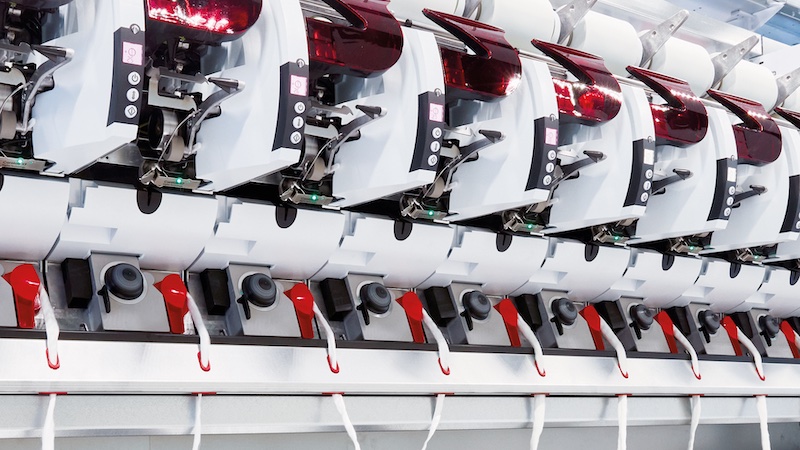
Economic efficiency, sustainability and climate-friendly yarn production - the Autocoro 11 plays in the top class in all areas. It spins sustainable raw materials with ease and is the spinning machine with the lowest energy consumption on the market.
Autocoro 11 © 2024 Saurer


The cost of yarn production is rising worldwide. The spinning mills have only a limited influence on this development, as too many factors play a role: Economic, political and financial, to name but a few. The best strategy for spinning is therefore to avoid costs. When it comes to the energy-saving production of yarns, there is no way around automatic rotor spinning. No spinning method requires less energy in the process to produce a ready-to-sell yarn.

After raw materials, energy is the second largest cost item in the automatic rotor spinning mill. Minimising costs here directly increases the profitability of the spinning mills. The Autocoro 11 automatic rotor spinning machine is a champion in this field which reduces spinning costs simultaneously on several levels. With the Recycling Xtreme equipment, spinning mills can save considerable raw material costs. The advanced full automation reduces the need for personnel and, thanks to comprehensive energy optimisation, each Autocoro 11 uses 10% less energy than its predecessor, and up to 48% less in comparison with older rotor spinning machines.

The key energy-saving factor - the new extraction system of the Autocoro 11

Around 30% of the energy required for spinning is used to provide the negative pressure necessary for the process. For the Autocoro 11, Saurer has designed, practically from scratch, an extraction system with everything needed for vacuum logistics. The result: A completely redesigned extraction system, modified ducts with a capacity increase of up to 85% that is resistant to pressure fluctuations. New air filter systems and a completely revised electronic control of the vacuum supply can now supply each of the different spinning processes individually with the suction air required. For example, the pure spinning process is supplied with suction air just as precisely as the yarn search during the initial spinning phase. Gone are the days of compromises, when simultaneously operated processes were supplied from a single compressed air supply and were therefore not 100% energy-optimised. Energy-saving air technology is the top priority for the new Autocoro 11.

One of the powerful workhorses in the Autocoro is the winding device. It needs energy to move and wind tonnes of yarn reliably throughout the year. The Autocoro 11 winding device is equipped with state-of-the-art, energy-optimised drives, enabling Saurer to reduce the base load. The numerous electronic components of the rotor spinning machine, such as the power supply units, were also checked and optimised with respect to their energy efficiency.

Energy cost savings in the six-figure range with the Autocoro 11

Compared to older generations of rotor spinning machines, many of which are still in use in various spinning mills today, the new Autocoro 11 saves up to 48% in energy costs. (Figure 1)
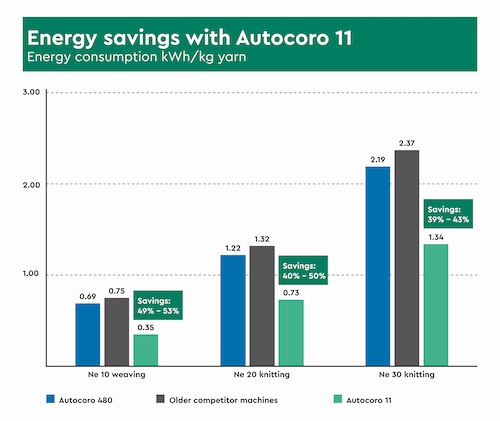
Figure 1: Energy savings with the Autocoro 11 in kWh/kg yarn © 2024 Saurer


Even with moderate energy prices of just €0.10/kWh and relatively short machines with 480 spinning positions, cost savings per year and machine are in the six-figure range (Figure 2).
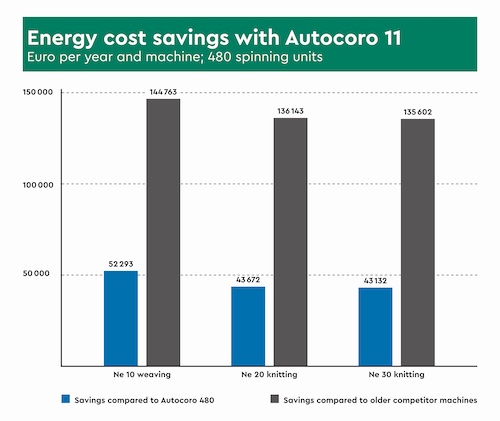
Figure 2: Annual cost savings with 480 spinning positions © 2024 Saurer


With Autocoro 11 customers can explore additional savings potential through a particularly energy-optimised spinning setting. These include measures such as reducing the spinning vacuum and the twist, increasing the rotor speed and using energy-saving small rotors (Figure 3).
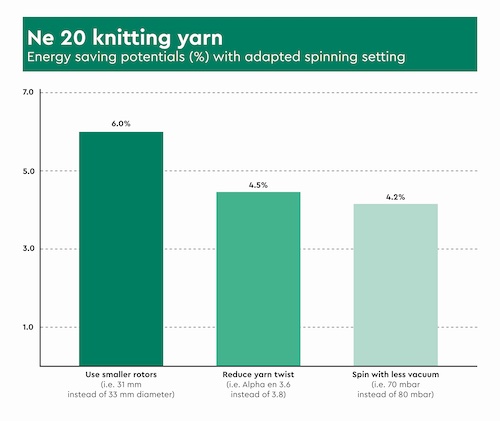
Figure 3: Potential for energy savings with different spinning settings © 2024 Saurer


Energy costs can be reduced by a further double-digit percentage by skilfully combining several measures, based on the respective raw material and the quality requirements of the yarn. 

The cost savings achieved by using the Autocoro 11 are an important aspect. Reducing energy requirements also means contributing to sustainability, an aspect that is becoming increasingly important in terms of achieving global climate targets. There are already spinning mills that use solar panels on their roofs to generate all the electricity required by their Autocoro spinning mills in a climate-neutral way.
Autocoro 11 © 2024 Saurer


More News from Saurer AG

#ITM 2026

Saurer at ITM 2026: Answering markets needs for flexibility

The textile industry is facing unprecedented challenges: geopolitical tensions, natural disasters and pandemics and are changing market conditions overnight. Today, flexibility is no longer an option, but a survival strategy. At the ITM 2026 in Istanbul, Saurer will be demonstrating how modern machine technology delivers flexibility – from bale to yarn – in hall 7 at booth 709 A.

#Techtextil 2026

Saurer sets new standards at Techtextil 2026

When the international textile industry gathers at Techtextil in Frankfurt from April 21 to 24, Saurer is going to present a powerful solution for the growing demands in the field of technical yarns with the TechnoCorder TC2plus.

#Spinning

Saurer Technologies Twisting Solutions at ICFE 2026

Saurer Technologies Twisting Solutions, a global leader in textile machinery innovation, will be present at the International Carpet and Flooring Expo ICFE 2026. Join us January 6–9 at the Istanbul Expo Center, Türkiye, as industry leaders, manufacturers, and innovators gather to explore the latest breakthroughs in carpet and flooring technology. Let’s meet at the new established global Center of the Carpet Sector in hall 3, booth 300!

#ITMA Asia + CITME Singapore 2025

Saurer’s leading technology for the yarns of tomorrow at ITMA Asia 2025

Saurer, is looking forward to presenting the latest innovation highlights at the ITMA Asia + CITME 2025 in Singapore on booth C 301 in hall 3. The spinning, twisting, and automation solutions are underlining the commitment to driving efficiency, sustain-ability, and digitalisation in the textile industry, paving the way for the yarns of tomorrow.

More News on Spinning

#ITMA Asia + CITME 2026

ITMA Asia 2026: How Barmag is reshaping the future of man-made fiber production

The textile industry is entering a groundbreaking era. Manufacturers face rising energy prices, growing sustainability demands, increasing labor shortages, and an unprecedented need for flexibility. For a globally active textile industry, where competitiveness is closely linked to production efficiency and cost leadership, this means that technology is no longer merely a means of improving operational processes – it is increasingly becoming a strategic differentiator.

#Spinning

Eltex takes the tension out of heat-setting

The ACT-MULTI system developed by Eltex – a member of TMAS, the Swedish textile machinery association – is bringing individual yarn tension monitoring and automatic control to the heat-setting process, helping manufacturers maintain consistent processing conditions across every yarn position.

#Spinning

Heberlein reinforces its commitment to the Chinese market

Heberlein, globally recognised as a leading provider of air interlacing and air texturing jets for synthetic filament yarns, is consolidating its success in the Chinese market with its APh- and APe-series for DTY applications. Particularly in the field of Air Covering, Heberlein technologies combine excellent quality with significant savings in compressed-air consumption. A new service hub in Shengze City underlines the company’s long-term commitment in the Chinese market.

#Recycled Fibers

Driving circularity with Uster Recycled Fiber Matrix

The textile industry’s commitment to circularity continues to accelerate, and mechanical recycling is viewed as a targeted approach to cutting textile waste and its environmental impact. At the forefront of this drive, Uster has developed the Recycled Fiber Matrix, a two-dimensional assessment of mechanically recycled fibers to guide optimum processing and end-uses.

Latest News

#Industry 4.0 / Digitalization

Coats Digital launches AI-powered GSD RealMotion for motion analysis

Coats Digital has launched GSD RealMotion, an AI-powered solution designed to provide apparel manufacturers with greater visibility into factory-floor operations. By analysing shop-floor video and applying Coats Digital’s GSD methodology, the solution turns video recordings into structured, motion-by-motion method studies.

#Textile chemistry

Archroma and Lameirinho partner in pioneering deployment of InOneGO single-step dyeing

Archroma, a global leader in specialty chemicals, and Lameirinho, a leading home textiles manufacturer based in Portugal, are collaborating to bring InOneGO by Archroma, a new single-step dyeing process, into commercial production. Lameirinho’s first InOneGo bedlinens collection is now available worldwide.

#Knitting & Hosiery

KARL MAYER launches extra-wide HKS 3-M EL for increased productivity

KARL MAYER has launched a new extra-wide version of its HKS 3-M EL tricot machine, designed to increase productivity particularly in the manufacture of textiles for sports, activewear and athleisure applications.

#Research & Development

Reducing development times for technical textiles by accelerated thermo-oxidative aging in a high-pressure autoclave

Synthetic polymers used in technical textiles can be effectively protected against degradation caused by heat, oxygen, and water through the use of stabilizer systems. This enables service lives of several decades, extending to more than 50 years. As the use of durable technical textiles continues to grow, so does the demand for reliable methods to predict their service life within economically feasible testing periods. For the first time the German Institutes of Textile and Fiber Research Denkendorf (DITF) developed methods for robust service life prediction for textiles in an IGF research project.

TOP