[pageLogInLogOut]

#Spinning

Oerlikon celebrates 20 years of e-save
Over 15 million tons of CO2 savings in 20 years – that is the balance sheet of e-save – the sustainability program of today's Oerlikon Polymer Processing Solutions Division. As one of the world's leading suppliers of manmade fiber plant technologies, the company has been developing, producing and launching its products and services with sustainability in mind since 2004: 'Energy' savings and 'Efficiency' of systems, machines and components, 'Environment' relief and improved 'Ergonomics' for optimal machine operation are the four e-save topics that have provided fiber and yarn manufacturers with significant added value in terms of economy, safety and process handling right from the start. The pioneers of today's brands Oerlikon Barmag, Oerlikon Neumag and Oerlikon Nonwoven were already true pioneers in terms of sustainability.
The e-save logo is awarded to components and machines from Oerlikon Barmag, Oerlikon Neumag and Oerlikon Nonwoven that are significantly more sustainable than the market standard or predecessor models © 2024 Oerlikon


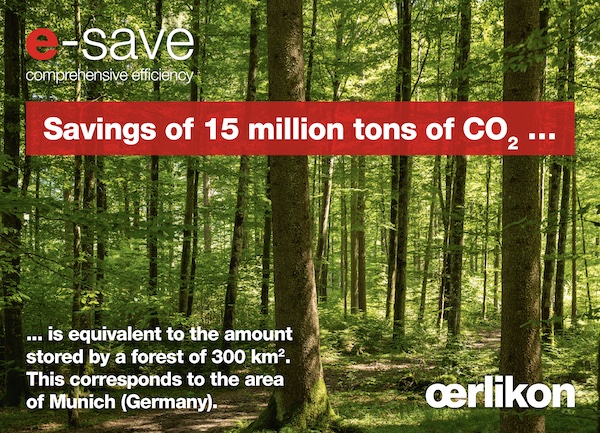
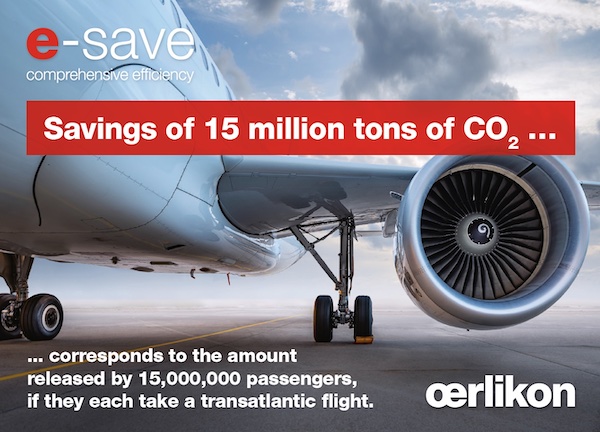
The CO2 balance of the e-save sustainability program is impressive: The e-save certified customer installations saved, cumulatively over the last 20 years, over 15 million tons of CO2. This is roughly equivalent to the emissions generated by around 15 million intercontinental passenger flights per capita, or the amount that a forest with a surface area of 300 km² – roughly the size of Munich, Germany – can store © 2024 Oerlikon


Pioneers in sustainability

Rising energy prices, scarce resources, an ageing society, a shortage of skilled workers and lower profit margins in many industries prove Oerlikon's e-save mission right. For 20 years, the technology leader in manmade fiber production has been scoring points with significantly lower energy consump-tion compared to the market standard, the competition or its own predecessor models. Fiber and yarn manufacturers around the world appreciate this, as investments in new systems developed according to e-save criteria pay for themselves in a much shorter time. “Topics such as energy efficiency and the careful use of resources have become increasingly important for all our customers in recent years, not least due to stricter legal framework conditions,” says Georg Stausberg, CEO of the Oerlikon Polymer Processing Solutions Division. “Our e-save sustainability program and the associated tech-nology development over the last two decades has often given us the decisive advantage in numer-ous investment decisions on the customer side and thus the edge over the competition.”
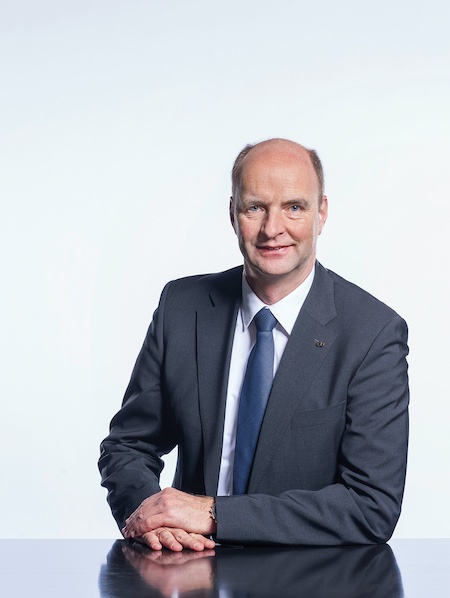

Georg Stausberg, CEO of the Oerlikon Polymer Processing Solutions Division and CSO of the Swiss Oerlikon Group © 2024 Oerlikon


Over 15 million tons of CO2 saved since the introduction of e-save

The Oerlikon Polymer Processing Solutions Division and its business units have been subject to DIN ISO certification for decades, they realize the CE marking and consistently implement the strict guide-lines for machine safety, especially in terms of protecting employees on the customer side. At the beginning of the millennium, however, this was no longer enough. The company and its managers wanted to voluntarily do even more with a view to the future. As a result, the e-save program was launched in 2004.
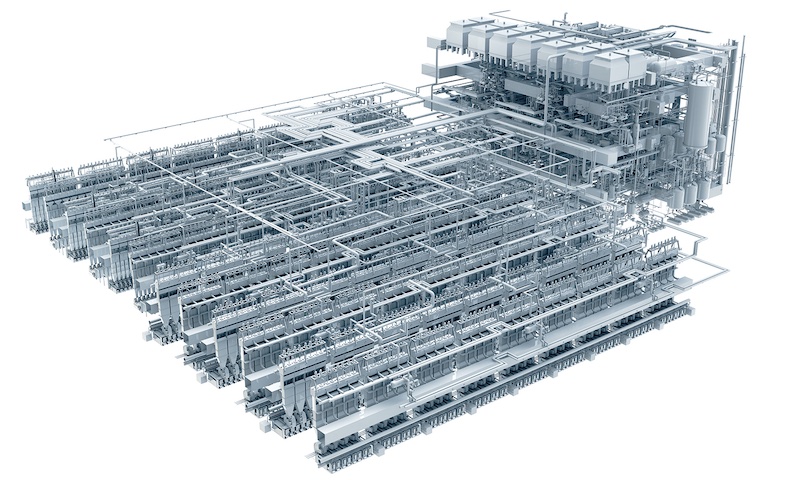
Over the past 20 years, Oerlikon has installed numerous large-scale plants worldwide for the production of several hundred tons of polyester, polypropylene or nylon per day © 2024 Oerlikon


Since its introduction, hundreds of manmade fiber spinning mills worldwide have been equipped with technology solutions from Oerlikon Barmag, Oerlikon Neumag and Oerlikon Nonwoven. Around half of the currently installed production capacity for polyester, polypropylene and nylon is based on Oer-likon technologies. According to an estimate by the publication “TheFiberYear 2024”, this corresponds to almost 40 million tons of fibers and yarn annually. The corresponding CO2 balance is impressive: The e-save certified customer installations saved, cumulatively over the last 20 years, over 15 million tons of CO2. This is roughly equivalent to the emissions generated by around 15 million intercontinen-tal passenger flights per capita, or the amount that a forest with a surface area of 300 km² – roughly the size of Munich, Germany – can store.
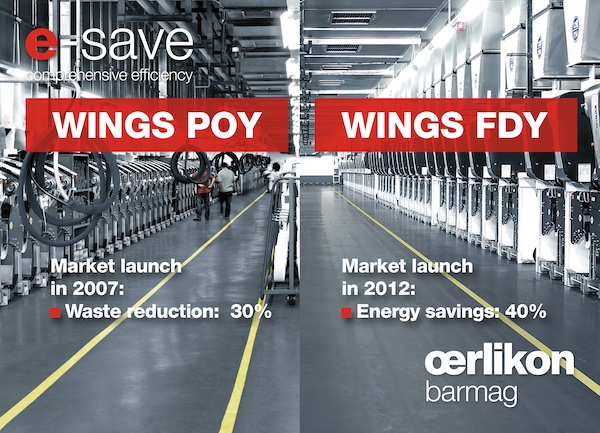
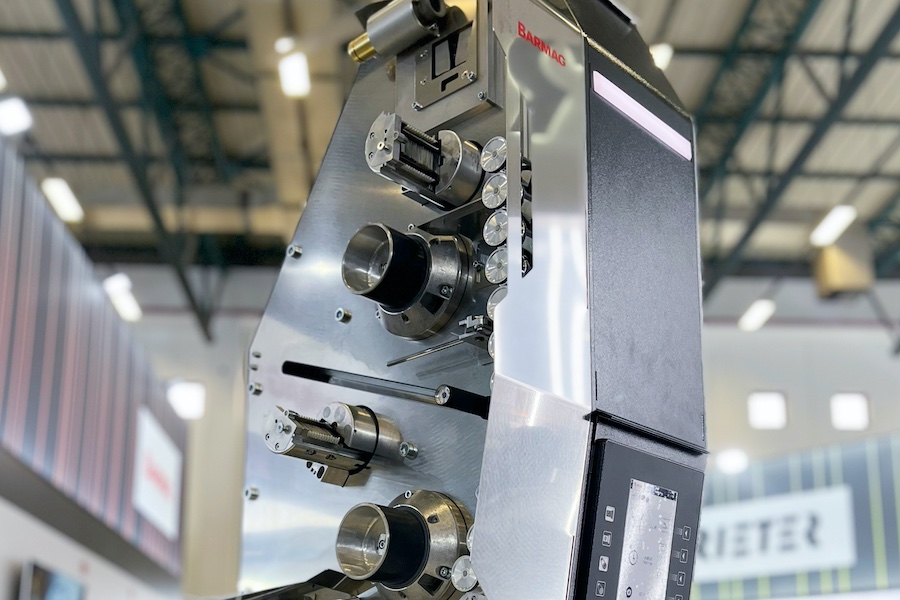
With WINGS (Winding Integrated Godet Solution), Oerlikon Barmag has secured its market position as one of the most important suppliers of manmade fiber systems for both POY and FDY © 2024 Oerlikon


Efficient heating and cooling creates energy-saving potential

What did the engineers focus on in the beginning? Heat is a crucial factor in polymer spinning sys-tems. Polyester melt is conveyed from the polycondensation plant to the spinning system at tempera-tures between 280 and 290 degrees Celsius. The hot filament coming out of the spinnerets is then cooled in the quenching unit before being drawn on hot godets, depending on the process. 
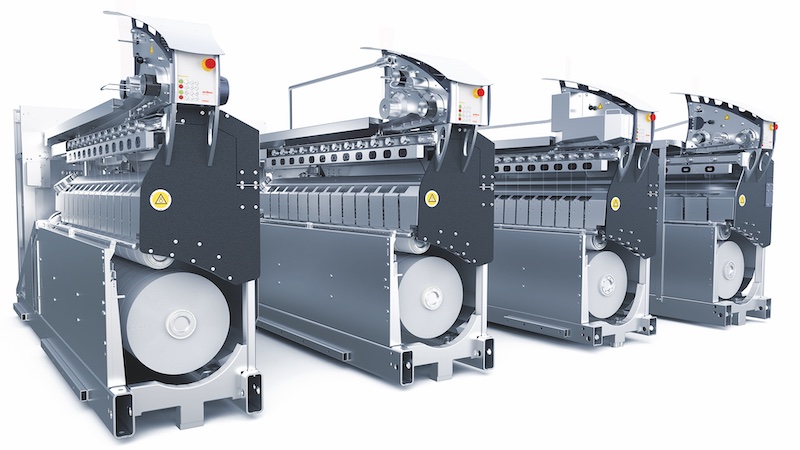

Oerlikon Barmag WINGS POY (Winding Integrated Godet Solution) revolutionized the manmade fiber industry at the ITMA 2007. There is now an entire product family of the successful winder. © 2024 Oerlikon


“All of this has the potential to optimize energy consumption: WINGS POY (Winding Integrated Godet Solution) revolutionized the manmade fiber industry at ITMA 2007. The completely new winding con-cept already showed the potential to turn the entire industry upside down. All market participants were enthusiastic from day one,” says Jochen Adler, CTO of the Oerlikon Polymer Processing Solutions Division.
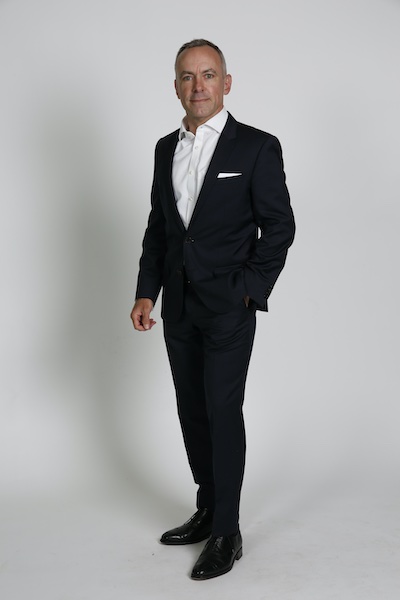
Jochen Adler, CTO of the Oerlikon Polymer Processing Solutions Division © 2024 Oerlikon


Chinese companies in particular already saw the technology that would make them global pioneers in the manmade fiber industry. Five years later, WINGS FDY conquered the market with even more e-save advantages, especially in the area of energy savings. The Oerlikon Barmag innovation achieved over 40 % lower energy consumption compared to the industry standard at the time. The return on investment (ROI) was and still is achieved very quickly. The best technology with the highest quality is therefore also worthwhile from an economic point of view. In addition to the Oerlikon Barmag core technology WINGS – today an indispensable part of a modern manmade fiber spinning mill – the company has set standards over the years with other components in the field of energy savings.


Benchmark market in the industry

The SP8x spinning head series, for example, is based on a reduced heat-radiating surface with signif-icantly improved insulation, resulting in more than 40 % less heat loss compared to its predecessor models. In concrete figures, this means energy savings of around 200,000 kWh per year for a system with 36 positions. The component therefore remains the benchmark in the industry.
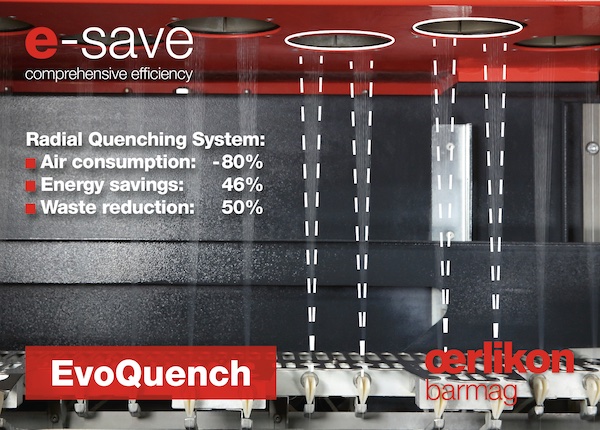
The EvoQuench radial quenching system is a real cash cow thanks to its up to 80 % lower air conditioning requirement © 2024 Oerlikon


“The EvoQuench radial quenching system is a real cash cow thanks to its up to 80 % lower air condi-tioning requirement. In combination with the WINGS take-up system, up to 46 % energy and around 50 % waste can be saved compared to conventional technology, depending on the process”, so Adler. The latter is mainly due to the ergonomically unique concept of the take-up unit: The component is placed at eye level in record time; only one operator is required. 

The sister company Oerlikon Neumag also contributed corresponding e-save components at an ex-ceedingly early stage. For example, the BCF tangle unit RoTac3 enables high energy savings through its targeted use of compressed air. Tangle knots are created with a pulsating rather than a continuous airflow, as is the case with conventional tangle processes. This means that compressed air is only ever used when a tangle knot is to be created. This significantly reduces the required volume flow or compressed air consumption – by up to 50 percent compared to conventional tangle units, depending on the yarn type. The component is naturally installed in Oerlikon Neumag's BCF S8 carpet yarn sys-tem, the most modern of its kind in the world. It makes a significant contribution to the energy-efficient production of carpet yarns. However, the system also convinces with impressive data thanks to the overall concept: Plant efficiency of 99%, higher throughputs of up to 15% and energy savings of up to 5% per kilogram of yarn.
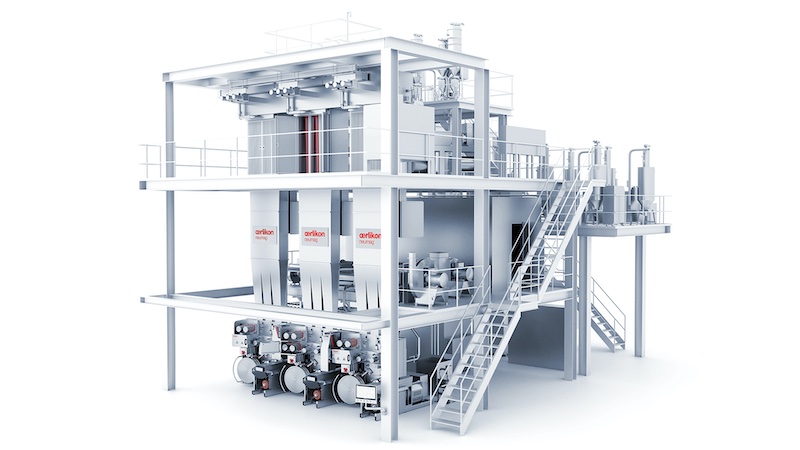
Oerlikon Neumag BCF S8 also impresses with impressive data thanks to the overall concept: System efficiency of 99 %, higher throughputs of up to 15 % and energy savings of up to 5 % per kilogram of yarn © 2024 Oerlikon


Less energy – more productivity

Compared to standard DTY machines, the Oerlikon Barmag eAFK Evo offers 30 % higher productivity with 20 % less energy consumption per kilogram of textured yarn. The significant increase in machine speed and the 50 % shorter texturing zone compared to a conventional machine ensure an exception-ally stable texturing process that enables maximum productivity and the lowest operating costs. The core component of the machine is the EvoCooler, whose sustainable cooling principle is based on the evaporation of water. This active cooling technology with direct contact to the yarn is independent of the ambient temperature and requires no additional energy. In addition, the low heat emission to the environment reduces the requirements for hall air conditioning. The collected coolant is recirculated and can therefore be recycled.
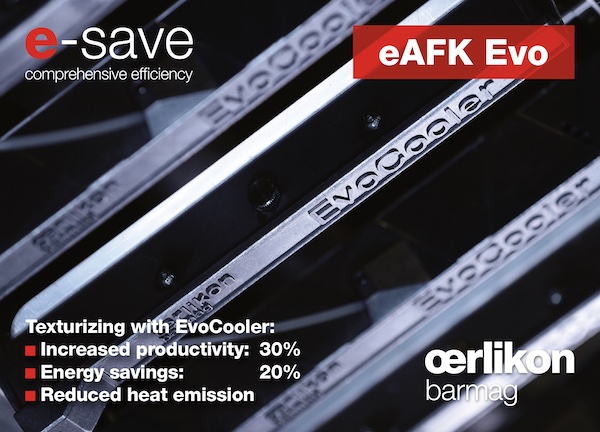
Compared to standard DTY machines, the Oerlikon Barmag eAFK Evo offers 30 % higher productivity with 20 % less energy consumption per kilogram of textured yarn thanks to its innovative EvoCooler, among other things © 2024 Oerlikon


“Precisely coordinated process steps in the textile value chain also offer potential in terms of effi-ciency. One example is the WINGS POY HD and eAFK Big V high-titer concept, which is designed for a carpet and home textile product range that uses particularly soft and bulky polyester yarns with BCF-like properties. The aim here is to produce yarns with a maximum count of 1200den with over 1000 filaments. As standard, DTY yarns up to 1200den with up to 1152 filaments from four POY bob-bins 300den/288f are spun together on a DTY machine”, says Jochen Adler. However, the process has a fundamental disadvantage: half of the available winding positions on a texturing machine re-main unused. This is where the spinning concept with a WINGS POY HD take-up unit in combination with an automatic eAFK Big V multi-spindle texturing machine offers a highly efficient solution – cur-rently the only one on the market.
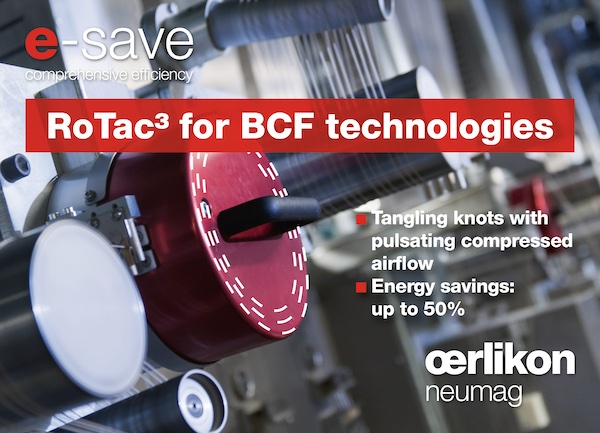
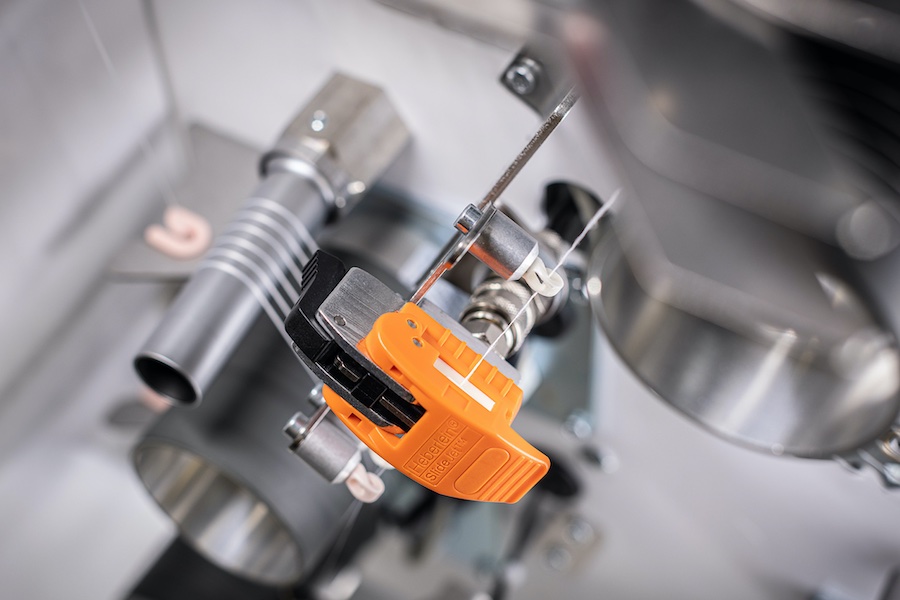
The Oerlikon Neumag BCF RoTac³ tangle unit enables high energy savings through its targeted use of compressed air © 2024 Oerlikon


Water – a contested resource

The most recent example of a sustainable e-save technology is the Oerlikon Neumag EvoSteam sta-ple fiber plant. Here, too, the relevant process steps in terms of sustainability were already taken into account during development. The innovative process does not require water baths. The result: water savings of up to 3.5 million liters per year, significantly lower consumption of drying energy and preparation, and ultimately a reduction in the CO2 footprint of up to 20 %. An optimized draw point release makes the EvoSteam staple fiber system up to 12% more efficient than previous concepts. Overall, the EvoSteam process reduces production waste by up to 50 % while at the same time saving up to 8 % energy.
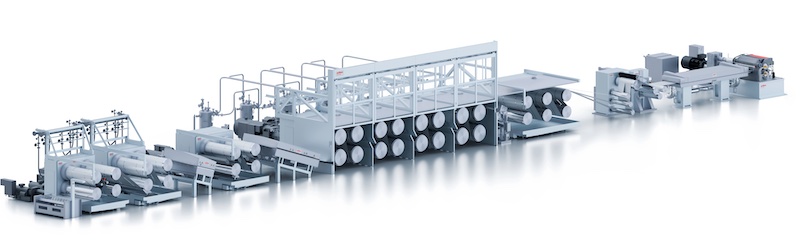
The most recent example of sustainable e-save technology is the Oerlikon Neumag EvoSteam staple fiber system. Here too, the relevant process steps in terms of sustainability were already addressed during development © 2024 Oerlikon


Another example: the pollution of water by dyeing textiles is a much-discussed topic. With the help of the 3DD mixer technology once developed at Oerlikon Barmag, manmade fiber production offers the injection of color pigments as a masterbatch as early as the melt preparation stage – this really is an exceptionally clean alternative. A nice side effect: the dyeing of these spun-dyed yarns is much more uniform than bath dyeing of bobbins or textile surfaces, and the color fastness is unsurpassed. In addition, the spun material retains its color almost forever.

Last but not least – the entire textile industry is striving for solutions for a functioning and all-encompassing circular economy. Together with its joint venture partner BB Engineering, Oerlikon Bar-mag already has at least one solution for a zero waste manmade fiber spinning mill on offer. With the help of the VacuFil technology, production waste can be reprocessed to a high quality in the spinning mill so that the waste material can be directly reintroduced into the melt flow.

On top: bluesign® certification

A good 20 years after the introduction of the e-save label as a voluntary commitment by Oerlikon, the company is following suit and is also subjecting itself to the assessment of independent institutes such as the Swiss bluesign Technologies AG as part of the ESG criteria that have been legally binding for a few years now.

Last year, the Oerlikon Neumag EvoSteam staple fiber plant was awarded the bluesign® VERIFIED DATA label. The label includes the verification of impact data such as water, spinning preparations, thermal and electrical energy as well as the CO2 footprint by means of a plausibility check of the supporting records for the EvoSteam draw frame, the central element in the EvoSteam process. For yarn manufacturers, this means that all polyester staple fibers produced with the EvoSteam process will actively contribute to the bluesign® SYSTEM in the future.
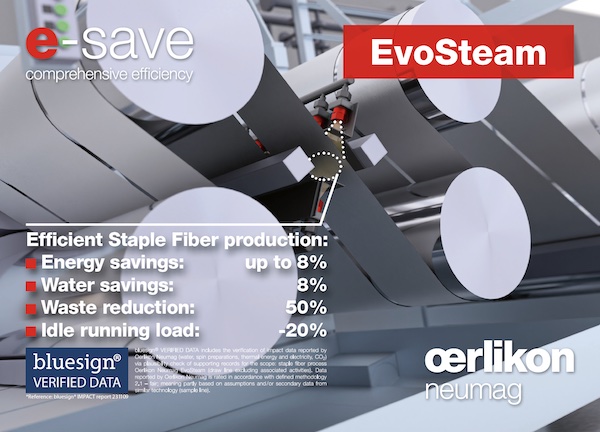
The Oerlikon Neumag EvoSteam staple fiber system was awarded the bluesign® VERIFIED DATA label last year © 2024 Oerlikon


“The trend towards greater sustainability is no longer just a trend, but a must for the industry and all market participants worldwide. With a view to the European Green Deal, we are creating even more transparency for our customers through external certifications such as bluesign® in addition to our own e-save label. In this way, we are intensively strengthening trust in all our products and services,” explains Georg Stausberg, who in addition to his role as Division CEO is also Chief Sustainability Officer (CSO) of the Swiss Oerlikon Group.
More News from Oerlikon Textile GmbH & Co. KG

#Nonwovens / Technical Textiles

Crimper repair workshop begins operations

Since the beginning of the year, Oerlikon Textile Inc. has been offering a crimper repair service, making it the company's first location worldwide to do so. The workshop in Charlotte specializes primarily in Fleissner and Neumag crimpers.

#Spinning

Oerlikon Manmade Fibers Solutions hosted successful Technology Day 2025 in India

Oerlikon Manmade Fibers Solutions recently hosted its highly anticipated Innovation and Technology Day at the Deltin Hotel in Daman by end of January 2025. The event attracted over 300 participants, including industry experts, partners, and stakeholders, who gathered to explore the latest advancements and trends in the manmade fibers industry in India.

#Spinning

Industrial yarn producer sees growth potential in tire cord sector

The Chinese Junma Group has expanded its HMLS capacities by 20 positions, hence becoming one of the largest tire cord manufacturers in China. At present, the company has 64 positions of HMLS systems, all of which are from Oerlikon Barmag.

#Spinning

Oerlikon reports third quarter 2024 results, highlights strong execution in a challenging market landscape

In the third quarter of 2024, Oerlikon reported a stable operational Group EBITDA margin, despite challenging market conditions, thanks to a focus on pricing, cost management, and efficiency across both divisions. Group order intake saw a 4% year-over-year decline at constant FX, attributed to temporary market softness in Surface Solutions, while orders in Polymer Processing Solutions showed signs of stabilization.

More News on Spinning

#Spinning

First PA66 spinning plant with EvoQuench successfully commissioned

With the successful commissioning of a multi-digit PA66 spinning line for microfiber yarns, Chinese textile company Shandong Nanshan Fashion Technology Co., Ltd. has added yarn production to its textile value chain.

#Spinning

Saurer Technologies Twisting Solutions at ICFE 2026

Saurer Technologies Twisting Solutions, a global leader in textile machinery innovation, will be present at the International Carpet and Flooring Expo ICFE 2026. Join us January 6–9 at the Istanbul Expo Center, Türkiye, as industry leaders, manufacturers, and innovators gather to explore the latest breakthroughs in carpet and flooring technology. Let’s meet at the new established global Center of the Carpet Sector in hall 3, booth 300!

#Spinning

Details matter: How Trützschler cylinder wires boost efficiency in Pakistan’s spinning sector

Pakistan’s textile industry, especially its spinning sector, is the backbone of the national economy and a vibrant hub of innovation. Today’s spinning mills face growing demands for efficiency, quality, and sustainability. From the serene northern valleys to the vibrant port city of Karachi in the south, mills like Suraj Cotton Mills, Liberty, and Nishat Chunian are turning to advanced solutions.

#Exhibitions & Events

Groz-Beckert showcases textile innovation at ShanghaiTex 2025

From December 16 to 19, 2025, the global textile industry will gather at ShanghaiTex at the Shanghai New International Expo Center (SNIEC), where Groz-Beckert will present its latest highlights and innovations across its five product areas – Knitting, Weaving, Nonwovens, Sewing, and Spinning – at Hall N3, Booth A05.

Latest News

#Natural Fibers

38th International Cotton Conference Bremen: Let´s Talk about Cotton!

The 38th International Cotton Conference Bremen, to be held on 25-27 March 2026 in Bremen’s parliament building on market square, once again sends a powerful signal for professional excellence and international dialogue. The focus is on the latest market trends and technical innovations throughout the entire value chain – from agriculture and quality assurance to processing and the circular economy. With its high-calibre speakers, the conference remains an indispensable forum for anyone involved in shaping the cotton industry scientifically, technically, or economically.

#Recycled_Fibers

Leading fashion brands step up to unlock the next chapter of Circulose

Since 2024, under new ownership and leadership, Circulose has set a renewed strategic direction focused on securing long-term commitments with partner brands to bring CIRCULOSE® back to market at scale. This strategy has proven successful.

#Research & Development

More safety and comfort for protective clothing thanks to auxetic fabrics

When everyday materials are pulled, they stretch or elongate in the direction of the pull and become narrower in cross-section. We can also observe this property in two-dimensional textiles. Auxetic structures behave differently here. They have the striking property of not changing under tensile stress or even increasing their width or thickness. These properties are advantageous, for example, in protective textiles or textile filter media. The DITF are researching auxetic fabrics for various applications.

#Recycled_Fibers

Recycling mixed-fibre garments becomes a reality: RadiciGroup, The LYCRA Company and Triumph take circular fashion a step forward

The process, which is both economically and environmentally sustainable, has enabled the production of an underwear set made from 100% recycled nylon and LYCRA® fibre in a closed-loop system.

TOP