[pageLogInLogOut]

#Spinning

The portal bale opener BO-P – the first step to optimum yarn quality
© 2022 Trützschler
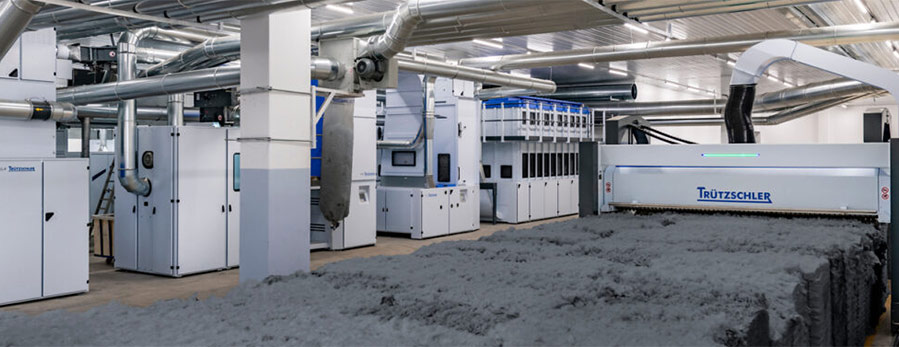
Differences in trash content, color and packing density of bales repeatedly lead to quality fluctuations in the spinning mill. So do elementary fiber properties like length, fineness or degree of maturity. In times of rising raw material prices, bales from different origins and quality grades are increasingly combined into one bale feed – and they must be blended well to ensure consistent yarn quality. The portal bale opener (BO-P) is the answer to these challenges. Three years after its launch, there are more than 150 BO-Ps helping to meet the increased requirements for blending and fiber opening for customers worldwide.

Whether ring spinning, open-end, airjet or recycling applications, “the foundation for yarn uniformity is laid in the blow room,” says Mr. Shi Chuangong, owner of Xiajing Xinshixing Textile Co, Ltd from China, which produces 30 tons of combed cotton yarn daily in its spinning mill. “With its larger working width and fine opening rollers, the BO-P meets these requirements exactly.

The BO-P can process up to six bales at the same time. As a result, fluctuations in quality or color in the bale feed are already almost non-existent before the next process step. In comparison, bale openers that can only process three or four bales in parallel already have a blending gap of 50 percent at this stage (for three bales versus six bales), or 33 percent (for four bales versus six bales).
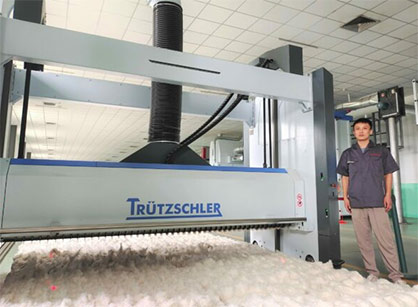
Mr. Hou Zongfei, Technical Chief Xiajing Xinshixing Textile Co., Ltd © 2022 Trützschler


Gentle opening, smaller fiber tufts, more efficient downstream processing

“The BO-P meets the requirements that we expect from a bale opener,” says Mr. Hakan Karagöl, General Manager Iskur Textile, which produces 130 tons of OE and 58 tons of ring yarn in various material combinations every day. “The advantages of fiber blending and opening that are possible for subsequent process steps when using the BO-P have clearly exceeded our expectations.”

Alongside the fiber blend, tuft size is another indicator of the quality of the fiber opening. The BO-P again benefits from its working width in this regard. For the same production quantity, the theoretical tuft size of the BO-P with a working width of 3500 mm is only half that of a bale opener with a working width of 1750 mm. The BO-P detaches the same amount of fiber material from twice the number of bales to achieve much finer tufts. In addition, the tooth density of the opening rollers is 25 percent higher compared to other bale openers. This makes detaching and cleaning the fiber tufts in the subsequent process steps considerably more efficient, so fewer good fibers are rejected.

Less space required

Today, spinning mills are faced with logistical challenges that require space-efficient solutions. In this context, the portal design of the BO-P offers a big advantage over other bale openers because less floor space is required for the same bale feed or production quantity.

The BO-P is also the right option for customers that want to process different materials with one bale opener. The number and length of different bale groups can be selected and programmed flexibly, up to 75 meters.


Higher productivity

The BO-P also sets new standards for productivity. It enables the production of 3000 kg/h (at 3500 mm working width) or 2500 kg/h (at 2900 mm working width).

Overview of the benefits of the BO-P:

  • Available as BO-P 2900 (working width 2900 mm) and BO-P 3500 (working width 3500 mm).
  • Production of up to 3000 kg/h.
  • Better blending.
  • Finer fiber tufts.
  • Flexible working areas with permanent access for bale inspection.
  • State-of-the-art and maintenance-free drives.
  • Production-optimized suction.
  • Intelligent safety system.
  • A T-LED remote display.


“Optimally mixed and gently opened fibers from the very beginning, combined with a consistently high production output, convince day after day,” says Mr. Hakan Karagöl, General Manager from Iskur Textile. “Many thanks to the entire Trützschler team.”
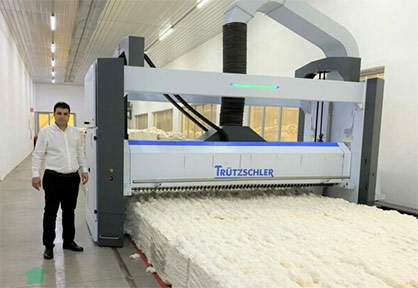
Mr. Hakan Karagöl, General Manager Iskur Textile. © 2022 Trützschler


More News from Truetzschler Card Clothing GmbH

More News on Spinning

#Techtextil 2026

DIENES at Techtextil 2026: Flexible pilot lines for bio-based fiber development

The growing relevance of bio-based materials in technical textiles is accompanied by increasing demands for reproducibility, high-quality data, and scalable process routes. Especially when working with cellulose and its derivatives, chitosan, lignin-based approaches, or bio-based PAN as a carbon-fiber precursor, R&D teams face variable feedstock quality, tighter process windows, and the need for reliable comparability across trials. This calls for flexible, data-driven experimental setups that can be reconfigured efficiently when recipes, solvents, and raw-material batches change.

#Techtextil 2026

RETECH showcases high-precision godets for high-performance fiber processing at Techtextil 2026

RETECH designs and manufactures godets and draw frames for heated, ambient and cooled processes, enabling precise heat treatment and consistently high yarn quality for a wide range of polymers and applications, with process temperatures of up to 400 °C for high-performance fibers. The company’s key competence lies in exact and stable temperature and speed control, individually adapted to the specific material and process requirements.

#Spinning

Barmag presents the next generation of POY production – energy-efficient and partial-automated

With POY 2.0, Barmag is introducing a completely redesigned spinning concept that takes the production of partially oriented yarn (POY) to a new level in terms of technology and economy. The solution, which was presented to a selected audience of experts for the first time at ITMA Asia + CITME 2025, was met with great enthusiasm: several yarn producers worldwide immediately expressed their interest in a pilot plant.

#Spinning

Development of bio-based polyethylene fibers for textile applications – BB Engineering partici-pates in the bioPEtex research project

In the German research project bioPEtex, BB Engineering (BBE) is working with other partners to develop textiles made from 100% bio-based polyethylene (PE). The aim is to make use of this poly-mer, which has hardly been used in the chemical fiber industry to date. BBE is contributing its spinning and texturizing expertise and developing the texturing process on an industrial scale. The first promising results are already available – opening up new opportu-nities for sustainable and economically attractive applications in the textile industry.

Latest News

#Texprocess 2026

Gunold showcases embroidery product range and services at Texprocess

At Texprocess 2026, GUNOLD will present numerous hands-on examples related to embroidery in Hall 8, Booth E20. The focus is on creative embroidery designs as well as the extensive product range of threads, nonwovens, and accessories for embroidery and embellishment. “Trade visitors can once again look forward to many new and creative embroidery designs. Of course, we will also showcase the matching products required to bring these ideas to life,” announces Marketing Manager Stephan Gunold.

#Nonwovens

EDANA and more than 70 industry organisations call for consistent exemptions in EU packaging regulation

EDANA, together with more than 70 industry associations and organisations, has issued a joint statement commenting on the European Commission’s Delegated Act under Article 29 of the Packaging and Packaging Waste Regulation (PPWR).

#Raw Materials

A Powerful Opening: Global thought leaders launch the International Cotton Conference Bremen

The International Cotton Conference Bremen will open on 25 March 2026 in the Parliament building of the Free Hanseatic City of Bremen with a keynote session of exceptional calibre. Distinguished international experts will set the stage for the conference by offering incisive perspectives on the most pressing challenges and the defining trends shaping the future of the global cotton trade. Their insights will span a broad spectrum — from geopolitically driven disruptions affecting global supply chains to the opportunities emerging from innovation-led agriculture capable of supporting a growing world population. Together, these opening keynotes will frame the dialogue of the conference, highlighting both the complexity of today’s market environment and the pathways toward a resilient and forward-looking cotton sector.

#Techtextil 2026

Where performance becomes product strategy: Techtextil 2026 puts functional apparel in the spotlight

The demand for high-performance textile solutions for the apparel industry increases – and with it the sector’s innovative strength. Techtextil 2026 addresses these developments: The Performance Apparel Textiles area (Hall 9.0) presents around 130 exhibitors from 13 countries showcasing innovative materials for workwear, protective clothing, smart fashion, outdoor and sports. Global key players such as Concordia Textiles, Getzner, Kermel, Klopman International and YKK Europe are among the participants. The live show “Performance Apparels on Stage” brings forward-looking wearables on stage and demonstrates textile innovations where they matter most: in action.

TOP