[pageLogInLogOut]

#Industry 4.0 / Digitalization

Dienes is moving rapidly towards Industry 4.0
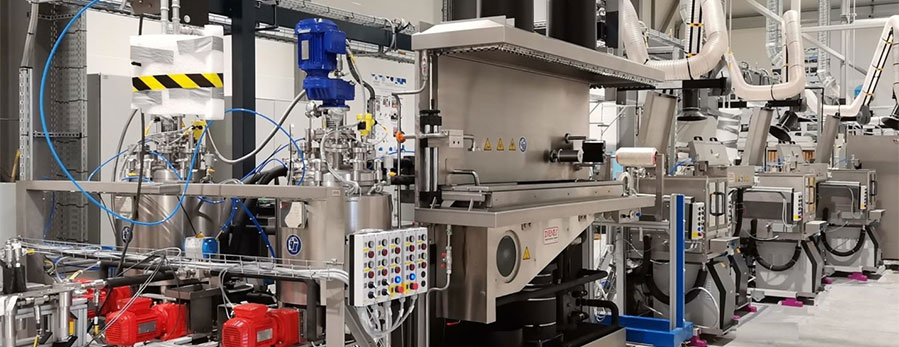
Automation of technical fiber production © 2022 Dienes
The transition is carried out using a new generation of automation systems in its plants helping the provider to achieve many goals at once. The systems include company’s own electronics, PLCs (programmable logic controller), touch panels, industrial PCs, etc. The enhancements focus on upgrading remote maintenance, improving performance and real-time behavior, using compatible standardized interfaces, and modernizing HMI (human machine interface) visualization.

The design of special equipment and fully-engineered solutions is quite a challenge. The utilization of CANopen specifications will not only increase the performance and reliability of the communication between field-level devices in the plant, but also simplify and help to reduce the costs of the development process. Dienes is keen on developing its own electronics with the newest CANopen specifications, so that all controllers, I/O cards and inverters support the CANopen communication protocol with its respective device profiles. This enables the devices to reach a higher standardized level of configurability and connectivity.

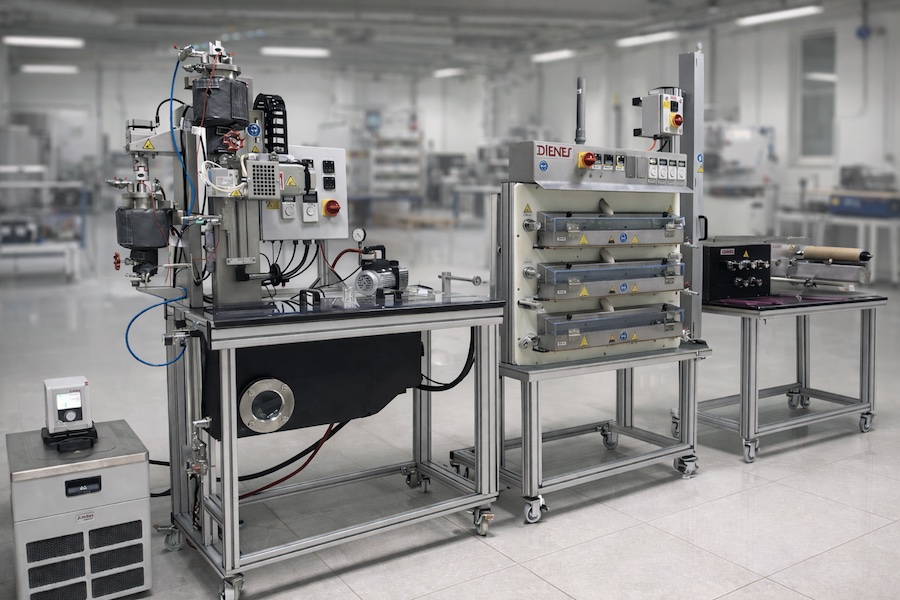
The development of innovative filaments demands an efficient, systematic and, in part, self-optimizing experimental working system, which must be smart and flexible. In the Dienes Multimode plants, each process step is represented by a module, which has its own decentralized control. This is the key for module’s integration into any plant at any time with a reduced programming effort. In the Multimode Explorer tool developed by Dienes, all process data are permanently visualized and recorded with a high degree of transparency for further evaluation. In order to guarantee the operation of each smart modular unit, an error-free system and communication are required. Furthermore, a reliable system makes sure that all production parameters can be permanently visualized and recorded, enabling a complete traceability of the process.


The recent CiA member Dienes Apparatebau is a supplier of fully-engineered solutions for leading manufacturers of technical fibers and renowned research institutes

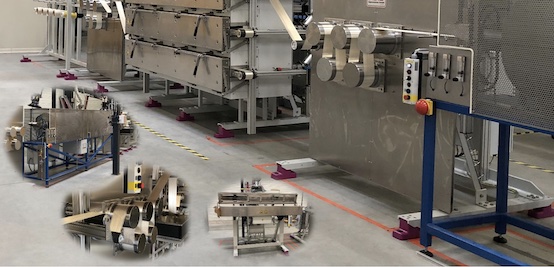
The company founded for over 90 years is located in Mühlheim am Main (Germany). Over the decades, the product range has been continuously growing from heated godets, control systems, individual plant modules up to complete laboratory, pilot and production lines for melt, wet, nano-?ber spinning, and further post-treatment. Growing demands on fiber performance require a continuous development and optimization of technology and production parameters.
More News from Dienes Apparatebau GmbH

#Techtextil 2026

DIENES at Techtextil 2026: Flexible pilot lines for bio-based fiber development

The growing relevance of bio-based materials in technical textiles is accompanied by increasing demands for reproducibility, high-quality data, and scalable process routes. Especially when working with cellulose and its derivatives, chitosan, lignin-based approaches, or bio-based PAN as a carbon-fiber precursor, R&D teams face variable feedstock quality, tighter process windows, and the need for reliable comparability across trials. This calls for flexible, data-driven experimental setups that can be reconfigured efficiently when recipes, solvents, and raw-material batches change.

#Composites

DIENES showcases MultiMode®: Pioneering solutions for the development of sustainable carbon fibres at JEC World 2025

DIENES Apparatebau GmbH, a global leader in innovative fibre processing technologies, is delighted to announce its participation at JEC World 2025 in Paris. The company will present its state-of-the-art MultiMode® modular platform, a revolutionary approach to developing sustainable carbon fibres. Visitors can explore DIENES’s advanced solutions at the Baden-Württemberg International stand in hall 6 stand N82.4.

#Techtextil 2024

DIENES at Techtextil 2024

The current accelerated growing demand for technical textile demands a more proactive approach which includes implementing frameworks and technologies for recycling and a broad use of biobased materials as an alternative to conventional polymers. Research work in this field is characterised by a high degree of adaptation needs, hence demanding an efficient, systematic and, in part, self-optimising experimental working system, which must be intelligent in gathering data from the process and flexible in enabling its rearrangement.

More News on Industry 4.0 / Digitalization

#ITM 2026

Driving digitalization, efficiency, and Smart Manufacturing across textiles and carpets

At this year’s ITM, BMSvision proudly showcases its next leap forward in digital manufacturing excellence. As a long-standing global pioneer in Manufacturing Execution Systems (MES) for the textile and plastics industries, BMSvision continues to accelerate digital transformation by delivering powerful, data-driven solutions that boost productivity, enhance quality and support sustainable growth. Visit BMSvision at the Vandewiele booth in Hall 7, Booth 710, to experience the future of textiles manufacturing.

#Industry 4.0 / Digitalization

Textile ETP launches digital transformation strategy, calling for urgent collective action across the value chain

Textile ETP’s DigitX Innovation Hub published its strategic roadmap for the digital transformation of Europe's textile and apparel industry.

#Research & Development

Textilfabrik 7.0 launched: Mönchengladbach becomes a real-world lab for sustainable textile production

With the official kick-off event of the Textilfabrik 7.0 (T7), a major transformation project for the German textile and apparel industry has been launched in the Monforts Quarter in Mönchengladbach. At the “Textile Roundtable,” an event format organized by the Zukunftsagentur Rheinisches Revier, representatives from industry, research, politics, and the regional economy came together to jointly lay the foundation for CO₂-neutral, circular, and economically viable textile production in Germany.

#Man-Made Fibers

OnceMore® from Södra brings end-to-end traceability for circular Man-made Cellulosic Fibers (MMCF) using TextileGenesis

OnceMore® from Södra, the world’s first large-scale process for recycling blended fabrics into high‐quality dissolving pulp, will begin using TextileGenesis, a Lectra company, to strengthen traceability from raw material to retail across the value chain. OnceMore® produces dissolving pulp made from blended textile waste and wood sourced from responsibly managed Swedish forests. By integrating TextileGenesis, OnceMore® supports the growing need for verified data and secure, transparent tracking throughout increasingly complex supply chain.

Latest News

#ITM 2026

SHIMA SEIKI to show complete knitting and cutting workflow at ITM 2026

Leading computerized flat knitting technology provider SHIMA SEIKI MFG., LTD. of Wakayama, Japan, together with its Turkish representative TETAS IC VE DIS TICARET A.S., will participate in the ITM 2026 International Textile Machinery Exhibition in Istanbul, Türkiye this month with a full product lineup. In addition to flat knitting machines and design software, visitors will also have the opportunity to experience the full range of SHIMA SEIKI textile machinery with its automatic cutting machine exhibit, all geared toward the fashion apparel market as well as non-apparel related businesses.

#Raw Materials

Global Cotton area and production are projected to decline in the 2026/27 Season

The June 2026 issue of Cotton This Month projects a modest contraction in global cotton area, production, and trade during the 2026/27 season, reflecting weaker demand sentiment, rising production costs, and shifting environmental factors across major producing nations.

#Natural Fibers

European Flax-Linen & Hemp step into advanced manufacturing: Enabling filament winding, 3D printing and high-performance composite processes

The Alliance for European Flax-Linen & Hemp announces a new wave of technological advancements demonstrating how flax-linen and hemp fibres are now being successfully integrated into advanced composite manufacturing processes. These developments mark a transition beyond traditional hand lay-up techniques, positioning natural fibres as credible, scalable solutions for high-performance industrial applications.

#ITM 2026

SETEX turns dyeing and finishing data into daily production control

At ITM 2026, SETEX will show how textile mills can use machine, recipe, quality and energy data for more reliable daily production decisions — not as another reporting layer, but as part of the running dyeing and finishing process. With OrgaTEX X3 MES, E390x/C390x controllers, CamCOUNT and FabricInspector Portable, SETEX connects planning, machine execution and fabric-related quality insight within existing mill structures.

TOP