[pageLogInLogOut]

#Spinning

The TCO 21: Boost your high-speed combing
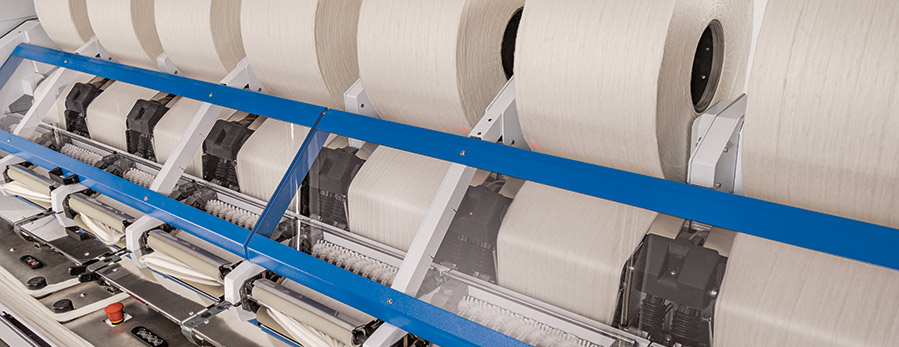
The state-of-the-art combing machine TCO 21. © 2022 Trützschler
Life isn’t easy for yarn producers. They need to improve raw material utilization. They need to boost productivity while balancing between quality and economy. They need to increase yarn quality to fulfill customer requirements. And they need to do it in combed applications where high-quality standards are essential. Those are some big challenges. The TCO 21 combing machine from Trützschler offers an innovative solution.

Since it was first launched in 2021, the TCO 21 has been delighting customers around the globe with its innovative features and enormous optimization potential. The first large-scale installations are now up and running in the world’s most important combing markets. And the results are extremely positive!

The TCO 21 offers automatic optimization functions and is the first ever comber to feature 100 % Trützschler technology. That powerful combination is now improving efficiency, productivity and quality in yarn-producing markets worldwide.

Optimized for high-speed combing

The TCO 21 is unique because it features the PIECING OPTIMIZER technology, which reduces fiber stress, especially during high-speed combing. And it works at the push of a single button. This is valuable for yarn producers because the pilger step movement – and the overall acceleration behavior of the detaching rollers – often acts as a bottleneck when operating at high speeds of up to 600 nips/min. A simple comparison: A detaching roller (48 g) in a high-speed comber accelerates roughly 8 times faster than a formular one car (6 g).

Testing data: High-speed combing

Tests clearly show the potential value offered by the PIECING OPTIMIZER technology for high-speed combing. Technologists examined the level of performance that customers can achieve with a yarn count of Ne 30 made from US cotton. The number of yarn imperfections remained constant even when increasing the combing speed from 500 to 600 nips/min – which is a 20 % higher production rate. Most important, the amount of noil also remained in the same range for all three trials. In fact, the total number of imperfections in the yarn (measured as IPI) was slightly lower because of fewer thick spots and neps.

Overall, the TCO 21 has demonstrated its capacity to deliver optimal yarn results even when increasing the production rate by up to 20 %.
© 2022 Trützschler
© 2022 Trützschler


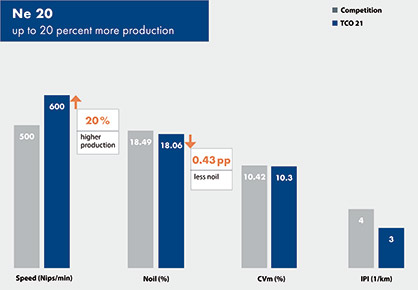
Testing data: Production increase with a yarn count of Ne 20

Trials have shown that the TCO 21 can achieve a 20 % increase in production output compared to the current combing machine from a competitor for yarn counts of Ne 20 – while also generating less noil. Operating at a rate of 600 nips/min instead of 500 increases yarn production per comber set by around two metric tons per day (depending on the specific settings). Importantly, the TCO 21 is able to provide this production increase while delivering similar yarn quality in terms of IPI and uniformity – and also reducing noil. The tests show that the TCO 21 can reduce the comber noil by 0.43 % compared to the competitor’s machine.

Testing data: Production increase with a yarn count of Ne 40

The TCO 21 also demonstrated a 20 % production increase and similar yarn quality compared to a competitor’s machine for yarn counts of Ne 40. With a production increase of 10 % – e.g. producing 550 nips/min instead of 500 nips/min – the yarn results improved with the TCO 21. Furthermore, the number of faults per kilometer only very slightly worsened with a 20 % increase in production. In addition, yarn uniformity remained at the same level in all trials, even when the production rate increased. The comber noils were at the same level too.

Testing data: Production increase with a yarn count of Ne 60

In the final trial, which involved a yarn count of Ne 60, the TCO 21 proved its capacity to achieve a 5 % or 10 % higher production rate with up to 26 % better results for yarn quality. Of course, it is more difficult to improve production rates and maintain quality when working with finer yarns. But also in this comparison the TCO 21 demonstrated its excellent performance and advantage compared to the competitor product. Remarkably, yarn results improved in this test when the production rate for the TCO 21 was increased by 5 % and 10 %. The overall IPI was 21 % and 26 % lower compared to the competition. Despite higher production rates, yarn evenness also remained slightly better than the competitor machine’s level. And the noil was constant across all three production rates that were tested.

Tapping into the full potential of the TCO 21

The results from these tests are extremely positive and Trützschler is confident that the unique machine concept has additional potential. Trützschler’s experts are now working side-by-side with our customers to open up new ways of further optimizing the performance of this machine in various application areas. However, the TCO 21, our first comber with 100 % Trützschler technology, will help our customers improve their competitive position in the global yarn market.
More News from Truetzschler GmbH & Co. KG

#Spinning

Perfect quality through collaboration: Machinery from Trützschler, Toyota and Murata at Zirve Tekstil

In today’s textile industry, excellence is not achieved by chance – it’s the result of deliberate decisions, technical expertise, and the courage to go beyond conventional paths. The Turkish company Zirve Tekstil has done just that: by combining the best technologies from Trützschler, Toyota and Murata, they’ve created a production setup that delivers outstanding yarn quality – recognized worldwide.

#Spinning

Details matter: How Trützschler cylinder wires boost efficiency in Pakistan’s spinning sector

Pakistan’s textile industry, especially its spinning sector, is the backbone of the national economy and a vibrant hub of innovation. Today’s spinning mills face growing demands for efficiency, quality, and sustainability. From the serene northern valleys to the vibrant port city of Karachi in the south, mills like Suraj Cotton Mills, Liberty, and Nishat Chunian are turning to advanced solutions.

#ITMA Asia + CITME Singapore 2025

T-CAN – Revolutionizing can transport

In virtually all spinning mills, transporting sliver cans is still done manually. Rising labor costs, lack of operators and increasing quality requirements make this a growing challenge. With T-CAN, Trützschler introduces a practical solution: a fully automated can transport system that will be presented live at ITMA ASIA 2025 in Singapore.

#Spinning

Pre-Cleaner CL-X: The future of cotton cleaning

What if the future of cotton cleaning was already here – setting a new standard for cleaning efficiency, productivity and energy savings? That future has a name: CL-X. Since its market launch in 2022, the Pre-Cleaner CL-X has become a true bestseller, proving its value in several hundred customer applications worldwide. Now, new results from Türkiye demonstrate again how the Pre-Cleaner CL-X outperforms the competition.

More News on Spinning

#Spinning

Temco launches a new DTY all-in-one solution

Temco introduces the DTY All-in-One Solution – a fully harmonized set of components engineered to give customers a highly stable, low maintenance and reproducible process environment. The solution reduces interruptions, extends component lifetimes and supports consistent yarn quality across all machine positions. All-in-One Solution – a fully harmonized set of components engineered to provide maintenance and reproducible process environment.

#Techtextil 2026

DIENES at Techtextil 2026: Flexible pilot lines for bio-based fiber development

The growing relevance of bio-based materials in technical textiles is accompanied by increasing demands for reproducibility, high-quality data, and scalable process routes. Especially when working with cellulose and its derivatives, chitosan, lignin-based approaches, or bio-based PAN as a carbon-fiber precursor, R&D teams face variable feedstock quality, tighter process windows, and the need for reliable comparability across trials. This calls for flexible, data-driven experimental setups that can be reconfigured efficiently when recipes, solvents, and raw-material batches change.

#Techtextil 2026

RETECH showcases high-precision godets for high-performance fiber processing at Techtextil 2026

RETECH designs and manufactures godets and draw frames for heated, ambient and cooled processes, enabling precise heat treatment and consistently high yarn quality for a wide range of polymers and applications, with process temperatures of up to 400 °C for high-performance fibers. The company’s key competence lies in exact and stable temperature and speed control, individually adapted to the specific material and process requirements.

#Spinning

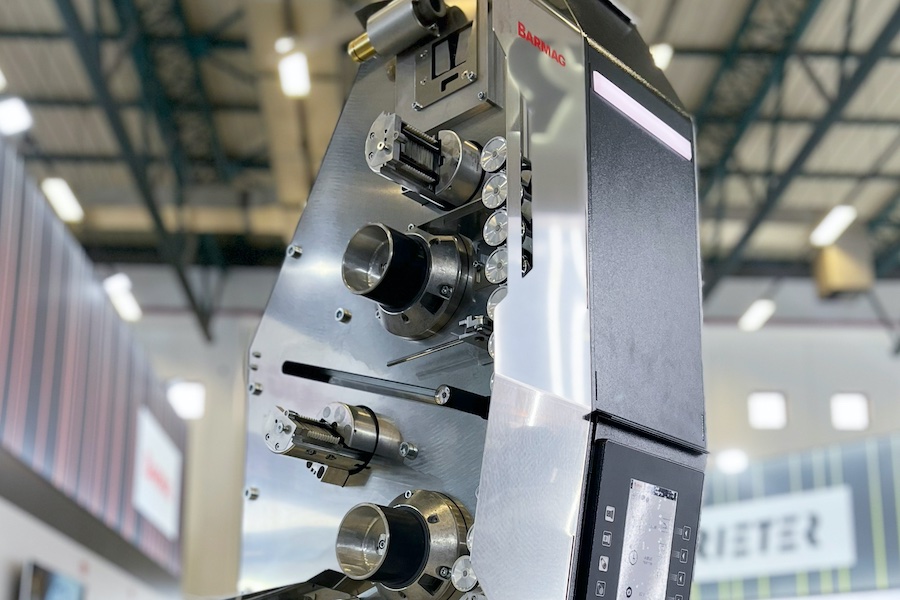
Barmag presents the next generation of POY production – energy-efficient and partial-automated

With POY 2.0, Barmag is introducing a completely redesigned spinning concept that takes the production of partially oriented yarn (POY) to a new level in terms of technology and economy. The solution, which was presented to a selected audience of experts for the first time at ITMA Asia + CITME 2025, was met with great enthusiasm: several yarn producers worldwide immediately expressed their interest in a pilot plant.

Latest News

#Europe

Commission presents proposal for EU Inc. - unlocking the full potential of the Single Market for Europe's entrepreneurs

Today, the European Commission presented its proposal for EU Inc., a new single set of corporate rules, building the cornerstone and starting point for the EU's 28th regime. EU Inc. is an optional, digital-by-default European corporate framework. It will make it easier for businesses to start, operate and grow across the EU – incentivising them to stay in Europe, and encourage those who once looked elsewhere to return.

#Man-Made Fibers

OnceMore® from Södra brings end-to-end traceability for circular Man-made Cellulosic Fibers (MMCF) using TextileGenesis

OnceMore® from Södra, the world’s first large-scale process for recycling blended fabrics into high‐quality dissolving pulp, will begin using TextileGenesis, a Lectra company, to strengthen traceability from raw material to retail across the value chain. OnceMore® produces dissolving pulp made from blended textile waste and wood sourced from responsibly managed Swedish forests. By integrating TextileGenesis, OnceMore® supports the growing need for verified data and secure, transparent tracking throughout increasingly complex supply chain.

#Sustainability

Experts publish APAC policy priorities

Cascale today announced the publication of its APAC Policy Priorities Paper, developed by the Asia-Pacific (APAC) Policy Member Expert Team (MET) to identify key regional sustainability challenges and provide practical, aligned recommendations for policymakers and industry stakeholders across Asia-Pacific.

#Knitting & Hosiery

SHIMA SEIKI announces partnership with CLO Virtual Fashion

Leading computerized flat knitting innovator SHIMA SEIKI MFG., LTD. of Wakayama, Japan is partnering with digital garment solutions provider CLO Virtual Fashion of Seoul, South Korea for the integration of technology in garment design and simulation.

TOP