[pageLogInLogOut]
TRÜTZSCHLER SPINNING - FROM WASTE TO VALUE

#Spinning

Rieter reports strong recovery for the first half of the year

Rieter posted an order intake of CHF 975.3 million, which corresponds to an increase of 289% compared to the previous year period (first half of 2020: CHF 250.7 million). The recovery is broadly supported globally and is based on a catch-up effect relating to the years 2019 and 2020 and a regional shift in demand. Rieter is benefitting from its innovative product portfolio and the company’s global positioning. The highest order intake was recorded in Turkey.

• Order intake of CHF 975.3 million

• Sales of CHF 400.5 million

• EBIT of CHF 9.0 million and net profit of CHF 5.3 million

• Strategy implementation and crisis management

• Outlook

On June 30, 2021, the company had an order backlog of about CHF 1 135 million (June 30, 2020: about CHF 490 million).

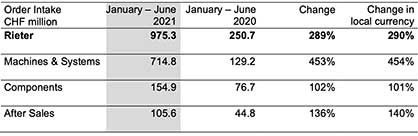
Order Intake by Business Group

In the Business Group Machines & Systems, order intake amounted to CHF 714.8 million (first half of 2020: CHF 129.2 million). In the Business Group Components, order intake rose to CHF 154.9 million (first half of 2020: CHF 76.7 million), and in the Business Group After Sales it increased to CHF 105.6 million (first half of 2020: CHF 44.8 million).

A key driver of growth in the machinery business has been the demand for innovative complete systems in the areas of ring and compact spinning. The successful commercialization of the compacting devices and the piecing robot ROBOspin, launched in 2019, contributed to the increase in the Business Groups Components and After Sales.

Sales by Business Group

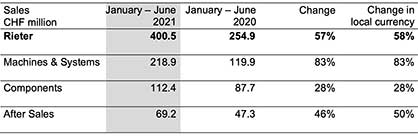
The Rieter Group recorded sales of CHF 400.5 million (first half of 2020: CHF 254.9 million). Sales significantly increased compared to the previous year period; however, as expected, they were still impacted by the low order intake of the financial year 2020.

In the first half of 2021, the Business Group Machines & Systems realized sales in the amount of CHF 218.9 million, which corresponds to an increase of about 83% compared to the previous year period.

Spinning mills are working at good capacity levels with an increased demand for components as well as spare and wear parts, which is the reason for the positive development in the Business Groups After Sales and Components. In the Business Group Components, sales rose to CHF 112.4 million (+28%), and in the Business Group After Sales to CHF 69.2 million (+46%).

Sales by Region

In the Asian countries, Rieter recorded sales of CHF 137.0 million (+57%) for the first half of the financial year 2021. In China, sales rose by 85% to CHF 68.5 million due to spinning mills investing in the improvement of their competitiveness. The recovery of the market in India resulted in a significant increase of 188% to CHF 51.0 million. In Turkey, sales improved slightly to CHF 59.8 million (+17%). Sales increased by 94% to CHF 59.8 million in the region North and South America, driven by a considerable increase in demand in Latin America. 


EBIT, Net Profit and Free Cash Flow

In terms of EBIT, Rieter posted a profit of CHF 9.0 million for the first half of 2021 and a net profit of CHF 5.3 million. A one-off effect associated with the reversal of allowances for machinery that was delivered in the first half of 2021 contributed to this development. Free cash flow amounted to CHF 53.2 million, which was considerably influenced by the advance payments received from customers in conjunction with the significantly increased order intake.


Strategy Implementation and Crisis Management

In recent years, Rieter has consistently implemented its strategy based on the cornerstones of innovation leadership, strengthening the components, spare parts and services businesses, and adjusting cost structures.

Crisis management in the pandemic year of 2020 was aimed at protecting employees, fulfilling customer commitments, ensuring liquidity, and also strengthening the market position for the time after the pandemic as well as retaining the ability to benefit from the incipient market recovery.

The focus for 2021 remains on the implementation of this strategy. The measures for crisis management relating to the protection of employees and fulfilling customer commitments are still in effect in countries that continue to be affected by the pandemic.

The Rieter Board of Directors has approved the implementation of the CAMPUS project. The Rieter CAMPUS comprises a customer and technology center as well as an administration building at the Winterthur location. It will make an important contribution to the implementation of the innovation strategy and to the enhancement of Rieter’s technology leadership position.


Outlook

As already announced, the first half of 2021 has been characterized by a strong market recovery in combination with a regional shift in demand for new machinery and systems. Rieter anticipates a normalization of the demand for new systems in the coming months. The company assumes that spinning mills will continue to work at high-capacity levels.

For the full year, Rieter expects sales to be above CHF 900 million.

The realization of sales from the order backlog continues to be associated with risks in light of bottlenecks in material deliveries and freight capacities as well as the ongoing pandemic in key markets for Rieter.

More News from Rieter Textile Systems

#Spinning

"We will become a recycling powerhouse"

The textile industry is now in its fourth consecutive year of crisis, while automation, artificial intelligence and recycling are reshaping the rules of the game. In this interview, Rieter CEO Thomas Oetterli discusses the first signs of a market recovery, reflects on his first three years at the helm of the company, explains the integration of Barmag, outlines Rieter’s vision of the fully automated spinning mill and highlights the strategic importance of recycling. In doing so, he explains why the new Rieter Group aims to play a leading role in transforming the textile value chain into a circular economy.

#ITM 2026

Rieter at ITM 2026: Spinning Redefined with Automation and Intelligence

Spinning mills need solutions that deliver stability, efficiency and future-proof performance. Rieter has put together a powerful portfolio for ITM 2026 in Istanbul, Türkiye. These innovations give customers the tools to enhance cost efficiency, improve responsiveness and actively develop their competitive edge. Step-by-step, Rieter is moving closer to its Vision 2027 – the fully automated spinning mill. With each new technology, Rieter enables spinning mills worldwide to operate with greater precision and reliability, ensuring they remain at the forefront of an increasingly demanding global market.

#Spinning

Rieter Annual General Meeting 2026: Shareholders approve all board proposals

At the Annual General Meeting of Rieter Holding Ltd. held on April 16, 2026, 342 shareholders representing 64.0% of the share capital approved all motions proposed by the Board of Directors. The shareholders adopted the Annual Report as well as the Financial Statements and Consolidated Financial Statements for 2025. They also granted discharge to the members of the Board of Directors and the Group Executive Committee for their activities in the reporting year. In an advisory vote, the 2025 Report on Non-Financial Matters was also approved.

#Spinning

Rieter advances strategic repositioning amid market volatility

Rieter successfully completed the acquisition of Barmag on February 2, 2026, and reached an important milestone in the company’s repositioning. Barmag will be integrated into the Rieter Group as the “Man-Made Fiber” Division. With this strategically transformative acquisition, Rieter is expanding its core business beyond the short-staple fiber business in a targeted way. This positions Rieter as the global market leader along the entire value chain for natural and man-made fibers. In addition, as a complete systems supplier, Rieter is further strengthening its technological leadership in the areas of automation and digitization.

More News on Spinning

#Spinning

Object Carpet tests production of rPET BCF yarn on Neumag BCF line

In a joint project with Object Carpet GmbH, Denkendorf; the Institute for Textile Technology (ITA), Augsburg; and Next Generation Recyclingmaschinen GmbH (NGR), Feldkirchen, Austria, Barmag investigated the processing of recycled polyester for BCF yarn. The goal was to evaluate the fundamental suitability of 100% recycled carpet material for reuse in carpet yarn production to create a closed-loop system in carpet manufacturing. To date, commercial rPET BCF processes have been based solely on rPET from bottle pellets.

#Spinning

New spinning package with two-step filtration for recycled yarns and more

At the ITM in Istanbul, BB Engineering unveiled its new, patented ValuePack spinning package for the first time, which features a two-stage filtration system. This is particularly beneficial for re-cycling processes. Until now, spinning packs have used either metal powder (“sand”) or filter candles as filter media. Both options are suitable for differ-ent applications, and each has its own specific advantages and dis-advantages.

#Research & Development

GenuTrace client advisory: Is your cotton supply chain UFLPA ready?

U.S. Customs and Border Protection has released updated operational guidance (CBP Publication No. 5560-0526) expanding its forced labor enforcement framework. The guidance supersedes the original 2022 UFLPA Operational Guidance and now covers all forced labor enforcement authorities — UFLPA, CAATSA, and WROs/Findings — in a single unified document. For cotton importers, the enforcement posture has not softened. It has become more structured, more documented, and more demanding. Learn more about UFLPA.

#Spinning

Barmag and Hitech Automation enter into partnership for an auto-doff system for texturing machines

Barmag (Suzhou) Technology Co., Ltd. and Hitech Automation Solutions PVT LTD. of Surat, India, have agreed to an exclusive partnership to jointly market Hitech’s Doffmatic automation solution for Barmag’s proven manual eFK texturing machines. In many texturing facilities, manual doffing processes remain heavily operator-dependent – resulting in issues such as increased scrap, inconsistent quality, and limited productivity.

Latest News

#Natural Fibers

Cotton made in Africa partners receive top marks in independent verifications

Cotton made in Africa® (CmiA) and CmiA Organic are two internationally recognised standards that aim to promote sustainable development in the African cotton sector south of the Sahara. To ensure the standards’ credibility among brands, retailers, and consumers, independent verifiers evaluate compliance on the ground. The verification results for 2025, now published in the Aggregated Verification & Implementation Report, were very strong: The verifiers awarded consistently very good remarks regarding management, people, prosperity, and the environment.

#Associations

Bangladesh: Italian textile machinery mission stops in Dhaka and Chittagong

Technological upgrading and the transition toward higher value-added production are driving the new Italian industrial mission to Bangladesh. This year, the mission will split between the country’s two main manufacturing hubs, where Italian manufacturers will meet the leaders of the local textile supply chain in two strategic stages: July 7th in Dhaka and July 9th in Chittagong.

#Recycling / Circular Economy

RE&UP establishes Fiber Club consortium to scale Next-Gen material sourcing

Originally developed as an umbrella framework by innovation platform Fashion for Good, the RE&UP Fiber Club aims to accelerate the commercial adoption of circular Next-Gen materials across the global fashion ecosystem.

#Yarns

Yarn Expo Shenzhen 2026 closes doors, advancing sustainable and innovative sourcing in South China

Yarn Expo Shenzhen 2026 served as a strategically positioned mid-year sourcing platform for the Greater Bay Area, highlighting Shenzhen’s role in connecting regional demand, supply and innovation exchange across the textile value chain. During the three-day fair, over 20,000 visits were drawn from 74 countries and regions[1], as exhibitors and buyers engaged with new developments in greener, performance-led, and value-added yarn and fibre solutions. Held in conjunction with Intertextile Shenzhen Apparel Fabrics and PH Value, the fair underscored the benefits of closer synergy and new materials across yarn, fabric and apparel platforms for the South China market.

TOP